


During a press conference on 5/5, WHO epidemiologist Maria Van Kerkhove stated her belief that rare human-to-human transmission of hantavirus occurred on the cruise ship, the epicenter of an outbreak that infected eight people and killed three. "We believe that human-to-human transmission may have occurred among groups in very close contact, such as spouses or those sharing a cabin. I reiterate, our assumption is that it did happen," Van Kerkhove said, referencing a Dutch couple who died after their stay on the MV Hondius.
The United Nations health agency also hypothesized that tourists might have carried the pathogen after visiting wilderness areas in Argentina or islands along the African coast.
However, the scientific community rejects the possibility of direct human-to-human transmission. Doctor Yomani Sarathkumara from the University of Queensland and Professor Vinod Balasubramaniam from Monash University Malaysia state that hantavirus primarily transmits to humans through rodent feces, urine, and saliva in enclosed or poorly ventilated spaces.
Experts deem the risk of infection from sharing air with an infected person low. Doctor Celine Gounder, a medical reporter for CBS News, also stated that human-to-human transmission requires "close and prolonged contact," emphasizing that "this is not a pandemic-causing virus".
"This also raises the question of whether many passengers were exposed to a contaminated environment. If so, some cases might not be human-to-human transmission at all," Gounder noted.
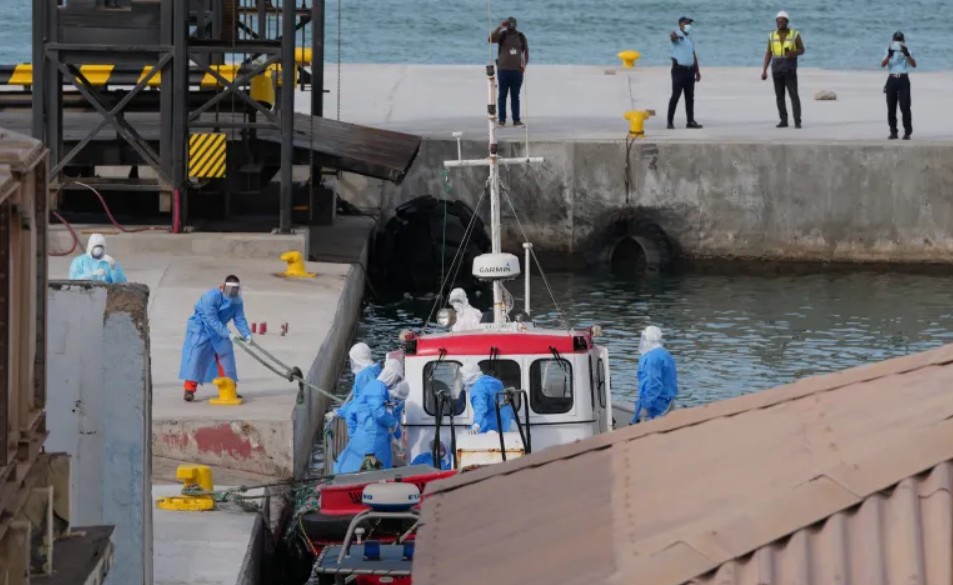 |
Medical personnel in protective gear evacuate a patient from the MV Hondius cruise ship at a port in Praia, Cape Verde, on 6/5. Photo: AP |
Instead of human-to-human transmission, experts propose three more realistic scenarios. First, infected rodents could have entered the ship's storage areas or cabins, spreading the virus through their waste.
Second, passengers might have contracted the pathogen from land-based activities before the voyage, given hantavirus's long incubation period.
Third, multiple passengers could have shared a contaminated terrestrial environment.
The absence of hantavirus patients in Argentina's Ushuaia province further strengthens the possibility of passengers contracting the illness at a different stop along the journey, despite this South American nation experiencing a significant Andes virus outbreak, infecting 34 and killing 11 in 2018.
Binh Minh (According to The Guardian, CBS News)


