Benign brain tumors are abnormal cell growths in the brain that are not cancerous. These tumors have clear boundaries, do not invade adjacent healthy brain tissue, and typically grow slowly.
However, benign brain tumors can still damage parts of the brain, leading to functional impairment and deformities. If located in critical areas of the brain, these tumors can even become life-threatening.
Surgery is the common treatment for benign brain tumors. Patients generally do not require chemotherapy or radiation therapy if the tumor is completely removed through surgery.
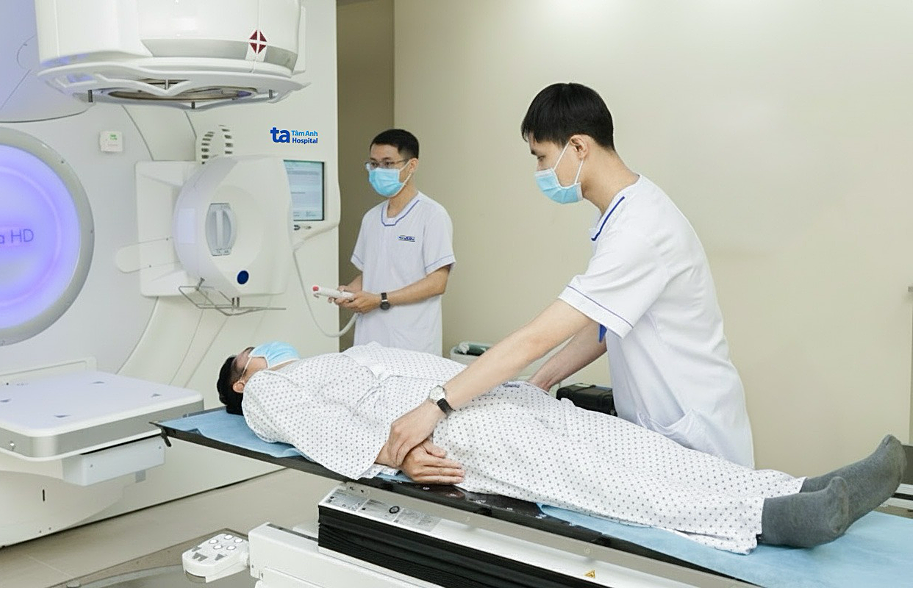 |
A technician prepares and adjusts the patient's position correctly before radiation therapy. Illustration: Tam Anh General Hospital.
If surgery does not completely remove the tumor, additional radiation therapy becomes necessary. Furthermore, if a tumor is difficult to access, poses high surgical risks, or if the patient's health cannot withstand an operation, doctors may prescribe radiation therapy as an alternative to surgery. This method uses high-energy radiation beams to destroy the abnormal cells forming the tumor.
It is advisable to take your brother to a general hospital for examination. You should provide his complete past medical records, recent test results, medical history, and current health status. The doctor will then consider and develop a suitable treatment plan based on the specific condition of his brain tumor.
Radiation therapy precisely delivers radiation beams to the tumor, minimizing damage to surrounding healthy tissue. With advanced radiation technology, treatment duration is short, and patients often experience fewer side effects such as scalp irritation, hair loss, or headaches. However, patients may experience mild nausea due to the radiation's effects. These side effects typically diminish as the radiation therapy course concludes.
Doctor Le Thi Thanh Hong, Master and Level II Specialist
Department of Radiation Oncology, Oncology Center
Tam Anh General Hospital, TP HCM