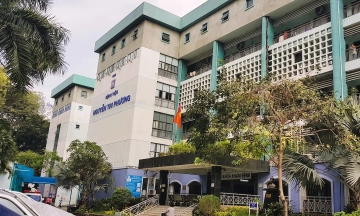
Mr. Quang experienced only mild, transient back pain. During a general health check-up at Tam Anh General Hospital Hanoi before traveling abroad, doctors discovered an abnormality in his kidney. A magnetic resonance imaging (MRI) scan of his abdomen revealed a tumor nearly 5 cm in size, located in the renal parenchyma near the left renal pelvis.
Associate Professor Dr. Tran Van Hinh, Head of the Department of Urology - Andrology, noted that the tumor, though of moderate size, was localized within the renal parenchyma and had not yet breached the renal capsule. However, its central position, invading the renal sinus and calyces, and proximity to the renal pelvis, complicated the possibility of kidney preservation. This was due to the heightened risk of incomplete lesion removal and the limited amount of healthy parenchyma remaining. Imaging characteristics strongly suggested malignancy, leading to a treatment plan for cancer.
 |
Associate Professor Dr. Tran Van Hinh examining a patient. Photo: *Tam Anh General Hospital* |
Mr. Quang had a history of coronary atherosclerosis. A thorough pre-surgical assessment was crucial to manage potential risks during anesthesia and the intervention. Cardiovascular parameters were closely monitored and stabilized before surgery, which helped minimize the risk of complications such as arrhythmias or myocardial ischemia during and after the operation.
The patient underwent a laparoscopic radical left nephrectomy to treat the cancer. The surgical team controlled the renal pedicle, including the renal artery and vein, from the outset. They meticulously dissected all perirenal fat along with lymph nodes in the renal hilum and those near the aorta. This approach effectively limited blood loss, reduced the risk of tumor cell dissemination, and ensured complete removal of the lesion.
Following surgery, Mr. Quang's health stabilized, his vital signs remained within normal limits, and the function of his remaining kidney was good. Post-operative pathology confirmed the tumor as kidney cancer, with clear surgical margins. Consequently, the patient has a good prognosis for recovery, requiring no post-operative radiation or chemotherapy, only regular follow-up.
Kidney cancer is more common in individuals over 60, affecting men more frequently than women. Risk factors include smoking, obesity, hypertension, or chronic kidney disease. According to Dr. Hinh, the disease often progresses silently in its early stages, leading many to discover it incidentally during routine health check-ups or examinations for unrelated reasons.
If left untreated, the tumor can invade renal blood vessels and spread to other organs, potentially causing conditions such as inferior vena cava thrombus or invading the adrenal glands, liver, or spleen. In advanced stages, kidney cancer can metastasize to the lungs, bones, or liver, making treatment significantly more complex and substantially reducing life expectancy.
Regular health check-ups are advisable for everyone, especially older adults, to facilitate early detection of the disease and enhance the chances of complete treatment.
Thu Giang
*The patient's name has been changed