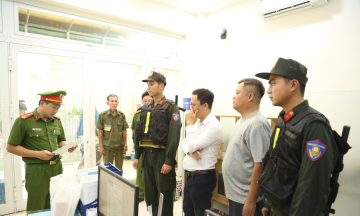
Le Dang Khoa, 38, and Dinh Thi Lich, 37, two former employees of Orient Commercial Joint Stock Bank (OCB) - Ha Noi Branch, along with seven other defendants, have been indicted by the People's Procuracy of Ha Noi in a case involving illegal cross-border currency transfer. Among the defendants are two Chinese nationals: Meng Jun, 36, and Yang Jing, 52.
Zheng Yan Fei, identified as the "kingpin" of this network, departed Vietnam on 11/6/2025. Investigative agencies have sought judicial assistance from China but have not yet received a response.
Shell companies moved tens of millions of USD despite no staff or goods
According to the indictment, Zheng met Nguyen Manh Linh, 39, in 2019 and instructed Linh to register two electronic equipment companies under his name. Despite being registered for import-export activities, these businesses had no employees, conducted no actual business operations, and possessed no goods.
Zheng sought individuals needing to transfer money, negotiated fees, and then directed Linh to use the two companies as intermediaries. Payment documents were falsified as purchases and sales of electronic components, primarily chip resistors, under a temporary import-re-export scheme.
The Prosecutor's Office stated that these items are compact, difficult to value, and lack clear branding. Furthermore, the contracts did not include quality certifications or origin documents typically found in high-value electronic transactions.
The group used two payment methods. With UPAS LC (Usance Payable at Sight Letter of Credit), the seller could receive early payment while the buyer was granted deferred payment. For direct Telegraphic Transfer (TT), foreign currency was transferred directly through banks based on payment instructions.
The indictment alleges that these commercial documents created a facade, enabling the companies to receive and transfer money across borders under the guise of import contract payments.
Two bank employees helped companies 'qualify' for appraisal
Khoa and Lich, then working at OCB - Ha Noi Branch, are accused of assisting Linh in completing procedures for company establishment, tax declarations, and building corporate profiles to facilitate transactions with the bank.
Khoa introduced Lich to Linh as an accountant. He also guided Linh on opening bank accounts and processing letters of credit. Both Khoa and Lich advised on completing tax documents and acquiring office equipment to ensure the businesses could pass physical inspections and appraisals.
According to the Prosecutor's Office, Lich directly participated in transactions, withdrawing a total of 97 billion VND (approximately 3,8 million USD) from the company accounts on 16 occasions and assisting in preparing payment documents. Investigators determined that Linh profited approximately 300 million VND, Lich 30 million VND, and Khoa 40 million VND.
The two front companies operated by Zheng and Linh are accused of illegally transferring over 40,2 million USD abroad, while also receiving over 11,7 million USD into Vietnam.
Subsequently, Meng Jun and Le Thanh Phuong also joined the network, serving as accountants and performing tasks similar to Lich.
Businesses used the network to transfer money to China
The case also includes the directors of two other businesses who are being prosecuted for using Linh and Zheng's shell companies to make payments to partners in China.
Tran Thanh Tung, director of a logistics service company, was identified as having transferred over 63,87 billion VND to Linh's account at the request of Company AEG in China. Tung stated that this money was for service payments, and the transfer content "transfer money for project trees" did not reflect the actual transaction.
Yang Jing, director of a branch of an engineering company in Ha Noi, is also accused of transferring 1,42 billion VND to Linh through an employee's account for transfer to China. The defendant stated that she chose this method due to difficulties in making payments for goods through conventional channels.
Why were some customs officers and bank employees not prosecuted?
Regarding other bank employees who processed foreign currency payments and customs officers who handled documents for the two front companies, investigators determined that they followed correct procedures and regulations and were unaware of the actual purpose of the transactions.
Authorities have not found evidence that these individuals assisted in the illegal cross-border currency transfer, hence no criminal charges have been filed against them.
Hai Thu