Today's market offers countless types of jeans with prices ranging from hundreds of thousands to millions of Vietnamese Dong (VND). To avoid purchasing low-quality items or unflattering styles, pay attention to the seven details below.
Fabric blend for shape retention
A common concern with jeans is the knees bagging out after just a few wears. Many mistakenly believe that 100% cotton jeans are the best, but natural cotton fibers easily deform in areas subjected to bending stress, such as the knees and seat.
Ideal jeans should have a blended composition: about 92% cotton for breathability, 3% spandex for stretch, and 5% polyester to help retain shape. This combination ensures the jeans maintain their smooth form for a long time.
For skinny jeans, choose a style with a spandex content above 3% for comfortable movement. Fabrics blended with Tencel, linen, or bamboo fibers are suitable for summer due to their lightweight, breathable properties.
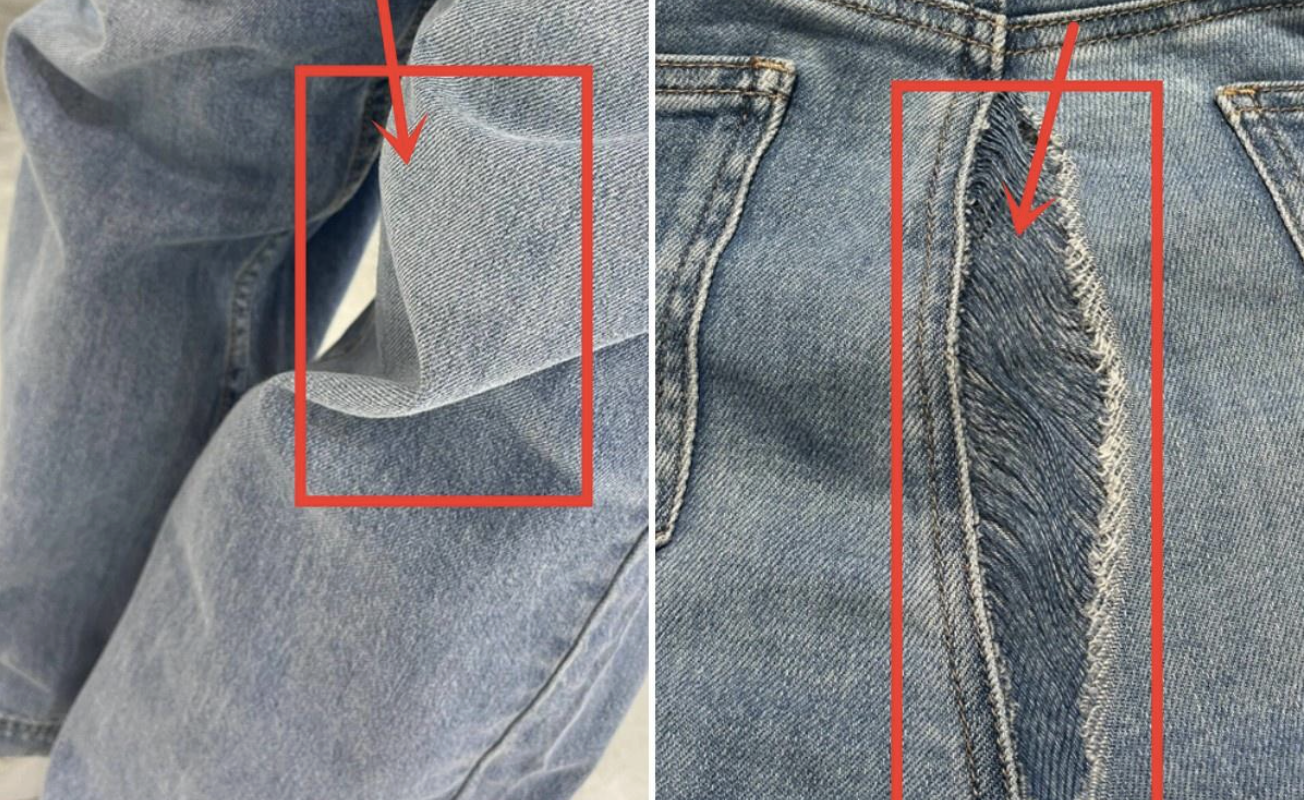 |
Bagging at the knees and tearing at the seat are often due to low-quality denim fabric not made with ideal component ratios. *Photo: Zhuanlan* |
Fabric weave density
Inexpensive jeans often use recycled cotton or short fibers, resulting in weak fabric bonds. With intense movement, the crotch area easily tears or rips at the seams.
Opt for high-density twill denim. Upon close inspection, you will notice coarse, dense diagonal lines. This fabric is not only durable but also develops attractive natural fades over time.
Side seams that flatter the thighs
The value of good jeans lies in meticulously calculated tailoring techniques that flatter the figure. Lay the jeans flat and observe the side seam running along the leg. If this seam is shifted forward by about one centimeter instead of being directly in the middle, it creates an optical illusion, making the wearer's legs appear slimmer and the thighs feel significantly smaller.
Conversely, poorly made jeans often have side seams in the middle or shifted backward, which can highlight large thigh imperfections.
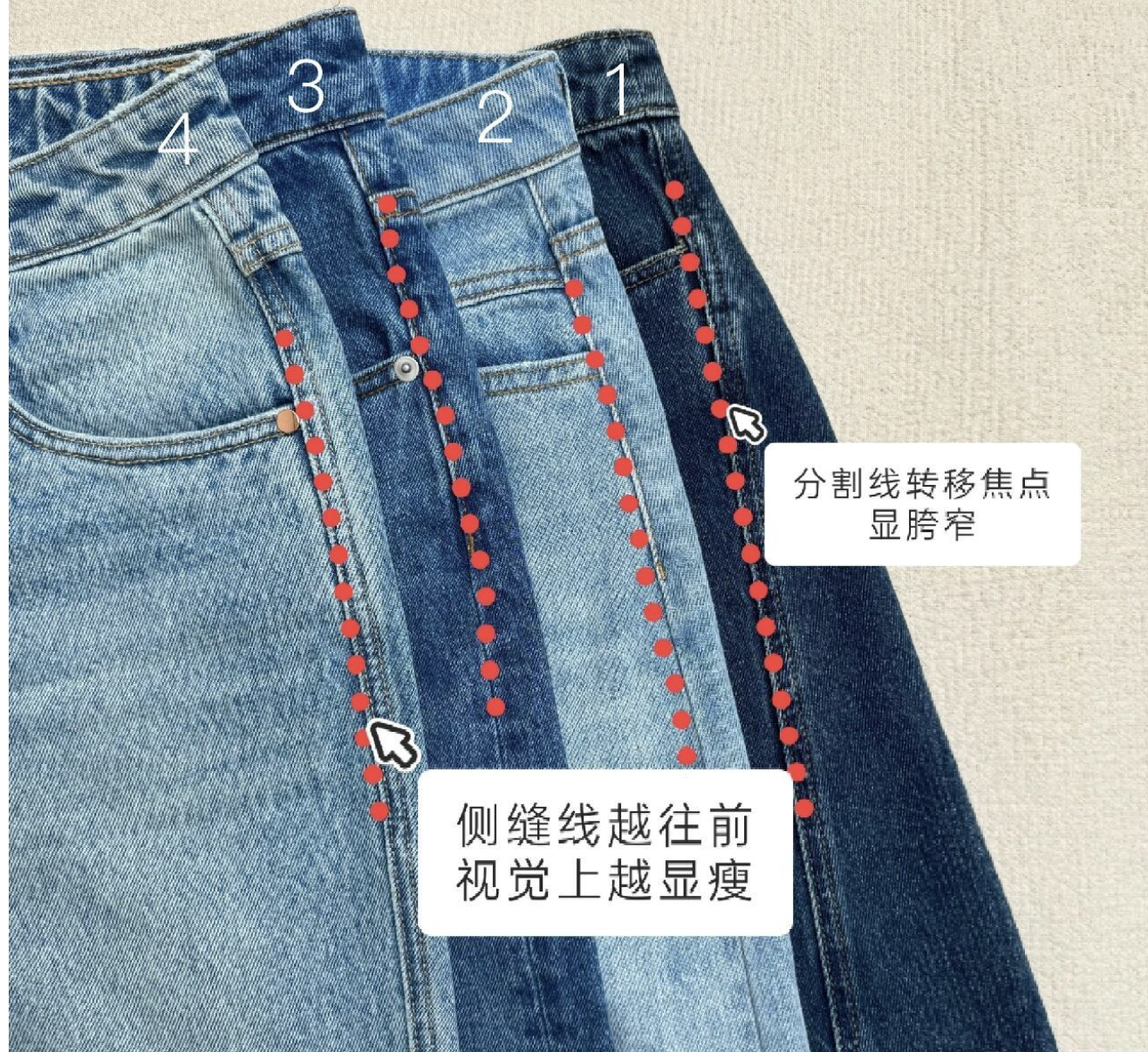 |
A forward-shifted side seam creates a leg-slimming effect. *Photo: Zhuanlan* |
Crotch rise differential
To conceal belly fat and avoid a sagging backside, the ratio between the front rise and back rise is crucial. The ideal difference is typically two to five centimeters.
If the difference is less than two centimeters, the front rise will be short, tightening around the stomach and revealing love handles. If the difference is more than five centimeters, the back rise will have excess fabric, giving the impression of a saggy bottom and shorter legs. However, for individuals with a fuller bottom, this difference needs to be greater to ensure comfort when sitting.
Waistband differential
Similar to the crotch rise, the difference between the front and back waistbands directly affects the wearing experience. If the back waistband is not sufficiently higher than the front waistband (typically more than two centimeters), you will be prone to exposing your back or having your pants slide down when sitting.
Note that if the fabric has a high spandex content (very stretchy), this difference can be slightly smaller because the fabric will stretch when worn.
 |
Standard crotch rise and waistband differential. *Photo: Zhuanlan* |
Back pocket placement
The back pockets of jeans act as a "cosmetic surgeon" for the backside. The top edge of the pocket should be about 3-5 centimeters from the waistband. This distance lifts the center of gravity of the bottom, creating the effect of longer legs and a higher bottom.
The distance between the two pockets should also be near the center axis of the back to create a rounded, neat appearance for the bottom. Pockets that are too large or too far apart will make the backside look wide and flat.
Decorative details and color
Elegance often stems from minimalism. Excessive details such as large embroidery, fringes, or overly distressed rips often indicate low-quality jeans. Additionally, "artificial stains" (discolored washes), if not done skillfully, will make the jeans look sloppy.
Regarding color, dark blue or white are safe choices. Dark blue creates a sophisticated feel, is easy to style, and helps legs appear slimmer. White offers an elegant, light aesthetic but is less forgiving on different body types.
Bao Nhien (According to Zhuanlan)