Grace's two children, Elliott, 8, and Charlotte, 6, would eat Japanese food daily if allowed. "Salmon rolls, tuna, egg sushi – they demand it all," Grace sighed.
The 43-year-old mother initially chose sushi for convenience. Now, she limits her "little food critics" to one meal weekly, with bills reaching up to 150 USD. "Sometimes I wonder why I didn't just give them chicken nuggets or cheese sandwiches to save money," she said.
Grace's family is not alone. Across the United States, a growing number of middle-class parents observe their children, Generation Alpha, turning away from traditional favorites like pizza and fried chicken in favor of nigiri and tempura shrimp. This shift in taste challenges many family food budgets.
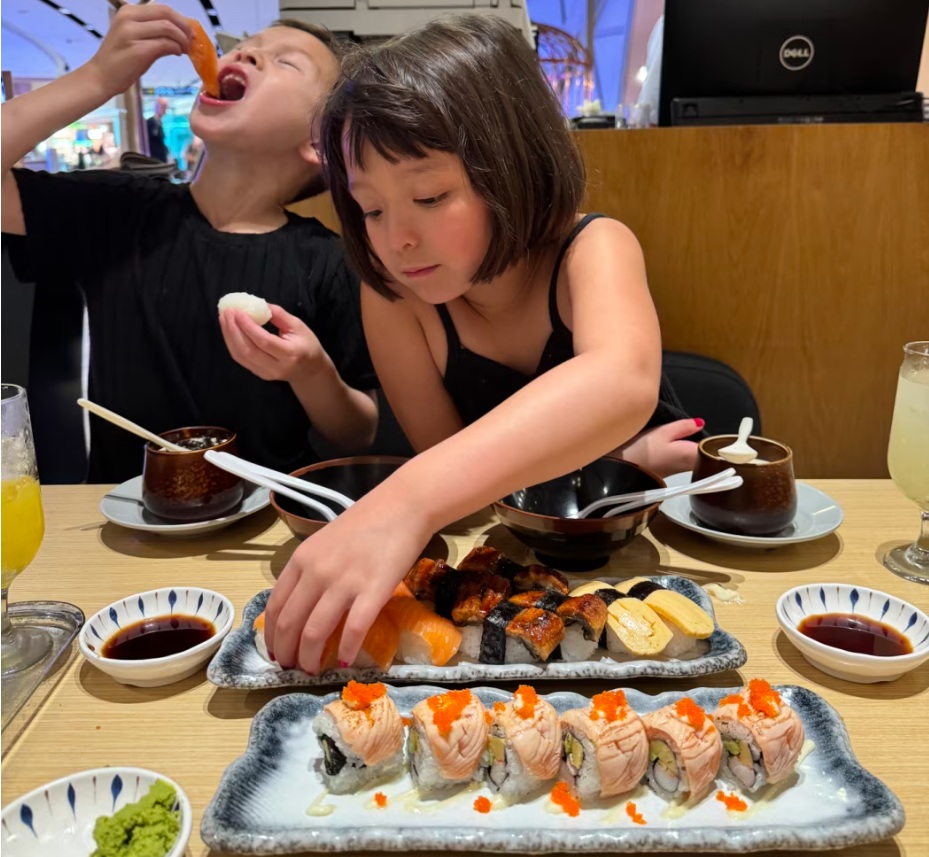 |
Grace Embury says her children, Elliott and Charlotte, would eat sushi every day if they could. Grace Embury
David Seo, owner of Shumi restaurant in New Jersey, reports that his establishment is often packed with families between 16h and 19h. He has observed parents ordering omakase – a chef-selected, high-end meal – for children as young as 6, costing 95 USD per person. "Parents tell me it's a reward for finishing homework," he shared.
Ashley Baptiste, a singer in Connecticut, was surprised to receive a call from her husband and children during an evening party. Expecting an emergency, she learned they were calling to ask permission to order sushi at 9h. Ashley's two daughters, 3 and 5, prefer raw fish to any fast food.
According to Trevor Corson, author of The Story of Sushi, the dish arrived in the US in the late 1960s. However, widespread accessibility for children is a recent phenomenon, driven by freezing technology and its availability in supermarkets. Corson also noted that children enjoy sushi not only for its perceived sophistication but also because the vinegared rice often contains a significant amount of sugar.
Data from analytics firm Circana indicates that retail sushi sales at US outlets, including supermarkets, reached 2,9 billion USD in the past year (as of 11/2025), representing a 7% increase year-over-year.
"This dish makes children feel grown-up," commented Isaac Bernstein, culinary director of the Reserve Cut Hospitality restaurant chain. At their establishments, the 30 USD crispy tuna rice dish is a frequent order for young diners.
Laureano Escobar, a chef in Dallas, recalled his astonishment at a 120 USD bill for lunch with his 6-year-old daughter. The girl was captivated by the dish's delicate presentation and refused to eat french fries.
Despite the high cost, many parents indulge this preference, believing sushi offers more nutritional value than other fast foods and broadens children's culinary experiences.
This trend also extends to birthday parties. Michelle Shuey, a high-end party organizer, notes that more families are hiring sushi chefs for their children's celebrations. "It has become as popular as fried chicken," she stated.
For Caitlin Murray, a content creator in Westchester and mother of three sushi enthusiasts, cost is not the primary concern.
"Just thinking about what they'll eat all day is exhausting enough," she remarked. "Finding something they enjoy without complaint, to me, is a success."
By Nhat Minh (Source: WSJ)