


Liu Ming, 73, lives in a 150 square meter single-story house on the outskirts of Langfang city, Hebei province, China. During the day, with outdoor temperatures around 5 degrees Celsius, Liu wears a thick coat indoors, rarely touching the wall-mounted heater switch. At night, when temperatures drop below freezing, he and his wife sleep on a traditional heated bed (kang), wrapped tightly in electric blankets to endure the cold.
"Our children work hard for their money; I don't dare to spend lavishly", Liu said, opening his phone to show a pension notification: 240 yuan (approximately 850,000 VND). This constitutes his entire monthly income.
Meanwhile, electricity and heating costs are entirely dependent on his children. Liu's situation is common for thousands of rural households in Hebei, which serves as a "defense belt" for the capital Beijing in the fight against air pollution.
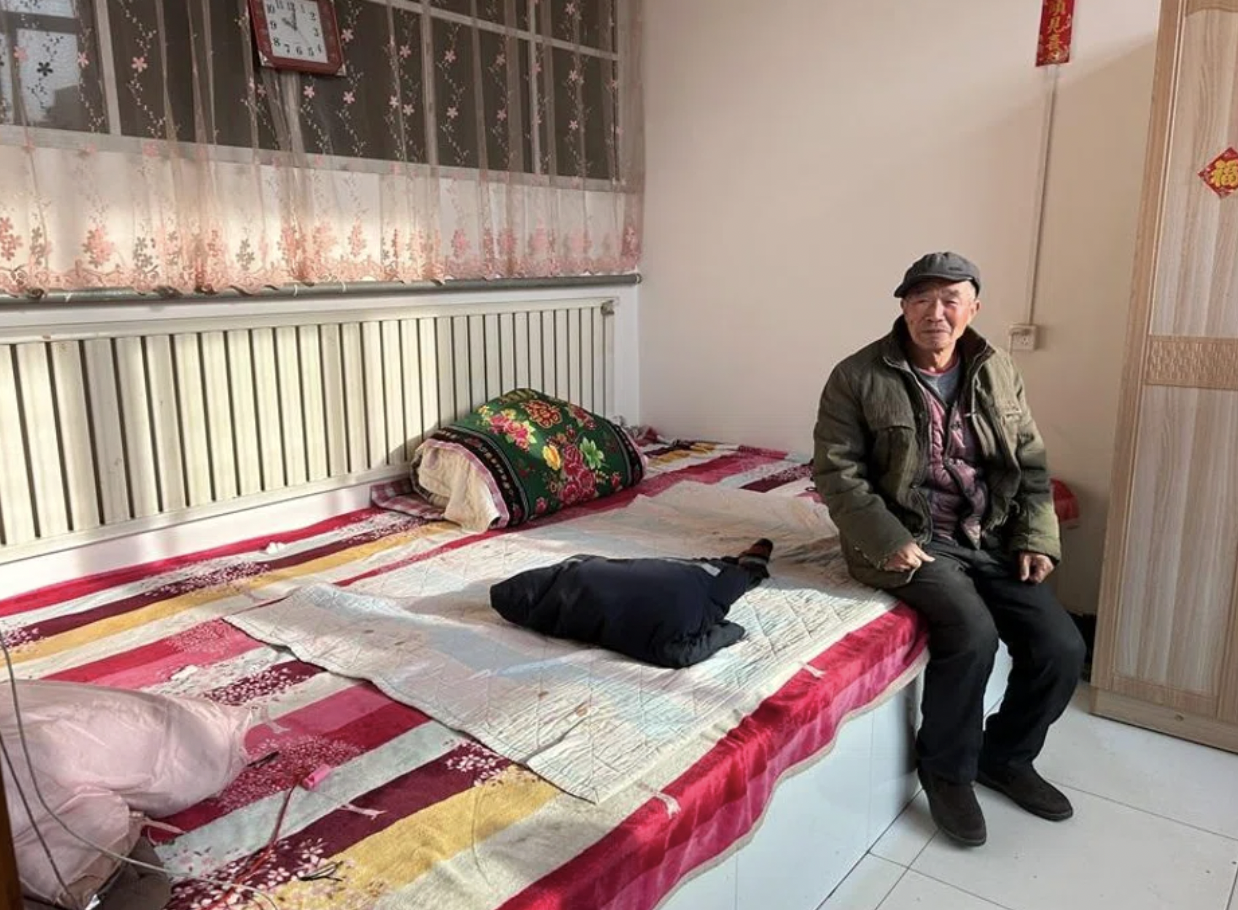 |
Liu Ming in his home in Hebei province, China. Photo: Think China
Since 2013, to restore blue skies to Beijing and Tianjin, China banned residents in surrounding areas from burning coal for heating, a traditional and inexpensive method. Instead, the government promoted a switch from coal to gas and electric heating. Households received initial support for heater installation and gas subsidies.
However, as subsidies gradually decreased, the harsh reality became clear. Zhang Yixing, 51, noted that his single-story house is poorly insulated. To stay warm, he spends about 5,000 yuan (17.5 million VND) each winter. A city apartment of the same size costs less than 2,000 yuan (7 million VND) due to central heating and better insulation.
Yang Huisu, a representative of the Hebei Provincial People's Congress, acknowledged at last year's session that while the policy led to cleaner air, it left farmers with "gas they dare not use." According to her calculations, maintaining a temperature of 18 degrees Celsius in a 100 square meter house in Shijiazhuang costs residents 7,500 - 11,000 yuan (26 - 38 million VND) each winter.
"This amount is beyond the means of those living on a few hundred yuan in pension, like Liu Ming", Yang stated.
Sociologist Zhan Shaohua from Nanyang Technological University, Singapore, commented that the energy transition policy was enacted during an urgent pollution crisis, lacking long-term livelihood considerations. Ma Jun, Director of the Institute of Public and Environmental Affairs, China, added: "The core issue lies in the structure of rural homes with thin walls and leaky doors. Burning any amount of gas is like pouring salt into the sea".
Experts believe returning to coal burning is not an option, but the government needs to renovate rural housing systems, including ceilings, walls, and windows, instead of simply forcing residents to change fuel. "If we only rely on the pockets of Hebei farmers, the winter heating problem has no solution", Ma concluded.
Ngoc Ngan (According to Think China)


