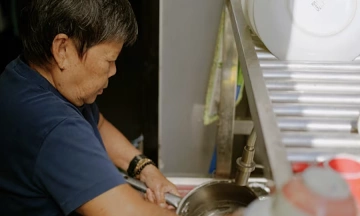
The story of Aihua, 42, from a village in Henan province, exemplifies this deeply rooted societal imbalance. Daily, she visits her childhood home to clean and cook for her nearly 80-year-old parents. Despite her consistent care, Aihua is not included in the inheritance plan. All accumulated assets of Mr. Huotou and Ms. Qiuyue are implicitly reserved for their only son, who has lost contact with them for the past 10 years and is consistently absent during his parents' illnesses.
Mr. and Mrs. Huotou enjoy stable finances due to railroad pensions. When questioned about leaving their assets to their unfilial son, Mr. Huotou stated that daughters and grandchildren are considered "outsiders", while only a son represents the "root" of the family.
Aihua's personal struggle highlights the depth of this issue. When she was diagnosed with breast cancer and needed surgery, she returned home hoping to borrow money from her father. Upon entering the room, Aihua witnessed Mr. Huotou burying a plastic bag filled with savings, intended for his son. She quietly left, choosing to manage her medical expenses independently.
Following her surgery, despite doctors advising against strenuous activity, Aihua continued her daily routine of cleaning and laundry at her parents' home. She emphasized her constant presence is crucial, as her mother suffers from memory loss and frequently wanders off at night.
Aihua's situation is common across many rural regions of China. In Jiangxi province, Wang Ling quit her job to return home and care for her 75-year-old grandmother, who required emergency medical attention after an injury. Even though her paternal uncle left the caregiving entirely to his niece, the grandmother, from her sickbed, expressed concern only for the well-being of her youngest son.
Similarly, in Henan, Li Ying, 20, spent 30,000 CNY (approximately 4,200 USD) of her savings on health insurance for her mother, who was battling cancer. She shouldered this financial responsibility in place of her older brother, who was preoccupied with wedding preparations. However, when Li Ying proposed using an old, abandoned family house, her grandmother refused, stating that they "must wait to ask the eldest grandson's opinion."
Despite daughters increasingly assuming the primary role in caring for their parents, their inheritance rights have not evolved accordingly. China's Civil Code mandates gender equality in inheritance, stipulating that individuals who primarily fulfill care duties may receive a larger share of an estate. Nevertheless, research student Huang Mengmeng from Zhengzhou University noted that this disconnect between rights and responsibilities remains a reality rarely discussed publicly.
Dr. Hu Xiaoying from Wuhan University analyzed that the combined forces of urbanization and economic pressure have compelled men to seek work in distant cities. Rural bride prices escalated from under 10,000 CNY in 2010 to between 80,000 and 100,000 CNY (11,000 - 14,000 USD) by 2018, often accompanied by the expectation of purchasing a city home. This economic shift has increasingly led daughters who marry locally to step in and care for their aging parents, filling the void left by their brothers.
However, this traditional mindset is beginning to shift, particularly among younger generations. Ruirui, a university student who witnessed family favoritism from a young age, declared, "My bride price will be decided by me; I won't use it to support my younger brother. Both siblings must share the responsibility of caring for our parents."
Experts believe that as younger generations embrace gender equality and migrate from villages to cities, the unequal structure of elder care will gradually lose its foundation.
Bao Nhien (According to QQ, Huxiu, Lifeweek)