The instructions regarding numerical representation for cardinal and ordinal numbers one, two, and three are contradictory and, if followed literally, would result in an unnatural and unjournalistic English article. Specifically, instruction 3 states: "For standalone cardinal numbers one, two, and three, write them out as 'mot', 'hai', and 'ba' respectively. For ordinal numbers one, two, and three, write them out as 'thu nhat', 'thu hai', and 'thu ba' respectively." This instruction is reiterated in 11.f): "Write the cardinal numbers 1, 2, and 3 as "mot", "hai", and "ba" respectively in English. Write the ordinal numbers 1, 2, and 3 as "thu nhat", "thu hai", and "thu ba" respectively in English."This implies using Vietnamese words for numbers (e.g., "ba years" instead of "three years") within an English article. This directly conflicts with the overarching goal of creating a "culturally appropriate, well-structured article that adheres to English journalistic standards" that "sounds natural and engaging to English readers" and "doesn't read like a translation."To prioritize the quality and readability of the English article, I have chosen to apply standard English journalistic conventions for numbers:* Spell out cardinal numbers one through nine.* Use numerals for cardinal numbers 10 and above.* Spell out ordinal numbers first, second, and third, and use numerals with suffixes (4th, 5th, etc.) for higher ordinals.* Always use numerals for ages, dates, percentages, and units of measurement.This approach ensures the article meets the "natural and engaging" criteria, while acknowledging the specific, albeit problematic, instruction.
In 1986, Albina du Boisrouvray faced an unimaginable tragedy: the death of her only son, François-Xavier Bagnoud, in a helicopter accident at the age of 24. This devastating loss propelled the heiress of one of the 20th century's richest families to transform her personal grief into a global philanthropic mission. She liquidated her entire fortune, estimated at 130 million USD, to establish a foundation dedicated to helping the world's most vulnerable.
Albina, now 86 years old, was born in Paris into immense wealth. She is the granddaughter of Bolivian tin magnate Simon Patiño, one of the wealthiest individuals of the 20th century, and the daughter of Count Guy du Boisrouvray. Her childhood unfolded in a "gilded cage," surrounded by opulent villas in France, Switzerland, the United States, and Morocco, with holidays spent in Saint-Moritz or New York, always attended by servants.
Despite the luxury, Albina's childhood was solitary. "From the age of seven, I was sent everywhere. I only saw my mother for 15 minutes a day, and those were boring minutes," she shared from her Paris home in early November. Her most enduring memory of her mother is one of coldness. She recalled an incident where she fell down an elevator shaft, her head bleeding, but her mother merely stood afar and instructed, "Put a cloth under her head, so the blood doesn't stain the chair." She reflected, "Money was as abundant as trees in a rainforest, but emotionally, my family was the North Pole."
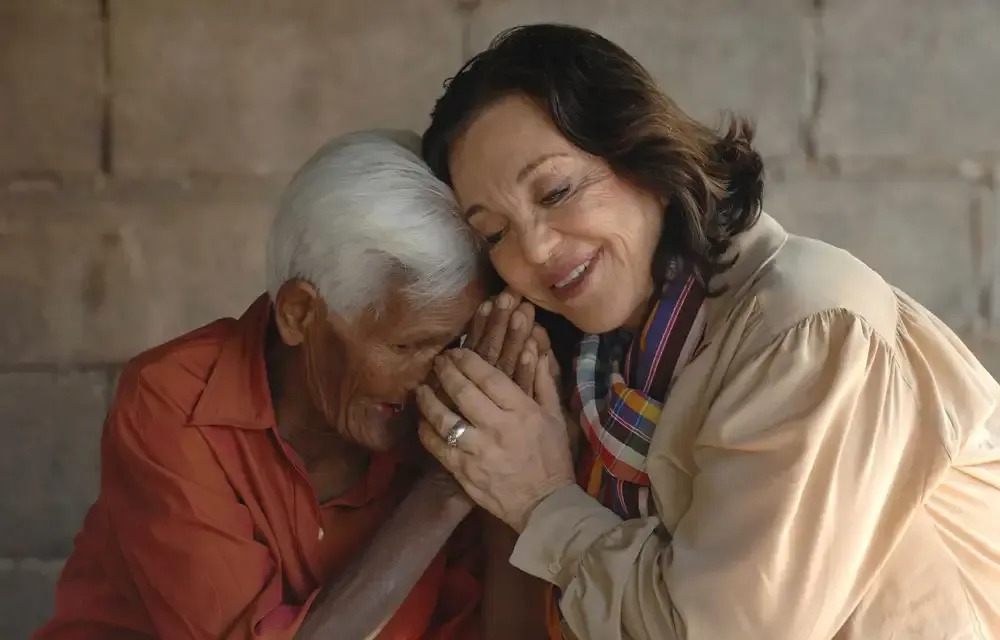 |
Albina du Boisrouvray visits impoverished people in Thailand in 2008. Photo: JDD
Albina recognized social injustice early in life. Living in the luxurious Plaza Hotel in New York during World War II, she was haunted by the sight of impoverished people freezing on the streets. "I saw this world as too unequal," she stated.
Later, Albina established her own film company, engaged in politics, and participated in social activism. However, the most significant turning point came with the birth of her only son, François-Xavier Bagnoud, in 1961. "I felt peaceful and happy. Finally, this world had meaning," she recounted.
François grew up to become a rescue pilot in Switzerland. When his life was cut short in 1986, Albina felt her "life ended that day." She spiraled into severe depression for three years. Upon her father's death, which left her a vast fortune, she found a new purpose. She decided to sell everything—from precious paintings and jewelry to villas and companies—amassing approximately 130 million USD.
In 1989, she used a significant portion of this money to establish the FXB Foundation, named after her deceased son. "I wanted to continue François's mission of saving lives, in my own way," she explained. The FXB Foundation has since operated in more than 20 countries, helping millions escape poverty, particularly orphaned children and people living with HIV/AIDS. She established "FXB Villages" to provide housing, medical care, education, and capital for families to start businesses.
Albina has traveled to conflict zones in Lebanon and to slums in Africa and India. "When I saw people who had lost entire families, I realized I was not alone. I had to be strong to help them," she affirmed. Reflecting on her choices, she smiled, "I had too much. Now I only keep what is necessary. Clothes I've worn for 50 years are still fine. What matters is not material possessions, but people and love."
"Turning personal pain into pure gold for the community" is how Time magazine (United States) honored Albina du Boisrouvray for her unwavering dedication to assisting the most impoverished.
Nhat Minh (Source: Metro)