Hours after Argentina defeated England 2-1 in the 2026 World Cup semi-final, the 39-year-old captain posted on Instagram: "We're in the final!!!! We have once again found the strength to play another great match. Thank you to everyone who has always believed in this team. Go Argentina!!!".
Minutes later, fans noted the caption was identical word-for-word to a post Messi made on 13/12/2022, after Argentina's 3-0 victory over Croatia secured their spot in the World Cup final in Qatar.
Argentine newspaper Infobae questioned if this was a "cabala"—a term for good luck rituals—or simply coincidence. Brazil's Globo Esporte suggested Messi's identical post led many fans to believe he was trying to preserve the winning "spirit" from four years prior.
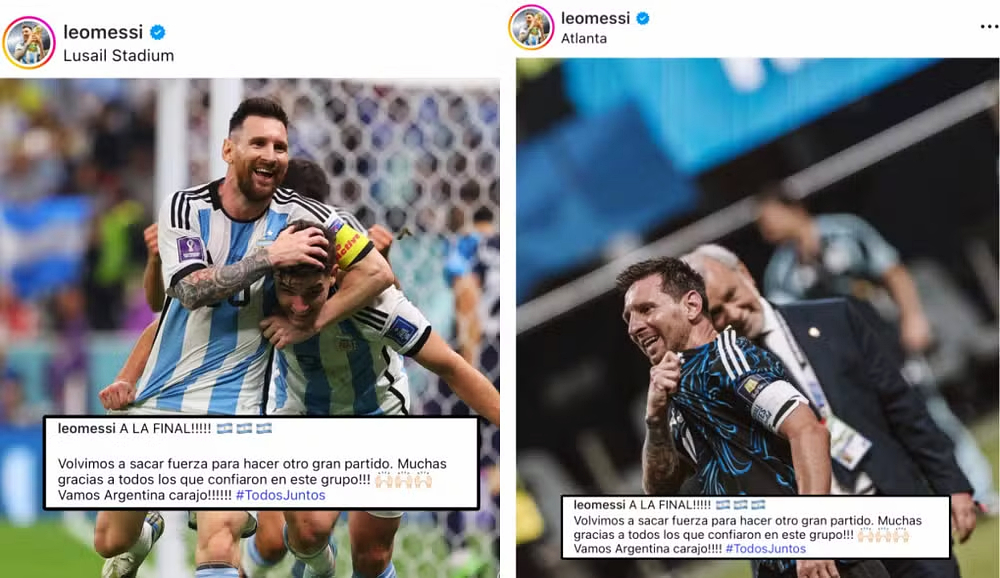 |
Messi's two semi-final posts from 2022 and 2026 are identical. *Photo: Infobae*
"Cabala" is a deeply ingrained superstition in Argentine football, embraced by both players and fans. Adherents believe that if a specific habit contributed to a victory, it must be replicated precisely for subsequent matches. For instance, after an Argentina win, fans might meticulously repeat every detail for the next game: wearing an unwashed jersey, occupying the same seat, eating the same meal, or even refraining from naming the opponent.
Ahead of the semi-final against England, 13-year-old student Ines Mutri recounted how she and friends wrote Harry Kane's name on paper and froze it, hoping to "freeze" the English striker's performance. Similarly, 18-year-old student Juan Pablo Calvo performed the same ritual for midfielder Jude Bellingham. During the match, Calvo wore a jersey replicating Diego Maradona's from Argentina's 1986 World Cup victory.
Even Argentine President Javier Milei planned to watch the final between Argentina and Spain from home to preserve good fortune. He stated he would wear his familiar jacket and watch the match on television at the Olivos residence, noting that Argentina had won all 7 of its recent World Cup matches when he followed this routine.
The cabala tradition has deep roots in Argentine sports, spanning decades. Carlos Bilardo, the coach who led Argentina to the 1986 World Cup title, was known for his specific rules regarding player entry onto the field. Current coach Lionel Scaloni similarly always steps onto the pitch with his right foot, then makes the sign of the cross.
Messi himself has never publicly affirmed a belief in cabala. Regardless of whether his post was coincidental or deliberate, it has undoubtedly fueled Argentine hopes for history to repeat itself in the final.
By Bao Nhien (Reuters, Infobae, Globo Esporte)