The Vung Tau Ward People's Committee reported this information to the Department of Agriculture and Environment of Ho Chi Minh City. Earlier, in early April, the seawater in the Bai Sau area turned a tea-green color, with foam and scum appearing on the surface. At times, a pinkish-purple film with the odor of decomposing algae was present. Later, oil-like clumps also washed ashore along the coast.
Concurrently, the Bai Dua area (Ha Long street) recorded significant ocean debris, including styrofoam boxes, plastic bags, plastic bottles, and tree branches, which drifted ashore and negatively impacted the beach's aesthetics. From 10/4, these phenomena ceased, and the marine environment returned to normal.
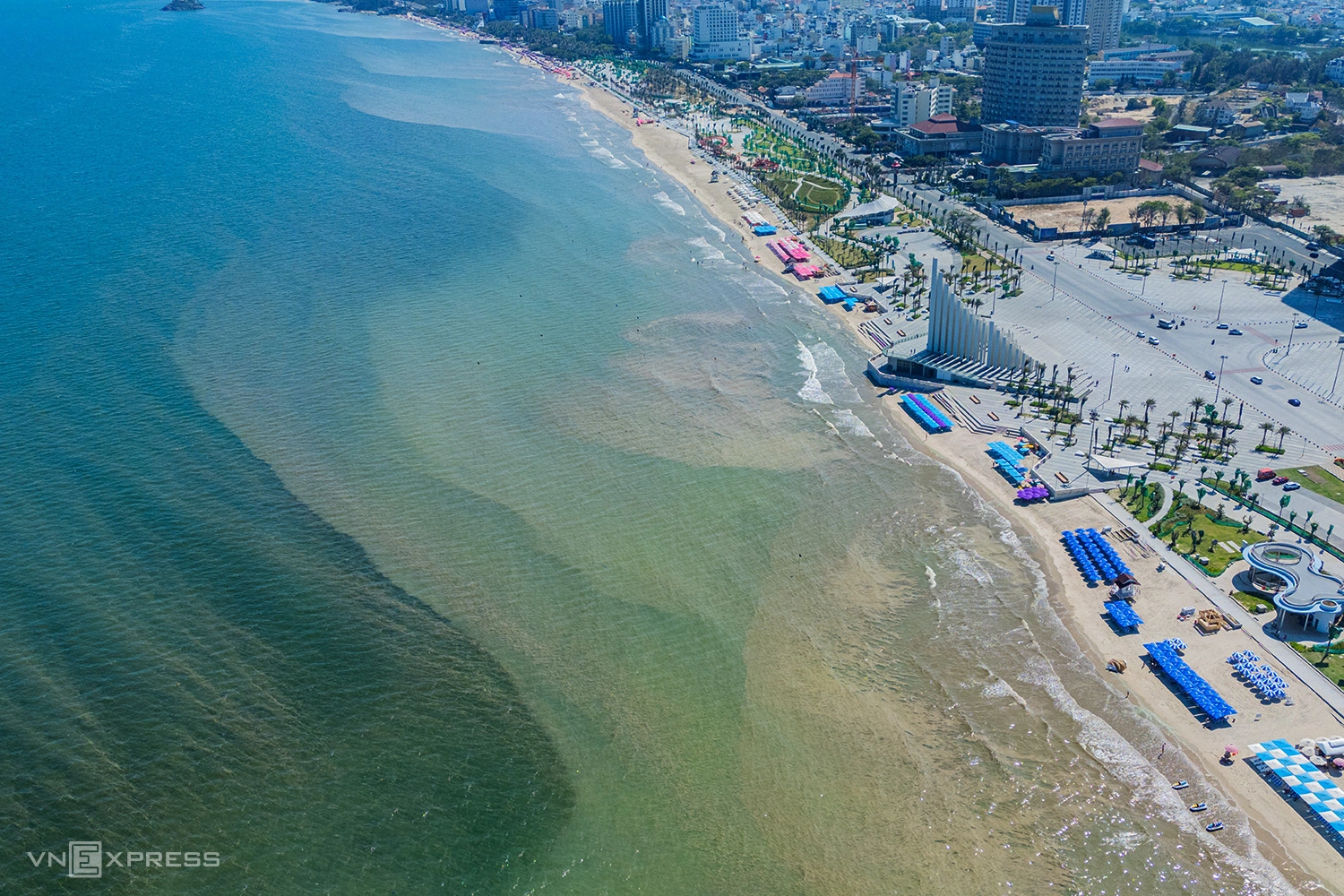 |
Scum stretching across Bai Sau beach on 4/4. *Truong Ha*
Analysis of samples from 5 coastal locations by the Institute of Marine Engineering (Vietnam Institute of Water Resources Science) identified 69 species belonging to three main groups: blue-green algae, diatoms, and dinoflagellates. The most prevalent species was Trichodesmium erythraeum blue-green algae, accounting for over 99% of the density.
This filamentous algae forms visible clumps. When it proliferates, it creates reddish-brown or yellowish-brown streaks, sometimes forming a thin scum on the sea surface with a mild odor. A sudden increase in this species causes localized algal blooms, leading to water discoloration.
Similar phenomena tend to recur annually in Vung Tau, with the most recent occurrence last October, also attributed to an algal bloom.
According to the Vung Tau Ward People's Committee, the incident resulted from multiple natural factors. The timing coincided with a period of hot, calm weather, which reduced diffusion and caused algae to accumulate near the shore. Additionally, the area is affected by rivers and canals discharging into the sea, carrying organic matter that supplements nutrients for localized algae growth.
Truong Ha