Japanese athlete Ikuma Horishima secured a silver medal in the men's dual moguls event, making its Olympic debut on 15/2. Despite falling on the final slope, Horishima crossed the finish line backward, continuing his run to claim the medal.
Dual moguls involves two athletes skiing parallel down a slope covered in moguls (mounds of snow), performing two aerial jumps. Competitors are judged on the difficulty and technique of their turns, the quality of their airborne maneuvers, and their finish time. Each run is scored out of 35 points, with athletes competing in a knockout bracket where a loss means elimination.
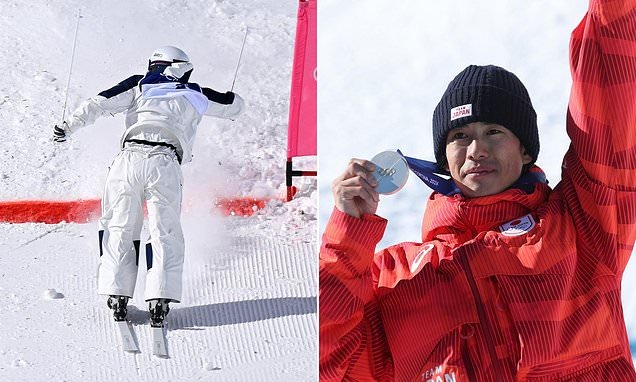 |
Ikuma Horishima slides backward to the finish line, later winning a silver medal in men's dual moguls at the Winter Olympics in Livigno Snow Park, Valtellina valley, Lombardy, Italy on 15/2. *Photo: Daily Mail* |
In the round of 16, 28-year-old Horishima faced Nick Page of the US. Both athletes had previously topped their qualifying rounds. Page, 23, was considered a favorite based on his earlier performance, while Horishima also demonstrated consistent form.
The race was intense from the upper half of the slope. Approaching the first jump of this run, Page lost his earlier stability. He lost control, veered off the course, and crossed a control gate, resulting in disqualification for leaving his lane. In dual moguls, each athlete must stay within their designated course.
Horishima's descent was also not smooth. He wobbled, even briefly encroaching into Page's lane, but quickly adjusted to continue. The situation escalated into chaos at the second jump. The Japanese athlete landed unsteadily, twisting his body while attempting to correct an aerial mistake, then fell hard onto the snow on his hip. His skis sprang off, and he tumbled several times.
Momentum carried Horishima into another mogul, launching him into the air again. Upon landing, he managed to stand on his skis but was facing backward relative to the downhill direction. Cheers erupted as he continued to slide, crossing the finish line still facing backward.
Although Page finished ahead, the outcome remained unchanged because the US athlete was disqualified for leaving his lane. Horishima was awarded the full 35 points and advanced. Page ultimately ranked 15th overall based on his performance in the previous round.
NBC commentators described Horishima's backward finish as "unbelievable" and called it the race of a lifetime. The moment quickly went viral on social media platform X, garnering over 3,2 million views.
Following his dramatic recovery, Horishima maintained his momentum, advancing to the final to compete for the gold medal. His opponent was 33-year-old Mikael Kingsbury of Canada.
Before starting, Horishima reminded himself to enjoy the competition. He aggressively attacked the moguls, maintaining high speed, but again encountered problems near the end. The Japanese athlete lost his balance and could not fully execute his second jump. Kingsbury seized the opportunity to win, securing Canada's first gold medal at this year's Winter Olympics. Horishima received the silver medal.
"I am very disappointed that I couldn't ski to the end exactly as I wanted," Horishima said after the final. "I think I saw Kingsbury's determination."
However, the silver medal also served as a reward for Horishima's comeback journey after a severe injury. Last March, he tore his left knee ligament at the world championships and underwent a long recovery period. Before the Olympics, Horishima led the World Cup standings this season.
Horishima became familiar with snow around one year old, accompanying his parents to ski resorts. In 2009, he met former athlete Shinji Osada at a facility in Hakuba. Osada, who had won an international event and competed despite a congenital heart condition, inspired Horishima. "If you keep dreaming, your dreams will come true. If you strive and don't give up, everything will be rewarded," Horishima recounted Osada's advice.
"He showed us a truly incredible performance," Osada said from Japan. "Horishima's determination to ski to the very last meters has inspired many people."
Despite missing out on the gold medal, Horishima left his mark with his unwavering competitive spirit. "My goal is to win gold four years from now," he said. "I want to continue training for the next four years and return to this stage."