In the history of the AFF U17 Championship, previously known as U16 or U15, Australia has participated in 10 editions, winning the title three times. They have played a total of 52 matches, with 31 wins, 12 draws, and 9 losses, excluding penalty shootouts. Among these defeats, three matches were against Vietnam, more than any other opponent in the region.
Australia is considered a dominant force in Southeast Asian youth tournaments, particularly in the early stages, thanks to their superior physique, speed, and modern footballing philosophy. However, statistics show they are not invincible. Vietnam previously defeated them 3-0 in the 2016 group stage, 2-0 in the 2017 semifinals, and now 2-1 in the 2026 semifinals. Notably, Vietnam's two semifinal victories occurred when Australia was the defending champion.
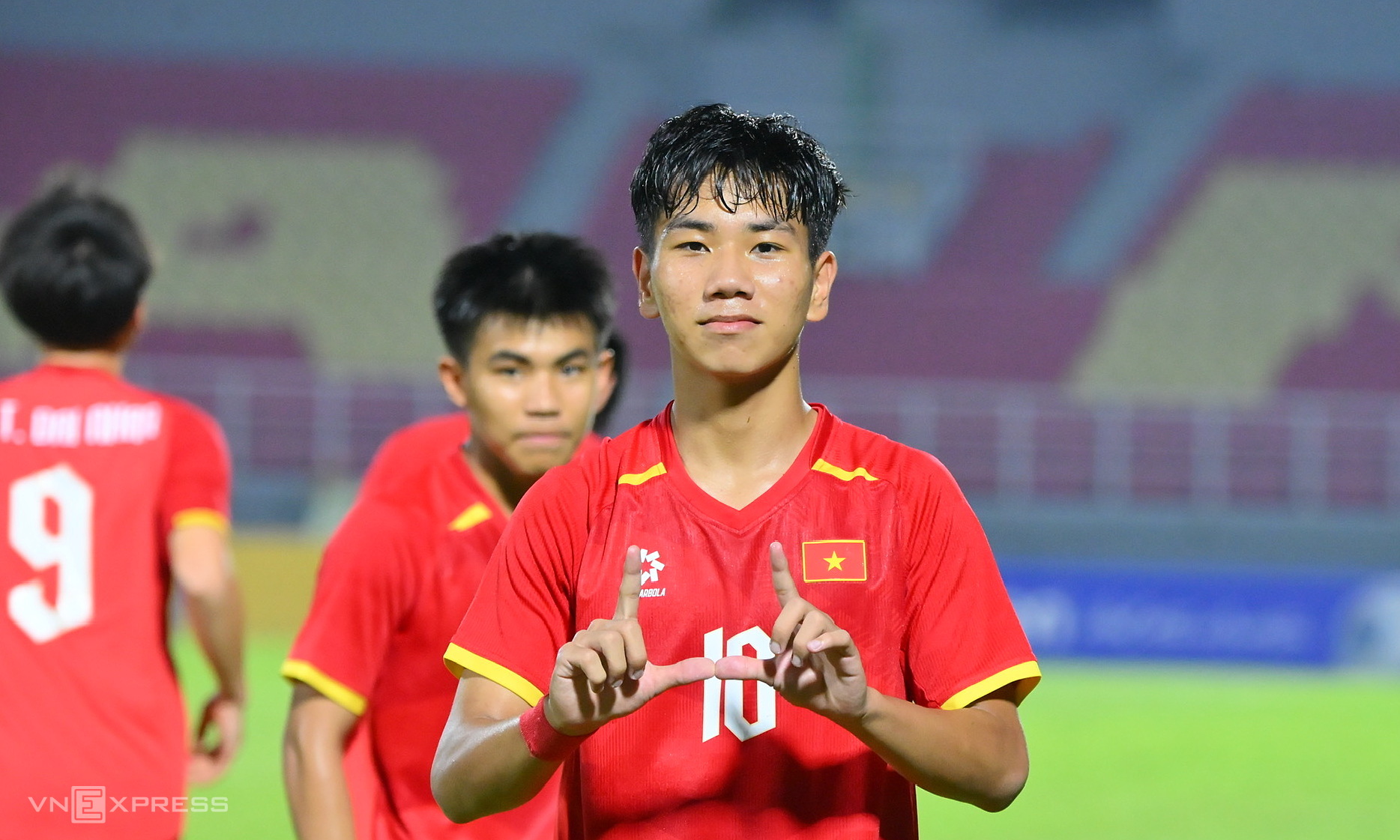 |
Midfielder Chu Ngoc Nguyen Luc celebrates the goal that sealed the 2-1 victory in the win against Australia during the 2026 AFF U17 Championship semifinals, at Gelora Delta Stadium in Indonesia on 22/4/2026. *Photo: Doan Huynh*
Thailand has also posed significant challenges for the Oceanic team, securing two victories (2015 semifinals and 2017 group stage). Australia's other losses were against Japan in 2012, Malaysia in 2019, and Myanmar and Cambodia in 2022. Additionally, they lost to Indonesia in a penalty shootout during the 2013 semifinals.
The two teams first met in 2013. Vietnam lost 0-3 in the group stage and subsequently fell in a penalty shootout in the third-place playoff, a dynamic that has clearly shifted over the past decade. The gap in physical prowess and organization, once Vietnam's weaknesses, has gradually narrowed, while their flexibility, technical skill, and small-group coordination have become effective weapons against physically stronger opponents.
The 3-0 victory in 2016 was a pivotal moment, marking Vietnam's first decisive win over Australia. Although Vietnam later lost the final in a penalty shootout, their group stage performance instilled confidence that the gap between the two footballing nations was no longer significant. One year later, the 2-0 semifinal win further solidified Vietnam's emerging status.
By 2026, the scenario repeated itself, but with an even more positive outcome for Vietnam. Australia still demonstrated their strength, winning all group stage matches, scoring 15 goals, and conceding none, but Vietnam knew how to finish off their opponent at the crucial moment. Coming from behind to win 2-1 highlighted the resilience and maturity of the squad under head coach Cristiano Roland.
Beyond Australia, Vietnam's record against non-Southeast Asian teams in the tournament is also impressive. The team twice defeated Trung Quoc in the 2010 edition, including the final to claim the championship. Bangladesh, a guest team in 2006, also lost to Vietnam in the group stage.
Conversely, Australia has had periods of dominance. They won titles in 2008 and 2024 without a single loss. In the current tournament, they fielded an age-appropriate squad, comprising players born in 2009, but ultimately fell to Vietnam.
For Vietnam, this marks the fifth time the team has reached the final, following appearances in 2010, 2016, 2017, and 2022. They have won the championship three times: in 2006 (round-robin format), 2010, and 2017. If they defeat Malaysia in the final on the evening of 24/4, Vietnam will become the first team to win the tournament four times. This prospect is highly likely, as Roland's squad already defeated Malaysia 4-0 in the group stage on 13/4.
Xuan Binh