The lavish lifestyle of the individual known as "Dash, The Iranian" was exposed in a Spanish court ruling. Records revealed he operated a multimillion-dollar empire, enabling him to acquire supercars, Rolex watches, and luxury properties.
"Dash", whose true identity remained undisclosed in court documents, primarily operated from Spain. A judge in the Criminal Chamber of Spain's National Court convicted him of running a sophisticated transnational criminal network.
The Iranian national provided thousands of pirated entertainment and sports websites to approximately two million users through domains like IPTVStack and RapidIPTV. The investigation focused on a five-year period from 2015 to 2020, during which the illegal organization's revenue was estimated to exceed USD 17 million.
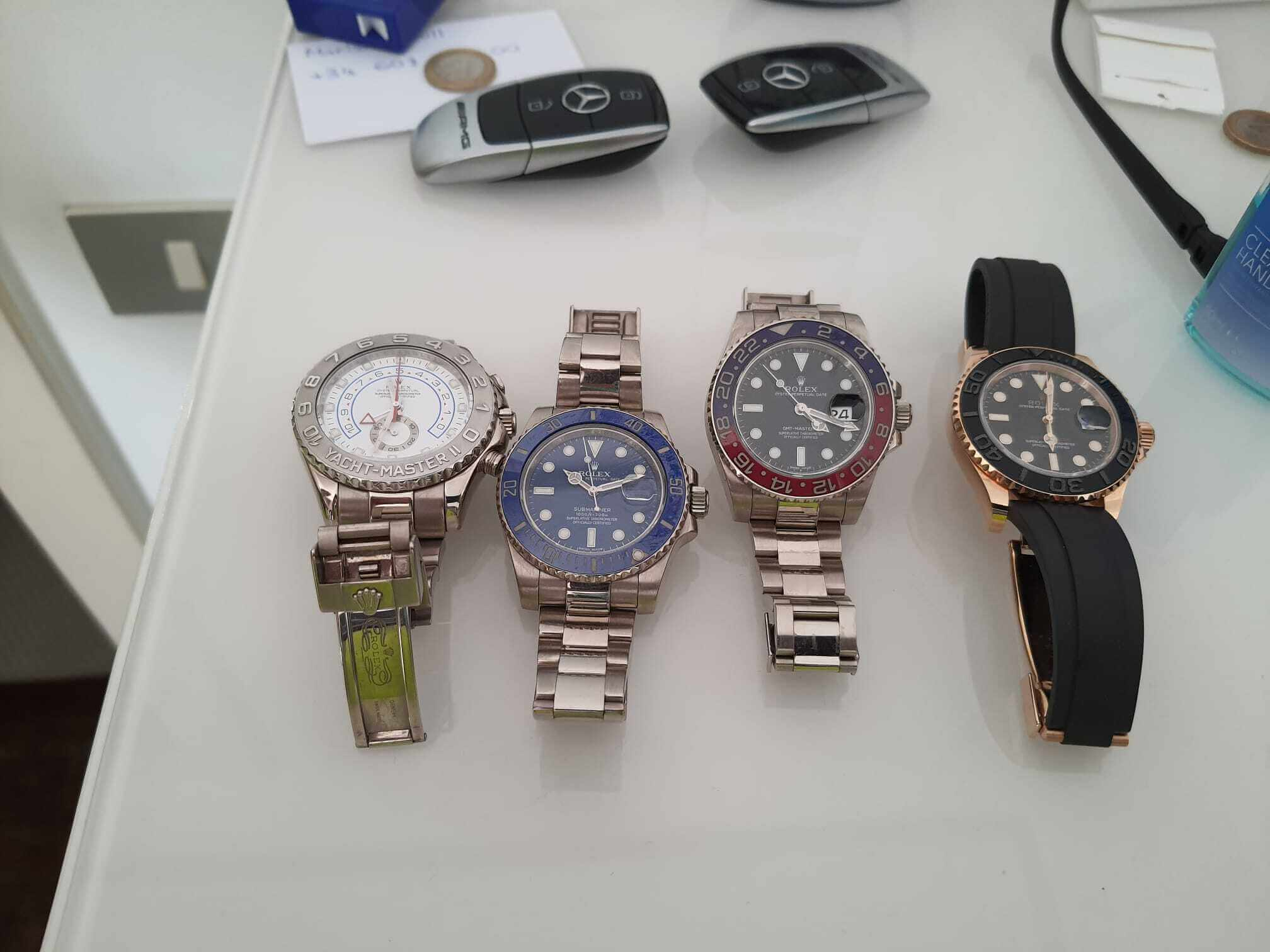 |
Four Rolex watches, valued at approximately USD 60,000, were found by police at an apartment belonging to the individual known as "Dash, The Iranian". Photo: ACE |
The court identified this individual as the leader of a group of five defendants. This group used fake identities to register and open bank accounts to launder money through high-value real estate projects, cryptocurrency transactions (including over 1,000 Bitcoin), and maintained close financial ties to his home country, Iran.
All five defendants pleaded guilty to intellectual property infringement and money laundering in exchange for lighter sentences on 15/4. In total, the fines and damages amounted to USD 23 million.
Revenue from the pirated streaming service, which included English Premier League and Champions League matches, helped the defendant, with support from his younger brother (named in the ruling but not prosecuted), plan a USD 4.7 million housing complex comprising five apartments in Tehran, Iran.
In Spain, he also owned a USD two million apartment in Barcelona, one of the locations raided by police in June 2020. During the initial crackdown on 3/6/2020, supported by Europol and direct surveillance rooms in Brussels and Spain, authorities seized two Mercedes cars: an AMG G-Wagon (USD 200,000) and an AMG GT S (USD 135,000). Police also found four Rolex watches valued at approximately USD 60,000, laptops, credit cards, and stacks of EUR 100 banknotes hidden under mattresses.
In total, 15 premises were searched, 11 people were arrested across four countries (four in Spain, one in Germany, three in Sweden, three in Denmark), and 16 others were questioned for suspected involvement in the international network. At one of the properties, believed to be the luxury apartment in Barcelona, police discovered a specialized Formula 1 (F1) racing game chair with pedals installed in front of a large TV screen.
 |
Authorities seized two Mercedes cars: an AMG G-Wagon (USD 200,000) and an AMG GT S (USD 135,000) belonging to "Dash, The Iranian". Photo: ACE |
This illegal business model was divided into two divisions: technical and financial-commercial. The technical branch, partly located in Iran, specialized in stealing original broadcast signals, decrypting them, and redistributing them via a complex network of servers in over 10 countries. The financial branch, mainly operating from Spain, was responsible for establishing shell companies, circulating funds, issuing fake invoices, and dispersing profits to conceal the illicit origin of the money.
By using multiple shell companies in Belize, Central America, and Spain, the Internet Protocol television (IPTV) network also exploited the informal Hawala and Sarraf money transfer systems (commonly used in the Middle East and North Africa as parallel banking networks). Their global money flow also passed through Luxembourg and utilized fake addresses in Dubai, UAE.
The organization even operated a franchise model, allowing intermediaries to run and profit from their own IPTV services based on the main network. Despite funds flowing into projects in Iran, investigators found no direct links to Iranian government activities. The European Union Agency for Criminal Justice Cooperation (Eurojust), based in the Netherlands, issued investigative orders to 14 countries, including the United States, Canada, and the United Kingdom, throughout the case.
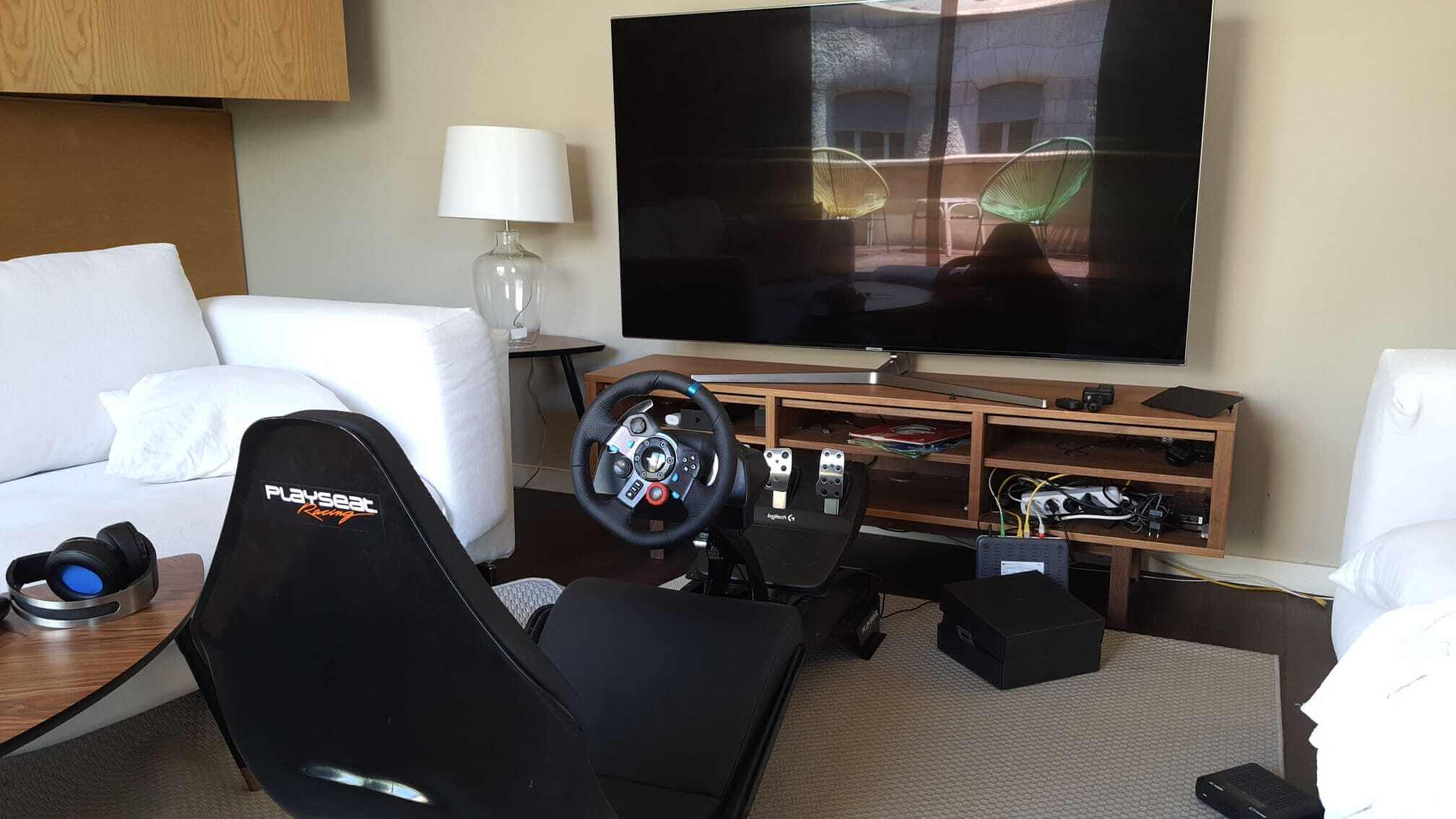 |
A specialized F1 racing game chair with pedals was installed in front of a large TV screen at a luxury apartment raided by police in Barcelona. Photo: ACE |
Chief Inspector Jose Luis Gomez Pidal of the Spanish National Police called these convictions "a landmark ruling in the fight against the largest international criminal organizations specializing in audiovisual piracy." He also emphasized that the investigation "paved the way for exposing the internal operating mechanisms" of illegal livestreaming networks.
La Liga, a major national league at the forefront of the fight against piracy, welcomed the outcome. President Javier Tebas called the fraud and theft of football broadcast rights a "scourge threatening the survival of an industry that forms the foundation of the European economy." He added, "Piracy must be fought vigorously at all levels, especially against the organizations and mafia groups behind them."
In 2025, the British newspaper The Athletic conducted an investigation titled "The Underworld of Illegal Livestreaming", highlighting the booming culture of illegal sports viewing and warning about the criminal precedents and the crisis it poses to the structure of football. A subsequent survey showed that 47% of the newspaper's over 5,000 readers admitted to watching football via illegal live streams.
The Alliance for Creativity and Entertainment (ACE), representing over 50 global media corporations such as MediaPro, Sky, and Amazon, was also a key player in this coordinated investigation. Larissa Knapp, Executive Vice President of the Motion Picture Association (MPA) and Head of Content Protection for ACE, affirmed that the combination of law enforcement and private entities helped the organization "detect, deter, and dismantle digital piracy networks."
Hoang Thong (via The Athletic)