When Pimpichaya Kokram served in set 5, Thailand was leading 24-23. Instead of receiving, opposite hitter Hoang Thi Kieu Trinh let the ball go, believing it was out. Standing nearby, coach Nguyen Tuan Kiet cheered as the ball hit the court, but was startled when the line judge flagged it in, meaning Thailand won the decisive point and successfully defended their gold medal.
Vietnam's coach offered a wry smile, then gave a thumbs-up and bowed with clasped hands towards the referee, remarking bitterly that since the match was played in Thailand, they had no choice but to accept it. At that point, Vietnam had also exhausted all their challenge rights, so the referee's initial decision could not be overturned.
Replays shown on television later were not clear enough to make a definitive conclusion. Even from another angle, not broadcast on television but obtained by VnExpress, it was difficult to confirm whether the ball was in or out.
"
 |
The "in or out" rule in volleyball differs from football. In football, such a situation would not be controversial, as the ball would clearly be in. Football rules determine "in or out" based on the vertical projection of the ball's edge closest to the line. Thus, a ball may not touch the ground but still be considered in.
According to FIVB volleyball rules, determining whether a ball is in or out is stipulated in Articles 8.1 and 9.1.
Article 8.1 states that a ball is considered in if, at any moment it touches the ground, a part of the ball makes contact with the playing court, including the boundary line. The boundary line is considered part of the court.
Conversely, Article 9.1 specifies that a ball is out when its entire part making contact with the ground is completely outside the boundary line, meaning there is no contact point with the playing court.
This interpretation shows that referees do not rely on intuition or the proportion of the ball being in or out, but solely on the criterion of the contact point with the court. Even if a small part of the ball touches the boundary line, it is still counted as in.
In the decisive situation at Huamark Arena, the line judge and main referee determined that the ball still touched the court, meaning it met FIVB Article 8.1. Since Vietnam had exhausted its challenge rights earlier, this decision could not be reviewed by technology.
The final moments of the match.
After the match, coach Nguyen Tuan Kiet acknowledged the harshness of the final situation but considered it part of the game. He stated that Vietnamese teams often face objective disadvantages when competing in away SEA Games matches, not just in volleyball.
Regarding the decisive serve, the head coach felt it was an emotionally difficult moment to accept, but not the sole factor leading to the defeat. According to him, Vietnam had many opportunities to finish the match at previous match points but failed to capitalize, and the primary fault still lay with the team itself.
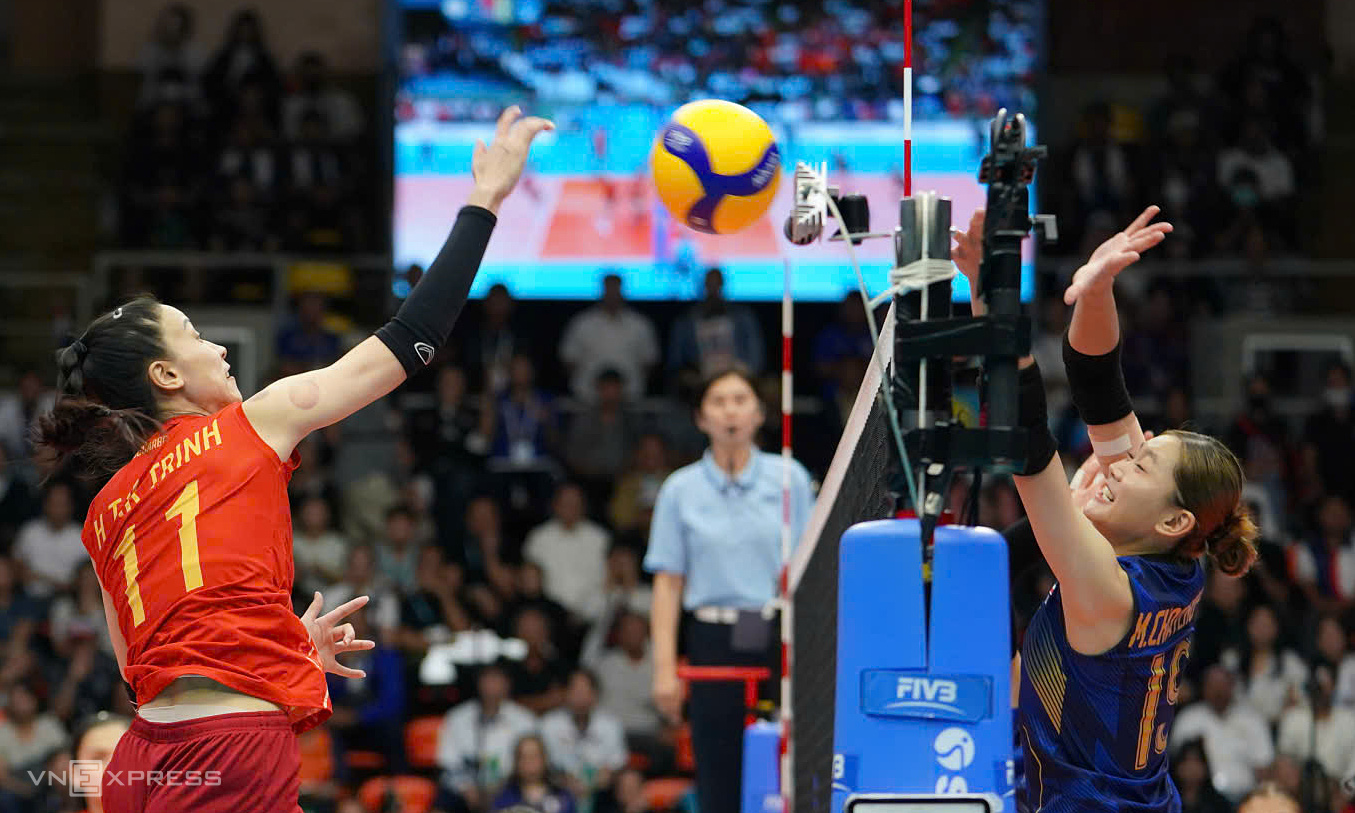 |
Kieu Trinh's attack during Vietnam's loss to Thailand in the SEA Games 33 women's volleyball final at Huamark Arena, Bangkok, Thailand, on 15/12. *Photo: Duc Dong*
The final situation left both fans and players with regret. Vietnam and Thailand played the most dramatic women's volleyball final in SEA Games history. Vietnam won the first set 25-19, lost the next two sets 13-25 and 18-25, then rallied in the fourth set to win 25-23. This was the first time a SEA Games final was decided in the fifth set.
The fifth set is played to 15 points, provided one team establishes a two-point lead. However, both sides traded points, creating tension until the very end. Vietnam reached match point multiple times but failed to convert, ultimately losing 23-25 from Pimpichaya's serve.
This defeat meant Vietnam once again missed out on a SEA Games gold medal, but the gap between the two teams has narrowed more than ever. Despite the absence of player Nguyen Thi Bich Tuyen, coach Tuan Kiet's squad showed they could still compete evenly with Thailand.
By Hieu Luong - Xuan Binh