Lionel Messi played for two hometown clubs, Grandoli and Newell’s Old Boys, from the age of five to 13 in Rosario, Argentina. During this period, the 38-year-old superstar only played for these clubs' youth teams and was not old enough to sign any professional contracts before moving to Spain to join Barca's La Masia academy in 2000.
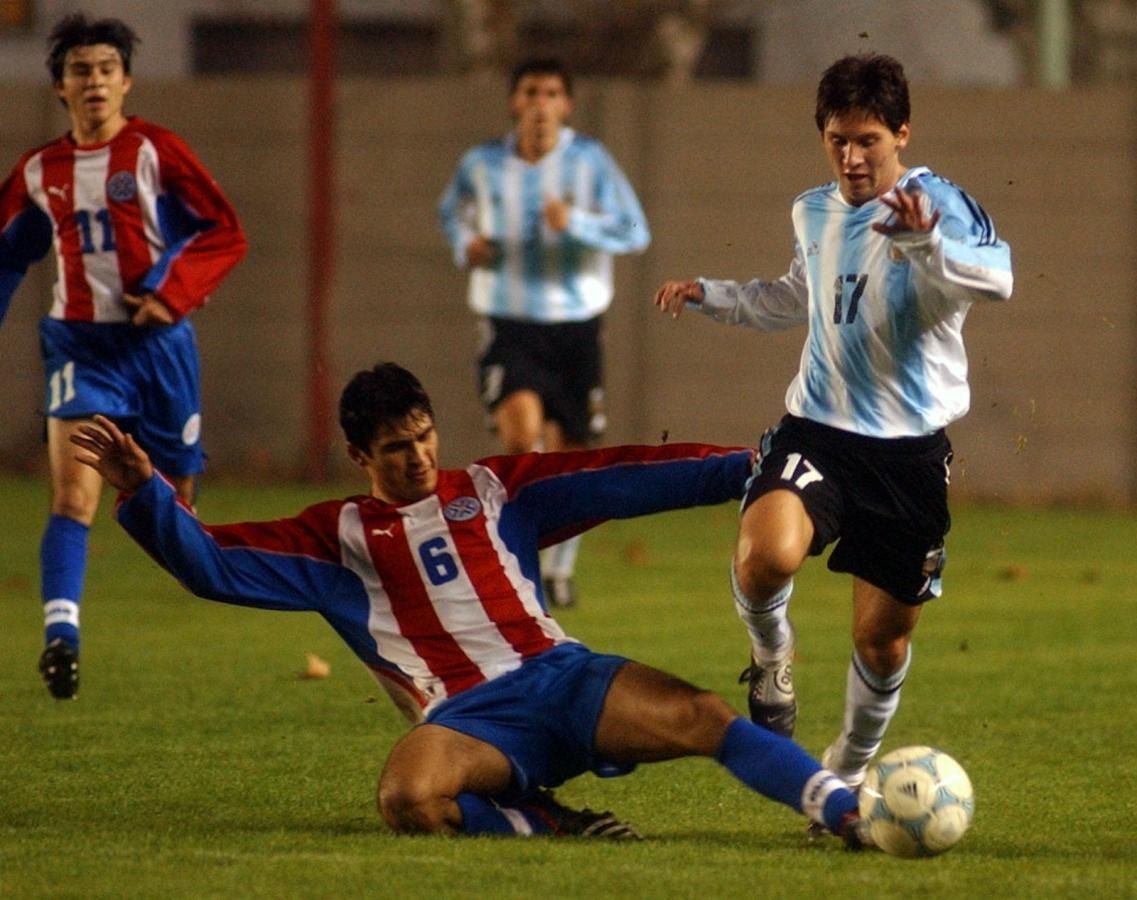 |
Messi debuted with the Argentina U20 team in a friendly against Paraguay on 30/6/2004, as a professional player for Barca, which recruited him in 2000 when the forward was just 13 years old. Photo: AFA
Had this new AFA measure been in place before 2004, when Messi first debuted with the Argentina U20 team, the player born in 1987 might not have achieved his national team career as it is today. Argentine media describes this retrospective hypothesis as "Messi's Law has expired due to AFA's new regulations".
The new policy aims to protect domestic clubs from "brain drain" and encourage youth development in academies. AFA stated that this move stems from "many recent cases exploiting the patria potestad regulation", a national law on parental rights that grants parents the power to "manage their children's assets".
For decades in Argentina, the patria potestad regulation allowed parents to decide where their children signed professional contracts without the consent of their current clubs. These clubs had only non-binding youth training agreements with the players. In Argentina, players can sign professional contracts from 16 years old, while patria potestad is effective until 18 years old. Consequently, when young players in the country turn 16 and until they reach 18, signing a professional contract with a domestic club is optional, not mandatory. If a player leaves before signing a professional contract, the club that developed them only receives a small training fee instead of a realistic transfer fee.
 |
Messi playing for the Barca first team in 2004, the year he began representing the Argentina U20 team. Photo: Action Images
The AFA's new measure is not expected to completely prevent this situation from recurring. However, by adding a penalty that excludes such players from consideration for future national youth teams, the regulation is anticipated to limit stories like Messi's past. This is despite the fact that Messi's journey led to the birth of one of the greatest football icons in history, culminating in the 2022 World Cup championship with "La Pulga" as captain.
From AFA's perspective, Messi's past case was a special exception, not representative of the majority of situations occurring or potentially occurring in Argentine football. Without implementing stricter measures, the "brain drain" of young talents from the country's football system to foreign clubs would worsen. "After discussing many aspects of the issue to protect the interests of clubs, members unanimously decided that players falling under this category will not be called up to national teams at any level," stated an AFA announcement in february 2026.
The Argentina squad called up in september 2025, besides Messi, included six other players who would have been ineligible if the new rule had applied in the past. Notable cases include goalkeeper Emiliano Martinez, who left Independiente's youth academy for Arsenal in 2010, and Giuliano Simeone, who joined Atletico Madrid from River Plate's youth academy in 2019. The remaining four are midfielders Emiliano Buendia and Enzo Barrenechea, and forwards Joaquin Panichelli and Valentin Carboni.
The AFA's new regulation is not retroactive, meaning it cannot apply to events before its effective date. Therefore, past events will remain as they are.
**Why did AFA act?**
Argentine news agency TyC Sports reported that the catalyst for AFA to establish this new technical barrier was the case of Lucas Scarlato, a 16-year-old midfielder who recently left River Plate, one of the country's largest clubs, to join Parma in Italy. Scarlato had not played any senior matches but had been called up to Argentina's youth teams, up to the U16 level, and had not signed a professional contract with River.
 |
Scarlato in the Argentina U16 jersey. Photo: AFA
"I care about Scarlato and wish him the best, but staying at River was best for him," River's youth football director Gabriel Rodriguez told DSports in december 2025. "I do not think his departure from the club at that time was right. Furthermore, agents are a plague on football because they only seek their own interests. They are an inevitable evil in the world of football."
Scarlato joined River at six years old. He was highly regarded at the club and captained the U16 team. When Scarlato turned 16 last april, River began negotiations with him, his family, and agent Martin Ariel Guastadisegno.
After Scarlato's move to Parma, River confirmed to The Athletic that they had filed a formal complaint with FIFA against Guastadisegno, accusing his actions of violating FIFA regulations on player agent conduct.
In response to The Athletic, Guastadisegno countered: "I am the target of slander, insults, and defamation from River, a mess I do not deserve because I am a football agent. I do not work for clubs; I work for players. My player and his family asked me to find the best option. That is exactly what I did."
However, in the announcement confirming Scarlato's departure, River still stated that the club "acknowledges and thanks partner Parma for their professionalism and respectful attitude during the negotiation process."
 |
Scarlato celebrating a goal in the River Plate U16 jersey. Photo: River Plate
In the past, Gabriel Heinze, now a member of Mikel Arteta's coaching staff at Arsenal, also called on football authorities to address the patria potestad issue.
"In most cases, agents are the reason these things happen," Heinze said in 2020 on TyC Sports. "Clubs are the ones who suffer the most, because they train players, and then parents make decisions, leaving the club unprotected. FIFA needs to intervene, from the highest level with its responsibility and duty, to outline a clear path. Clubs, which do excellent training work, are frustrated because this is crucial for them."
Argentine sports and commercial law litigator Samuel Cuthbert stated that the AFA regulation does not conflict with current FIFA statutes. "FIFA does not dictate specific selection policies for member associations, and there are no provisions in FIFA's statutes prohibiting limiting selection eligibility based on the league or country where a player is playing," Cuthbert said.
Cuthbert also added that AFA's new patria potestad regulation is not significantly different from the policy adopted by the English Rugby Football Union since 2012, which renders players playing for foreign clubs ineligible for national team selection unless an exception is made.
"Ultimately, the idea behind such policies is to retain players domestically for the perceived benefit of the national football system, although some players will certainly accept exclusion from the national team to play abroad, unable to resist lucrative offers from major clubs," Cuthbert added. "The success of such a policy will largely depend on the success or prestige of that national team, as well as the disadvantage a player suffers by losing the opportunity for selection due to playing abroad contrary to the regulation."
By Hoang Thong