On 13/6 at MetLife Stadium in New Jersey, United States, the Morocco national team started their match with only one player born in the country: midfielder Azzedine Ounahi, who plays for Girona.
In the 65th minute, coach Mohamed Ouahbi made two substitutions, bringing off Ounahi and Brahim Diaz and replacing them with Chemsdine Talbi and Samir El Mourabet. From that moment, Morocco had no players born in their home country on the pitch.
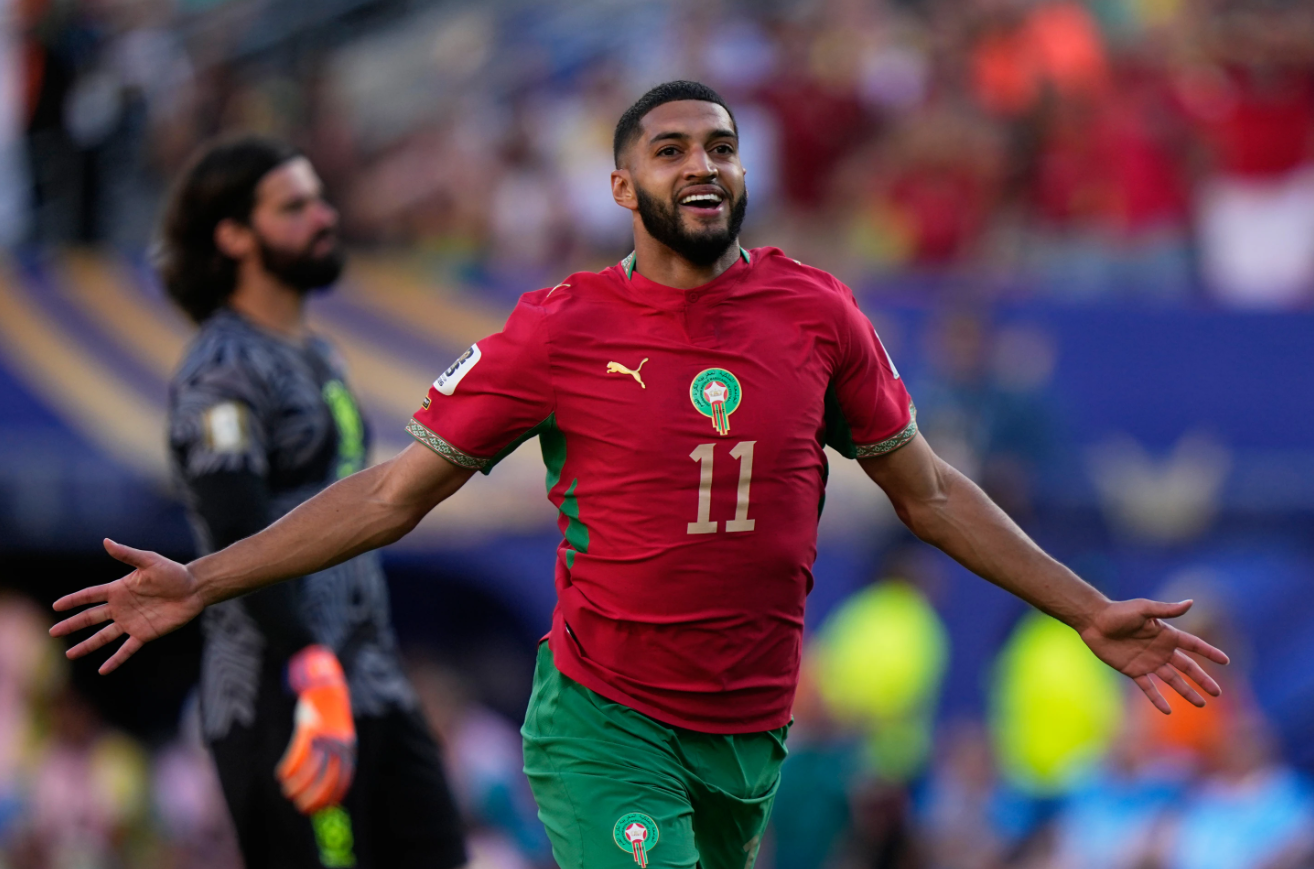 |
Ismael Saibari celebrates Morocco's opening goal in their 1-1 draw against Brazil in Group C of the 2026 World Cup, at MetLife Stadium, East Rutherford, New Jersey, United States on 13/6. *Photo: AP*
The goalkeeper at the time was Yassine Bounou, born in Montreal, Canada. The defensive four included Achraf Hakimi (Madrid, Spain), Issa Diop (Toulouse, France), Chadi Riad (Palma de Mallorca, Spain), and Noussair Mazraoui (Leiderdorp, Netherlands).
The midfield trio of Neil El Aynaoui, Ayyoub Bouaddi, and Samir El Mourabet were all born in France. Wingers Bilal El Khannouss and Chemsdine Talbi were born in Strombeek-Bever and Sambreville, Belgium, respectively. Up front, Ismael Saibari, who scored Morocco's opening goal, was born in Terrassa, Spain.
Even coach Mohamed Ouahbi was born in Schaerbeek, Belgium. He was appointed head coach, replacing Walid Regragui, just three months before the 2026 World Cup.
This lineup, consisting of 11 players born outside Morocco, remained on the field from the 65th to the 89th minute. It was only when Soufiane Rahimi, born in Casablanca, was brought on as the final substitute that Morocco once again had a player born in their home country.
Prior to this, social media had widely shared images showing Diaz and Bounou completing immigration procedures in the United States using Spanish and Canadian passports. Both hold the nationality of their birth countries, as their families had migrated there in search of better opportunities.
This image partly reflects the modern landscape of Moroccan football. The national team is built upon a strong national identity but increasingly bears the imprint of the Moroccan diaspora living in Europe. This trend has been evident through the country's success in continental competitions and the increasingly modern sports infrastructure in Rabat.
At the 2026 World Cup, Morocco continues to demonstrate the strength of a team diverse in origin but unified under their national colors. With their performance, the North African representative has a strong foundation to pursue further ambitions, following their semi-final appearance at the 2022 World Cup and their victory in the 2026 Africa Cup of Nations.