According to a decision by the International Football Association Board (IFAB), referees will have the authority to expel any player engaging in this behavior, starting from the 2026 World Cup. This proposal, initiated by FIFA, received consensus at its annual meeting before being officially approved at an extraordinary meeting in Vancouver, Canada.
The new rule addresses a long-standing issue on the pitch. Players cover their mouths to prevent cameras and lip-readers from discerning their words. While often used for tactical communication, this action has also been exploited to conceal offensive or discriminatory remarks.
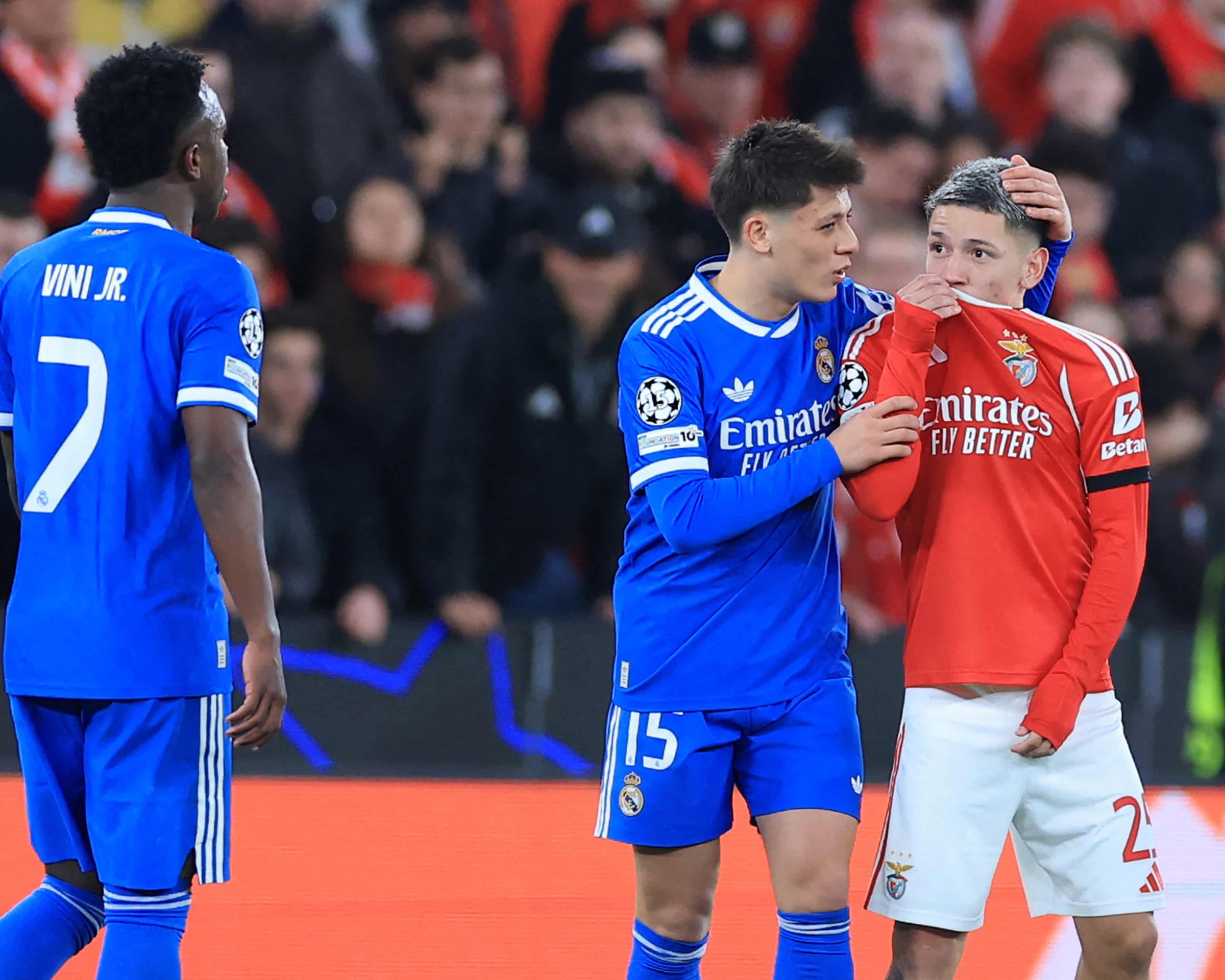 |
Prestianni speaks to Vinicius with his mouth covered, before the match between Benfica and Real Madrid was postponed in the first leg of the Champions League play-offs at Da Luz stadium, Lisbon, Portugal on 17/2. Photo: AFP
The direct catalyst for this change was an incident involving Vinicius Junior and Gianluca Prestianni in the Champions League in 2/2026. During a match between Real Madrid and Benfica, Vinicius accused his opponent of racist abuse. The situation drew attention when Prestianni covered his mouth while speaking, preventing the referee from immediate verification.
The match was halted for about 10 minutes to activate UEFA's anti-racism protocol. Following an investigation, the disciplinary body lacked sufficient evidence to confirm racist behavior but identified homophobic language. Prestianni received a 6-match ban, with a portion of the penalty suspended.
According to FIFA, covering the mouth complicated the verification process. President Gianni Infantino previously suggested stronger measures. He argued that if a player intentionally covers their mouth while speaking during a tense situation, it could be presumed an act requiring serious action, thereby protecting efforts against discrimination in football.
Thus, the "Vinicius rule" serves as a deterrent but has not received absolute consensus. Some federations argue that covering the mouth is not always negative. Players often do it to keep tactics secret or avoid having their words caught on camera during sensitive moments. Applying a red card could lead to controversial penalties if contextual assessment is lacking.
In addition to the "Vinicius rule", IFAB also approved another significant change concerning player reactions on the pitch. Players leaving the field to protest a referee's decision can be immediately disqualified. This regulation also applies to coaching staff members who incite players to abandon the field.
This rule follows several chaotic incidents in recent tournaments, notably the 2026 African Cup final. In that match, Senegal players walked into the tunnel mid-game after a penalty was awarded against them, only returning to play after several minutes. The team won the match but was later stripped of its title.
Hoang An (according to Independent)