Instead of an extreme boycott, a group of top players has adopted a highly symbolic form of protest. Members participating in this "soft protest" will limit their interview time during the traditional pre-tournament media day, today, 22/5. They will leave the press conference room as soon as the clock reaches 15 minutes.
The 15-minute figure is a sarcastic jab at the current reality where Grand Slam tournaments allocate only about 15% of their revenue to player prize money. At Roland Garros 2026, the prize money percentage for players has decreased from 15,5% to 14,9%, even though the tournament's revenue is expected to exceed 400 million Euro (465 million USD). This rate is significantly lower than the 22% offered at other ATP and WTA events.
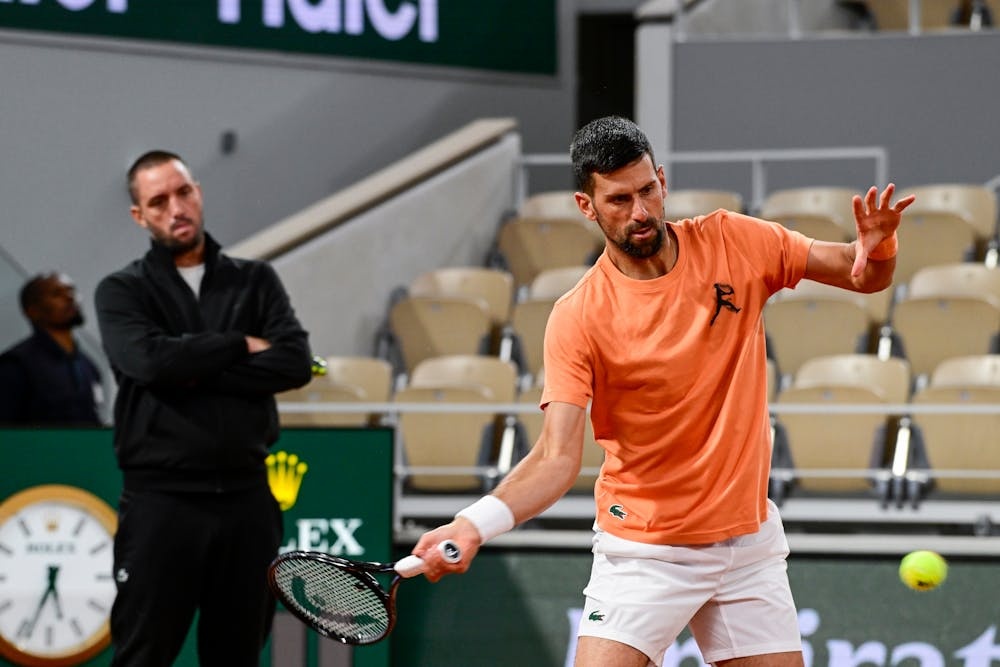 |
Djokovic (right) trains under the watchful eye of his new coach, compatriot and close friend Viktor Troicki, on Philippe Chatrier court in Paris, France on 21/5. *Reuters*.
Roland Garros organizers announced last month that the total prize fund would increase by about 10%, reaching 61,7 million Euro (72,1 million USD), an increase of 5,3 million Euro from last year. However, players contend that "the actual figures tell a completely different story," as the percentage of revenue they receive is decreasing.
Women's world number one player Sabalenka, along with men's world number one player Sinner, were among the top players who issued a statement earlier this month, expressing "deep disappointment" regarding the prize money at Roland Garros. According to them, a "mere" 5,4% increase in prize money last year was insufficient, given that Roland Garros 2025 revenue rose by 14% compared to the previous year.
Sabalenka has been identified as the initiator of the protest campaign, while Sinner publicly stated, "Without players, this tournament would not exist." Meanwhile, Djokovic, who co-founded the Professional Tennis Players Association (PTPA), openly supports a fundamental reform of the Grand Slam profit-sharing system.
Under media pressure, the French Tennis Federation (FFT) proposed an emergency meeting today, 22/5. President Gilles Moretton and Tournament Director Amelie Mauresmo will directly negotiate with the players and their representatives to seek a common agreement before the main draw officially begins.
"The FFT is ready for direct and constructive discussions on governance issues, with the goal of giving players a greater role in decision-making, contributing to a social protection system for participants, and adjusting value distribution. The Federation made many proposals in this regard during the meeting," the FFT announced on 21/5.
According to the FFT, beyond prize money, a Grand Slam like Roland Garros also provides players with significant exposure, generating indirect revenue through sponsorships, commercial partnerships, exhibition matches, and appearance fees. This year, the FFT also decided to allocate most of the additional funds to players eliminated early in the main draw and qualifiers, with an increase of over 11%. "This aims to better support those who rely most on tournament prize money to cover their season," the FFT statement read.
Individually, Tournament Director Amelie Mauresmo stated she would not concede to the players. "I think we never take statements from players lightly," the former French player said. "I am confident that dialogues will continue, similar to the discussions that have taken place before."
This year, the clay-court Grand Slam begins on 24/5 and concludes on 8/6. The projected prize money for the men's and women's singles champions is 3,25 million USD. Runners-up receive 1,62 million USD, while semifinalists take home 871 thousand USD. Players eliminated in the first round also receive up to 101 thousand USD.
Vy Anh