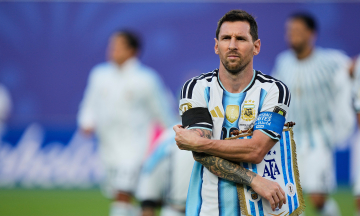
The most notable change is the introduction of a "league phase", where teams will play each other once in the group stage with a flexible schedule, rather than the previous home-and-away format across multiple smaller groups. UEFA decided to implement this new format for national teams after Euro 2028, commencing with the 2030 World Cup qualifiers, in a reform European media has described as "revolutionary".
Under the new model, national teams will not face the same opponent twice in the group stage. Instead, each team will play a single match against each opponent, either at home or away.
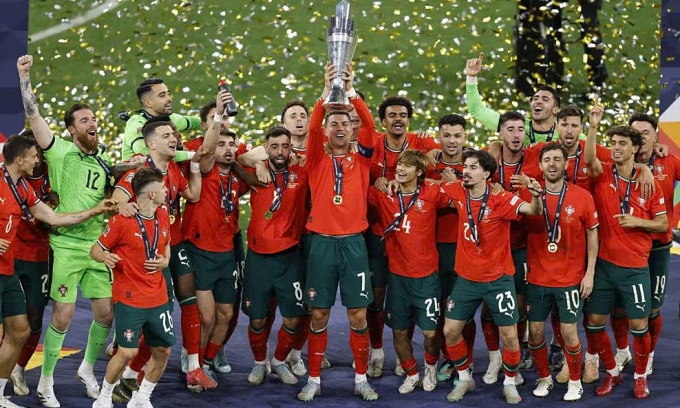 |
Portugal celebrates winning the UEFA Nations League at Allianz Stadium in Munich, Germany, on the evening of 8/6/2025. Photo: Reuters
The Nations League will also undergo structural changes. The competition will be reduced from four divisions to three, with each division comprising 18 teams. These divisions will be split into three groups, each containing six teams. Every team will play six matches against five different opponents. UEFA stated that two teams from different seeding pots could face each other in a single home or away match, but will play both legs against teams from the same seeding pot.
As UEFA comprises 55 members, Group C will have one group consisting of seven teams. The schedule for this group will begin one FIFA Days period earlier than the others. The quarterfinals, the final four (semifinals and final), and promotion/relegation playoffs will remain unchanged.
Beyond the Nations League, the European qualifiers for the World Cup and Euro will also transition to a new tiered system. UEFA will divide teams into two tiers: Tier one will include 36 teams from the A and B divisions of the Nations League. Tier two will comprise the remaining 18 or 19 teams.
In Tier one, the 36 teams will be divided into three large groups, each with 12 teams, drawn from three seeding pots. Each team will play six matches against six different opponents, including two opponents from each seeding pot, following a model similar to current European club competitions. Tier two will operate similarly to Nations League Group C, with three groups of six teams or two groups of six teams and one group of seven teams.
The top teams in each group in Tier one will secure direct qualification for the World Cup or Euro. The remaining spots will be decided through playoffs. UEFA also affirmed that the new system will continue to provide opportunities for Tier two teams to qualify for major tournaments.
This move is seen as the next step in the "Champions League-ification" of European football, as UEFA aims to increase the number of attractive matches between strong teams while reducing repetitive traditional fixtures. For many years, the Champions League has set the standard for commercial value and global appeal in football.
Playing only a single match against each opponent will also make the competition more unpredictable, unlike the previous format which offered a chance in the return leg. UEFA expects the new format to improve the quality of the match schedule, enhance commercial value, and generate greater television appeal for national team competitions.
Vy Anh