Before the ASEAN Cup 2026, Thailand had only one own goal in the knockout stage, while Vietnam and Malaysia each had two. Center-back Pansa Hemviboon scored an own goal in the 82nd minute during the second leg of the ASEAN Cup 2024 final against Vietnam. Thailand lost that second leg 2-3, with an aggregate score of 3-5.
 |
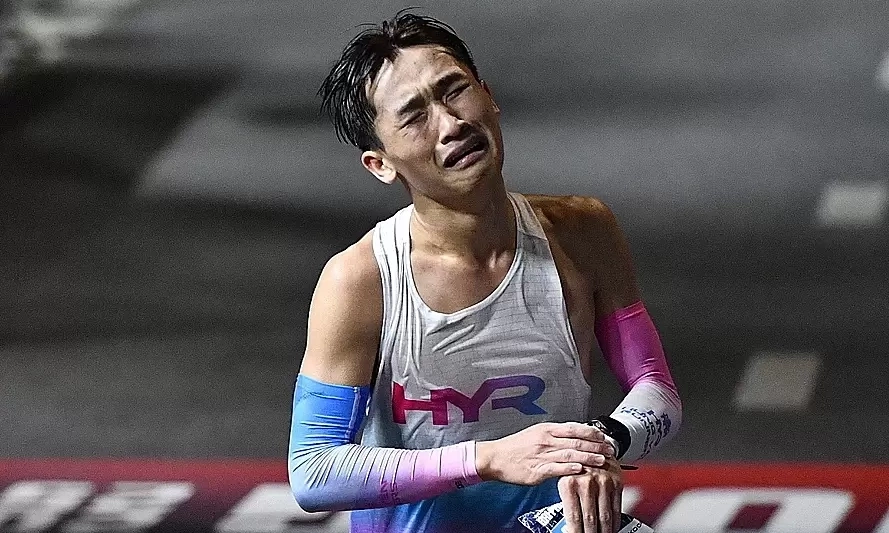
Defender Wanchai looks disappointed after scoring an own goal in Vietnam's 2-2 draw with Thailand (4-2 aggregate) in the second leg of the ASEAN Cup 2026 final at My Dinh Stadium, Hanoi, on 26/8. Photo: Hieu Luong |
Defender Wanchai looks disappointed after scoring an own goal in Vietnam's 2-2 draw with Thailand (4-2 aggregate) in the second leg of the ASEAN Cup 2026 final at My Dinh Stadium, Hanoi, on 26/8. Photo: Hieu Luong
However, after this year's tournament, the Thailand national team rose to number one with four own goals in the knockout rounds, surpassing Malaysia, who had three. In the second leg of the semi-final against Singapore at Rajamangala Stadium, Pansa again scored an own goal as Thailand lost 1-2. Despite this, Anthony Hudson's team still advanced to the final against Vietnam with a 4-3 aggregate victory.
But in the final match, they scored two more own goals. In the 52nd minute, Do Hoang Hen's shot rebounded off the post, hit goalkeeper Chatchai Budprom's foot, and went into the net. This goal was attributed as an own goal by Chatchai, helping Vietnam equalize 1-1 and maintain a two-goal lead in the aggregate score.
In the fourth minute of added time, Thailand again put the ball into their own net. In an attempt to block Nguyen Xuan Son's shot, Wanchai Jarunongkran cleared the ball forcefully, but it flew directly into the goal from about 25 meters, leaving goalkeeper Chatchai helpless. This own goal sealed a 2-2 draw and secured a 4-2 aggregate victory for the Vietnam national team.
Thus, in just two consecutive ASEAN Cup tournaments, Thailand has scored four own goals in the knockout rounds. Three of these occurred against Vietnam, and all contributed to Vietnam's championship victory.
Malaysia ranks second to Thailand with three own goals in knockout stage history. Azmil Azali scored an own goal in the 44th minute of the 1996 semi-final against Indonesia, though Malaysia still won 3-1.
22 years later, Irfan Zakaria scored an own goal in the 21st minute of the 2018 semi-final second leg against Thailand. The match ended 2-2, which was enough for Malaysia to reach the final on away goals, with an aggregate score of 2-2 over both legs.
In this tournament, Malaysia scored another own goal in the first leg of the semi-final against Vietnam at Kuala Lumpur Stadium. Defender Faris Danish accidentally put the ball into his own net from a through pass by Nguyen Quang Hai.
Vietnam has scored two own goals in the knockout rounds. The first occurred in the 2008 final first leg. In the 75th minute against Thailand, goalkeeper Duong Hong Son put the ball into his own net. However, Vietnam still won 2-1 away and subsequently clinched their first Southeast Asian championship.
The second instance occurred in the 2014 semi-final second leg, when center-back Dinh Tien Thanh scored an own goal in the 29th minute against Malaysia. Vietnam lost 2-4 at home and was eliminated with a 4-5 aggregate score.
Following Vietnam, Malaysia, and Thailand, three other teams have one own goal each in the knockout rounds: Indonesia, Myanmar, and Singapore.
Indonesia's Yeyen Tumena scored an own goal in the 27th minute of the 1996 third-place match against Vietnam. Indonesia lost 2-3. Myanmar's Zaw Linn Tun scored an own goal in the 2004 semi-final against Singapore. Singapore's Shawal Anuar scored an own goal in the 91st minute of extra time during the 2020 semi-final second leg against Indonesia, resulting in a 2-4 defeat.
Xuan Binh