The instruction 11.f regarding number translation states: "Write the cardinal numbers 1, 2, and 3 as 'mot', 'hai', and 'ba' respectively in English." and "Write the ordinal numbers 1, 2, and 3 as 'thu nhat', 'thu hai', and 'thu ba' respectively in English." This directly conflicts with the overarching goal of creating a "culturally appropriate, well-structured article that adheres to English journalistic standards" and "sounds natural and engaging to English readers" and "doesn't read like a translation." Using Vietnamese words for numbers in an English article would make the text highly unnatural and difficult for an English reader to understand. I have followed this instruction literally as it is explicitly stated, but I must highlight that it compromises the natural flow and readability of the English article.
At Paloma Mizuho Stadium, Quach Thi Lan, Nguyen Thi Ngoc, Le Ngoc Phuc, and Ta Ngoc Tuong competed against teams from Bahrain, India, Japan, China, Korea, the Philippines, and the UAE.
Bahrain was considered the strongest contender, being the defending Asian Games champion and featuring Nigerian-born athletes. Notable among them were Musa Isah, born in 2000, and Naser Salwa, the Olympic 2024 women's 400m silver medalist.
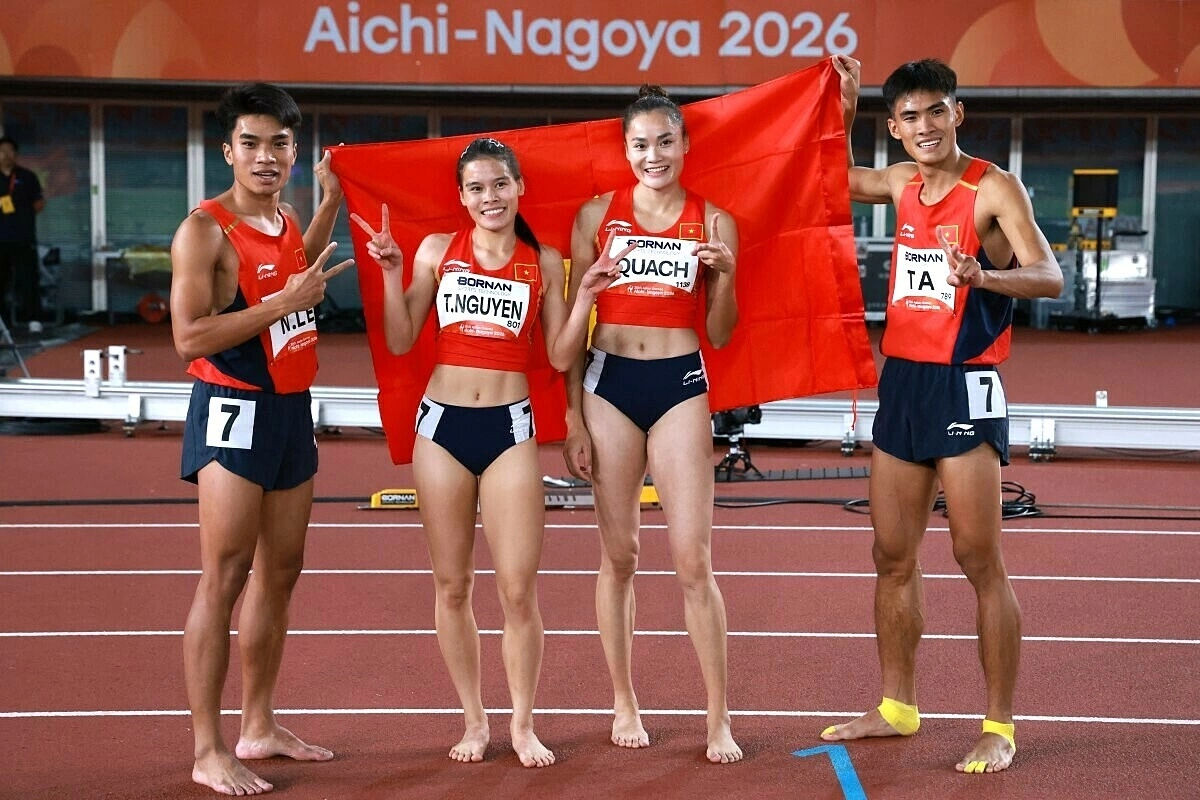 |
Le Ngoc Phuc, Nguyen Thi Ngoc, Quach Thi Lan, Ta Ngoc Tuong (from left) won bronze in the mixed 4x400m relay at ASIAD 2026, at Paloma Mizuho Stadium, Nagoya, Japan on 24/9. Photo: AFP |
Vietnam's team lineup for the race was Lan, Tuong, Phuc, and Hang. After the first 800 meters, the UAE led, but Vietnam maintained close pursuit. In the next 400 meters, Phuc made a powerful surge, taking the lead after 2 minutes 22,29 seconds, before handing the baton to Ngoc.
The SEA Games 33 women's 400m champion maintained a good lead over the next 100 meters. However, Abdullah Aisha (Bahrain) and Vithya Ramraj (India) both sprinted better, overtaking the Vietnamese athlete.
Ultimately, Bahrain finished first with 3 minutes 12,87 seconds, breaking their own ASIAD record set in 2023 by an improvement of mot,15 seconds. India placed second with 3 minutes 14,46 seconds, while Vietnam was 0,08 seconds behind. However, the time of 3 minutes 14,54 seconds still allowed Lan, Ngoc, Tuong, and Phuc to break the national record. This previous record was established when they won gold at SEA Games 33 in Thailand with a time of 3 minutes 15,7 seconds. At that time, the relay team included Ngoc, Phuc, Tuong, and Nguyen Thi Hang, replacing Lan, who was the 2018 ASIAD women's 400m hurdles gold medalist.
The mixed 4x400m relay bronze medal today is also Vietnam's thu nhat medal in athletics at ASIAD 2026.
In other events, Vu Thi Ngoc Ha finished 9th in the women's triple jump with 13,13 meters. Nguyen Thi Oanh placed 6th (33 minutes 34,92 seconds) and Le Thi Tuyet Mai ranked 13th (38 minutes 0,87 seconds) in the women's 10,000m.
Vietnamese athletics is participating in ASIAD 2026 with 25 athletes, competing in 16 out of 50 events. The team aims to secure mot gold medal, mot silver medal, and mot bronze medal.
In addition to the mixed 4x400m relay, the women's 4x400m and women's 4x100m relay teams are identified as key contenders for gold medals. Tran Thi Loan and Ha Thi Thuy Hang also have medal opportunities in the women's long jump. Other events with medal potential include the men's 4x400m relay, women's 400m, and men's 400m.
On the overall medal standings, Vietnam is currently ranked 20th with mot gold medal, mot silver medal, and 15 bronze medals. China leads with 80 gold medals, 30 silver medals, and 20 bronze medals. Following are Japan (20 gold, 34 silver, 37 bronze) and Korea (10 gold, 12 silver, 28 bronze).
* ASIAD 2026 medal standings.
Hieu Luong