Haaland is a nightmare for many defenses at the 2026 World Cup. The Norway striker has scored 7 goals in just four matches, playing a major role in helping his team eliminate Cote d'Ivoire and then Brazil to reach the quarter-finals for the first time. However, Norway's strength extends beyond Haaland's scoring ability. He is the culmination of a well-structured system built by coach Stale Solbakken. This is the challenge England must overcome if they want to advance to the semi-finals.
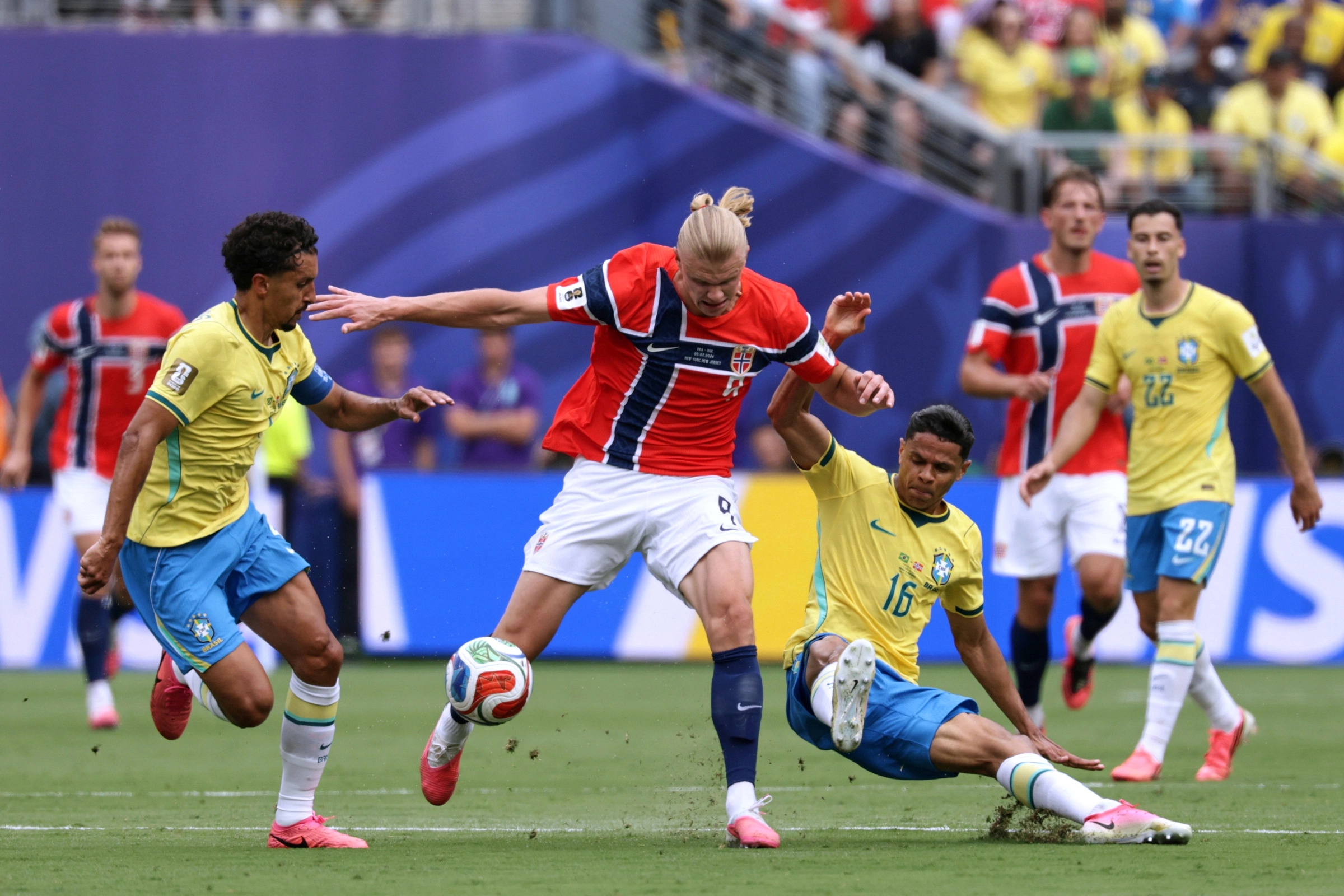 |
Norway striker Erling Haaland (9) competes with Brazil's Douglas Santos (16) during Norway's 2-1 victory over Brazil in the 2026 World Cup round of 16 at New York New Jersey in the United States on 5/7/2026. Photo: AP |
A common mistake made by many opponents is to focus solely on neutralizing Haaland. In reality, Norway creates opportunities for the striker through a diverse ball-progression system.
Contesting aerial balls with Sorloth
Everything begins with goalkeeper Orjan Nyland. In goal kicks, Norway prioritizes short passes. The two center-backs spread wide, the goalkeeper becomes a passing link, and the two defensive midfielders drop deep to receive the ball. This approach often gives Norway a numerical advantage in their own half. This is also a common strategy for most teams at the 2026 World Cup.
If opponents press high to block all short passing options, Nyland immediately switches to option B: a long ball to the right flank for Alexander Sorloth.
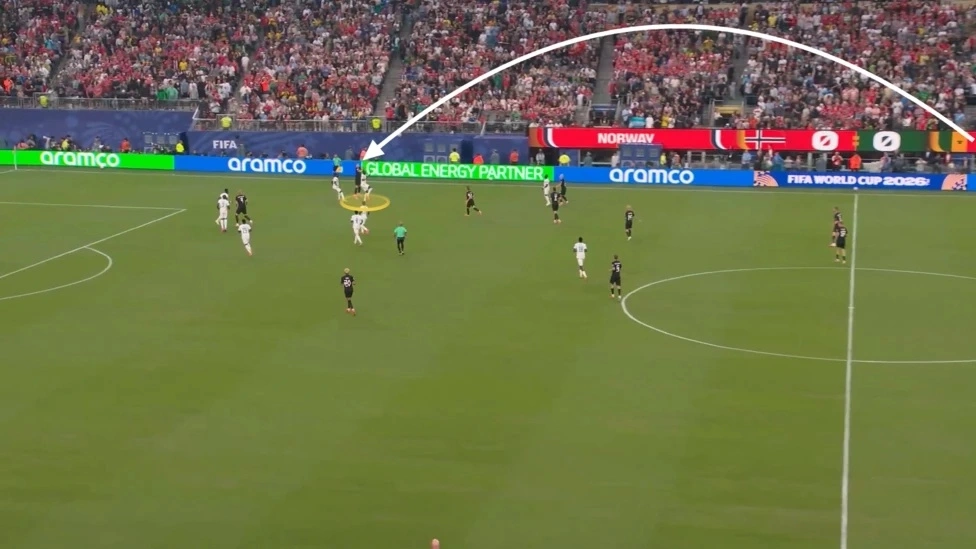 |
Nyland sends a long ball for Sorloth to head down during Norway's match against Senegal in the 2026 World Cup group stage at MetLife Stadium, United States on 22/6. Photo: screenshot |
The 1.96 m tall striker does not play as a central forward but often starts on the right as a "holding station". Nyland's diagonal passes have often helped Norway bypass the first pressing line with a single ball.
This requires left-back Nico O'Reilly to be ready for one-on-one aerial duels. Standing at 1.93 m, the Manchester City player is expected to have the physique to compete with Sorloth.
However, even if Sorloth is controlled, England's problems are not over. Norway's players have trained extensively to win second balls from Sorloth's contests.
Neutralizing goalkeeper Nyland
Regarding pressing, Thomas Tuchel has two options. The first method is a one-on-one press across the entire field.
This is the most direct way to negate Norway's numerical advantage in the backline. If Nyland is forced to play long, England would accept one-on-one duels with Sorloth. However, the drawback is that Haaland would have more space in the central area.
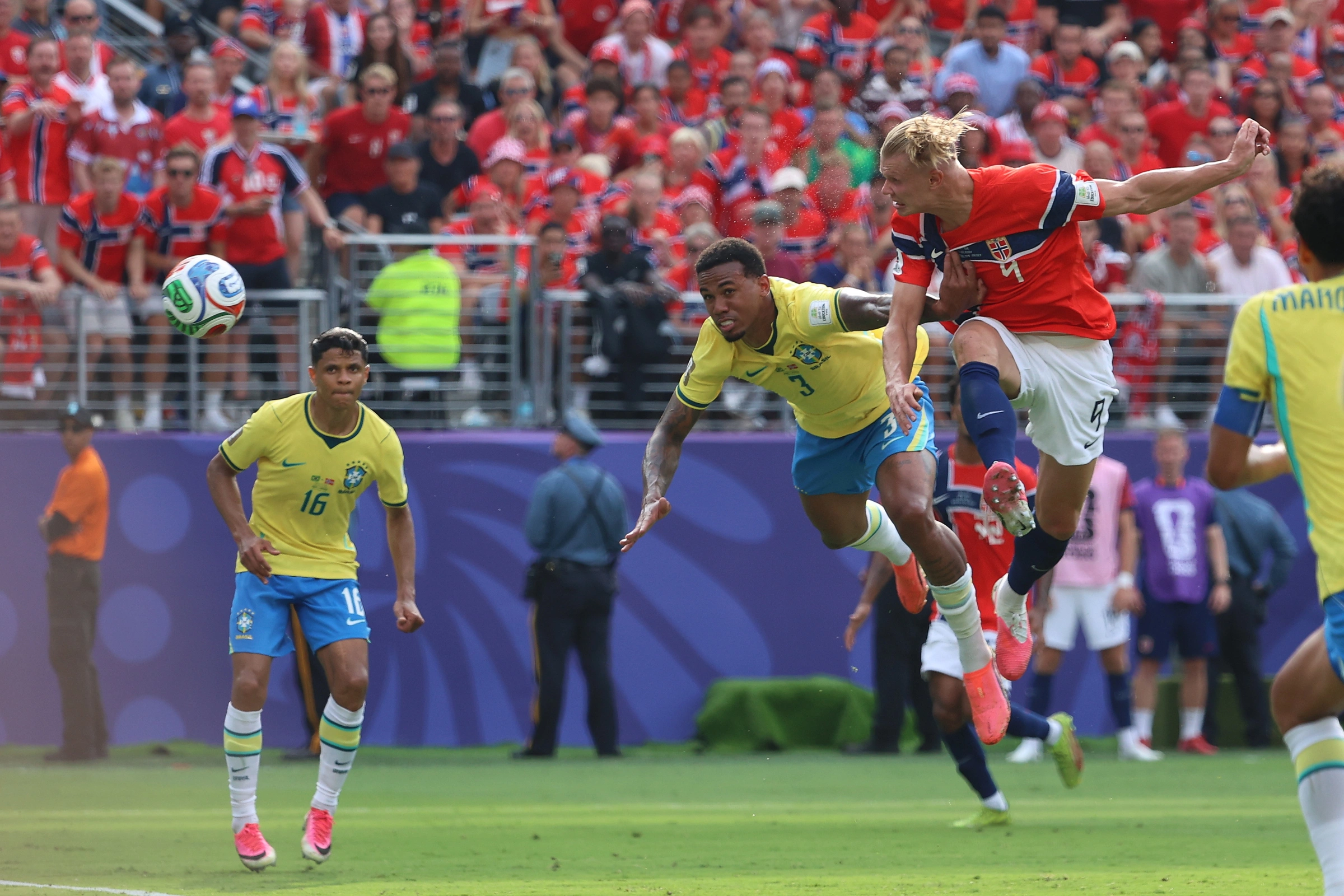 |
Erling Haaland (right) shoots to score Norway's opening goal, challenged by Gabriel Magalhaes, in Brazil's 1-2 loss in the 2026 World Cup round of 16 at New York/New Jersey Stadium, East Rutherford, New Jersey, United States on 5/7. Photo: AP |
When every player is man-marking, the Norway striker only needs to win one movement to face the defense in a one-on-one situation. This is something most coaches want to avoid.
Therefore, Tuchel will likely keep a defender covering at the back, meaning England will press with fewer players. This is when Norway gains an advantage, as they also have goalkeeper Nyland participating in ball circulation. If only Harry Kane and Jude Bellingham apply pressure, England would almost always be outnumbered.
One solution is to push Declan Rice higher, forming a pressing trio. This makes England's defensive structure riskier, but in return, they can force Norway to play as desired.
Brazil attempted to nullify Nyland's ball distribution in their loss to Norway. Instead of a comprehensive press, they actively closed off one side of the pitch, forcing Nyland to use his left foot and limiting short passing options.
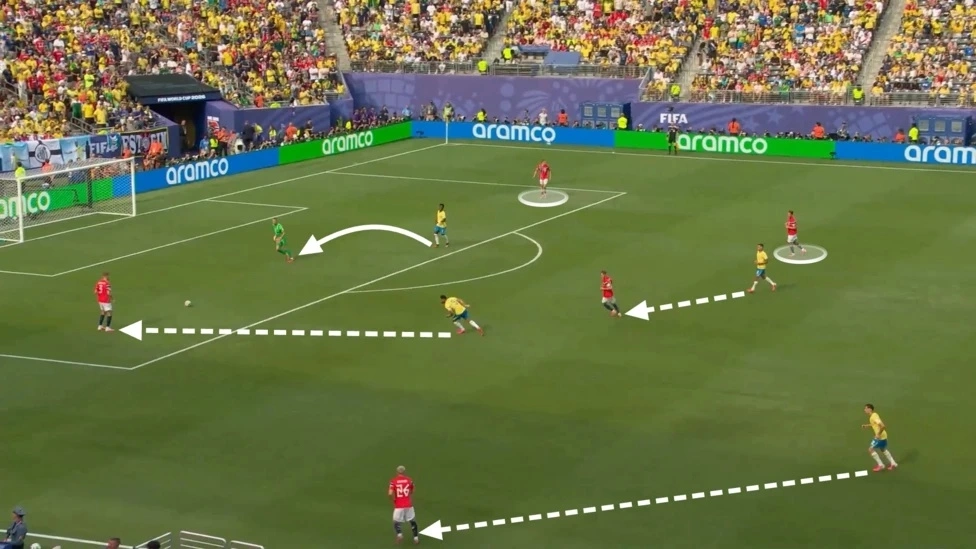 |
Brazil did not always press one-on-one across the entire field, but at times they were effective in closing down half of Norway's build-up space. This allowed Brazil to press with fewer players, applying one-on-one pressure on easily accessible players, while accepting that more difficult-to-reach players (circled in white) were not marked. Photo: screenshot |
Theoretically, this is a logical approach. When forced onto their weaker foot, goalkeepers often process slower or make inaccurate passes. The problem is that Nyland is still very good at playing long balls with his left foot. Many times, he still delivered accurate passes to Sorloth's position despite being pressured.
Therefore, England's goal is not necessarily to win the ball directly from Nyland, but to actively force Norway into a predictable long pass. When the ball is directed towards Sorloth, England's players will immediately converge on the landing spot to regain control. This is a more realistic option than trying to prevent Norway from building up play from the start.
Cutting off Haaland's supply
Neutralizing Haaland is always easier said than done. Pep Guardiola once described this after Manchester City's match against West Ham in the 2025-2026 season. He stated that Haaland is always surrounded by many midfielders and center-backs, making it difficult to stop him.
Reality proves this. Haaland's three most common ways of scoring are making runs to the far post to meet crosses, bursting into space to receive through balls from the left wing, and finishing from cut-backs when the defense is retreating.
Among these, crosses to the far post appear most frequently at the World Cup. Norway has built an entire system to create this type of opportunity. On the left wing, Antonio Nusa and Andreas Schjelderup constantly interchange positions.
Left-back David Moller Wolfe often makes inverted runs to receive passes into the half-space, rather than sticking to the touchline. These movements draw opposing midfielders backward, opening up space for players to sprint down the wing. This is followed by whipped crosses to the far post, where Haaland awaits.
The opening goal against Brazil is an example. Moller Wolfe drew defenders, Schjelderup found space to cross, and Haaland headed in to score.
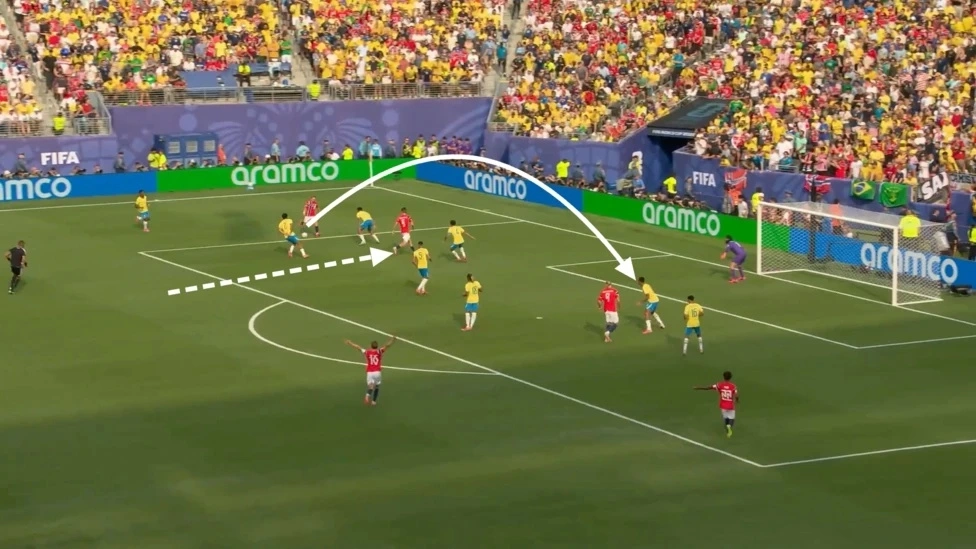 |
After the wing-back's inverted run, space opened up for Norway's wingers to cut inside onto their strong foot. It was from such a whipped cross that Haaland scored the opening goal against Brazil. Photo: screenshot |
If opposing defenders ignore Moller Wolfe to closely mark the winger, the Norway left-back will receive the ball in space and deliver a low cross. This is a problem with almost no perfect solution.
No one-on-one with Haaland
Marc Guehi will likely mark Haaland directly if he recovers in time. However, Guehi alone is not enough. Gabriel Magalhaes, considered the best center-back in the Premier League last season, also struggled against Haaland in a one-on-one situation.
Guehi himself failed when facing Haaland in 2024 while playing for Crystal Palace. From a cross to the far post, Haaland separated from Guehi and headed in to score.
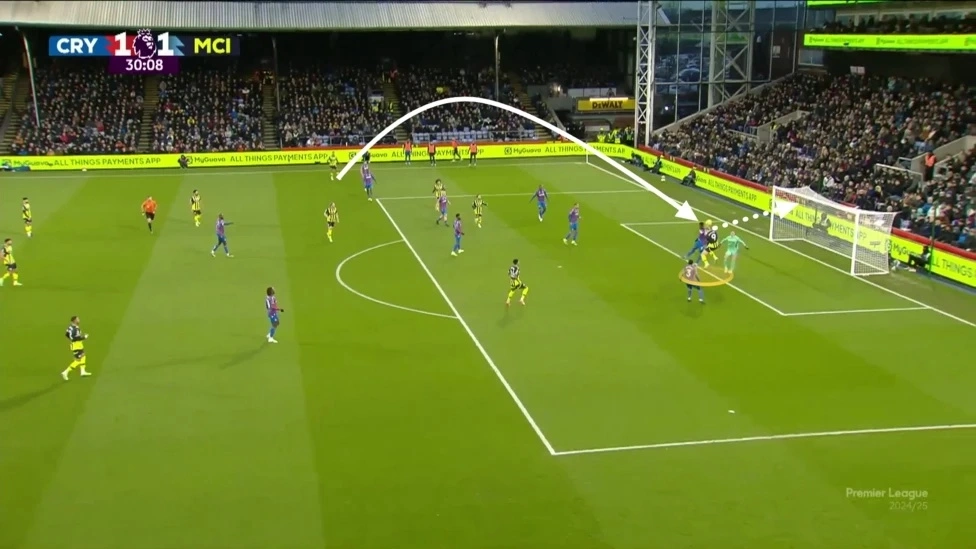 |
Haaland's goal against Crystal Palace in 2024 is a typical example of the kind of situation Norway will try to recreate against England and center-back Marc Guehi. Photo: screenshot |
Experience from West Ham shows that limiting Haaland requires more than one center-back. David Moyes' team often used three center-backs along with a defensive midfielder to press the Norway striker, giving him little space to maneuver.
This means Bellingham may have to drop deeper, forming a five-man midfield when England defends. The goal is not only to prevent Haaland from receiving the ball, but also to reduce the space for Norway's wide players to deliver their characteristic crosses.
Attack as a form of defense
To limit Haaland, England cannot focus solely on defending. Maintaining possession is also an effective strategy. By controlling the game, England will force Norway to drop deep, reducing the number of times Haaland can participate in counter-attacks.
Conversely, Norway also exposed weaknesses when their team pushed forward. Brazil did not score from open play, but every time they won the ball, they created dangerous counter-attacks. However, Endrick missed the best chance after a through ball from Vinicius.
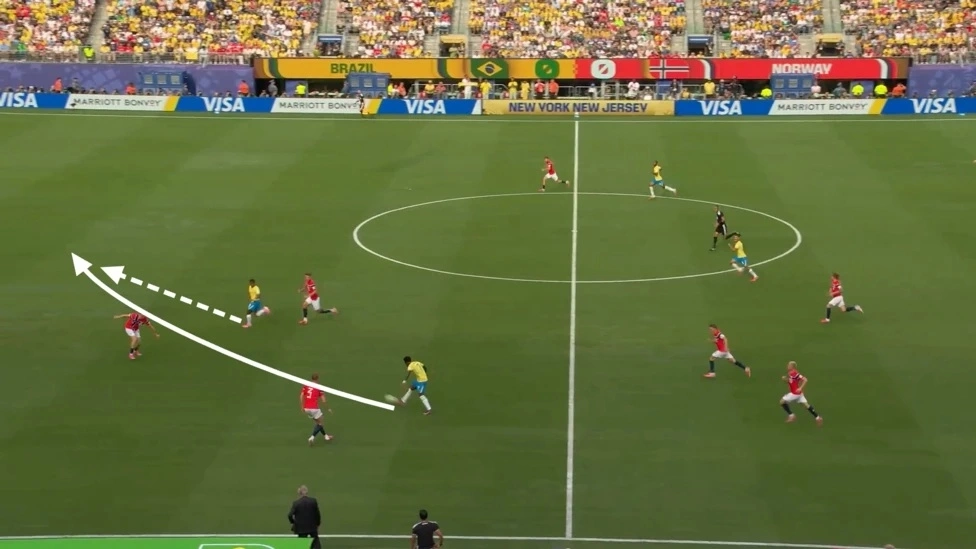 |
The situation where Vinicius played a through ball for Endrick to break free in the second half. At that moment, a large space opened up in the central and left-sided defense of Norway. However, Norway was fortunate to escape conceding as Endrick's first touch was poor before he shot wide of the post on the next touch. Photo: screenshot |
The space behind Norway's midfield is something Gordon, Bellingham, Rice, or Noni Madueke can exploit. Additionally, England's full-backs also have opportunities to create two-on-one situations on the flanks if they combine well with the wingers. This is how Cote d'Ivoire and Iraq previously caused Norway many problems.
Tuchel's challenge
England versus Norway is a clash between two tactical systems with many similarities, both relying heavily on wide combinations, overlapping runs, and crosses into the penalty area.
If they press too aggressively, England could leave Haaland facing the defense in open space. If they drop too deep, they will concede control to Martin Odegaard and allow Norway to build up play as they wish.
The most reasonable solution is likely balance. England needs to press selectively, actively forcing Nyland to make predictable long passes, while organizing group defense to isolate Haaland in the penalty area.
The most important thing is that England cannot view Haaland as an individual problem. To stop Norway's number one striker, they must first dismantle the entire system that serves him.
Xuan Binh (according to BBC)