Situated on Nguyen Hue Street in Kon Tum Ward, the wooden church, with its classic design, is an ancient architectural work integral to the religious and cultural life of the local community for over a century.
Upon entering the gate, visitors can see a painting depicting elephants pulling logs from the forest, illustrating the construction process.
"The walls and ceiling were built with earth and straw. The materials and construction techniques were suited to the terrain, blending Western architecture with the cultural identity of the Central Highlands", said Father A De, 67, who has overseen the church since 1982.
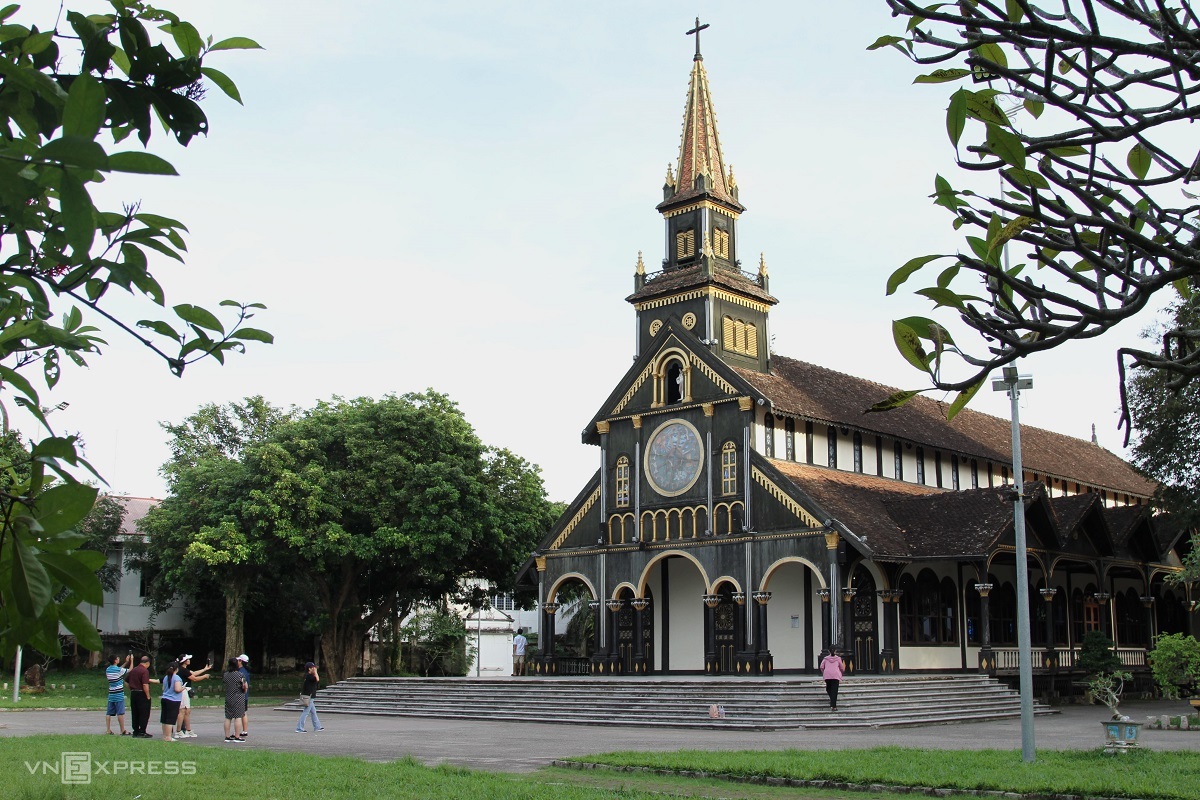 |
Visitors check in front of Kon Tum Wooden Church. Photo: Thao Vy |
Ca chit (red sen) wood was chosen as the main material due to its abundance in Kon Tum's old-growth forests and its high durability. Artisans applied mortise-and-tenon joint techniques, using chisels to remove excess wood, creating convex and concave sections that fit tightly together, ensuring the church's structural integrity.
According to the church's historical records, during those years, many local people and skilled carpenters from Central regions like Quang Ngai, Quang Nam, and Binh Dinh collaborated on its construction. The building became a major village event for many years, with people carrying wood, erecting columns, laying roofs, and carving from morning until night.
This collective effort elevated the church beyond a mere architectural work, transforming it into a symbol of the local community's unity and dedication.
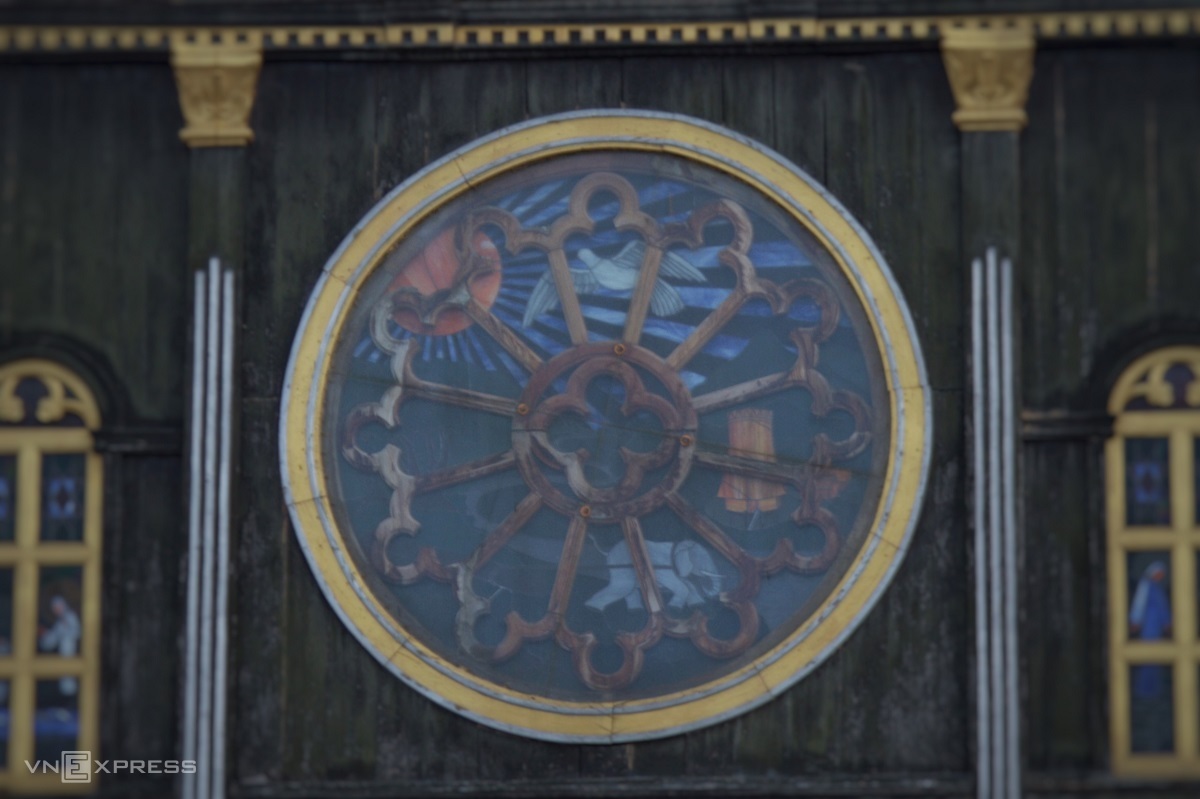 |
The image of elephants pulling wood is re-enacted on the main facade's window frame. Photo: Thao Vy |
The structure was built after two temporary bamboo and nipa churches had burned down. It was inaugurated between 1913-1918, named Toring Parish Church. With consultation from Father Kemlin and architect/priest in charge Joseph Decrouille De, the church took shape in a localized Roman style.
The entire campus spans approximately 1,200 square meters. The main facade features a 24-meter-tall tower, divided into 4 stories, corresponding to 4 roofs. The main body of the church and the sanctuary were constructed first. The roof uses bamboo rafters and scale tiles instead of thatch. The windows and ceiling are arched, and large 12-meter-tall columns inside and outside the nave reflect the Roman style.
Surrounding the church is a system of window frames depicting segments of the Bible and the cultural life of the people of Kon Tum village. The tall, narrow windows, with their pointed tops, allow natural light and create a sense of lightness for the entire structure.
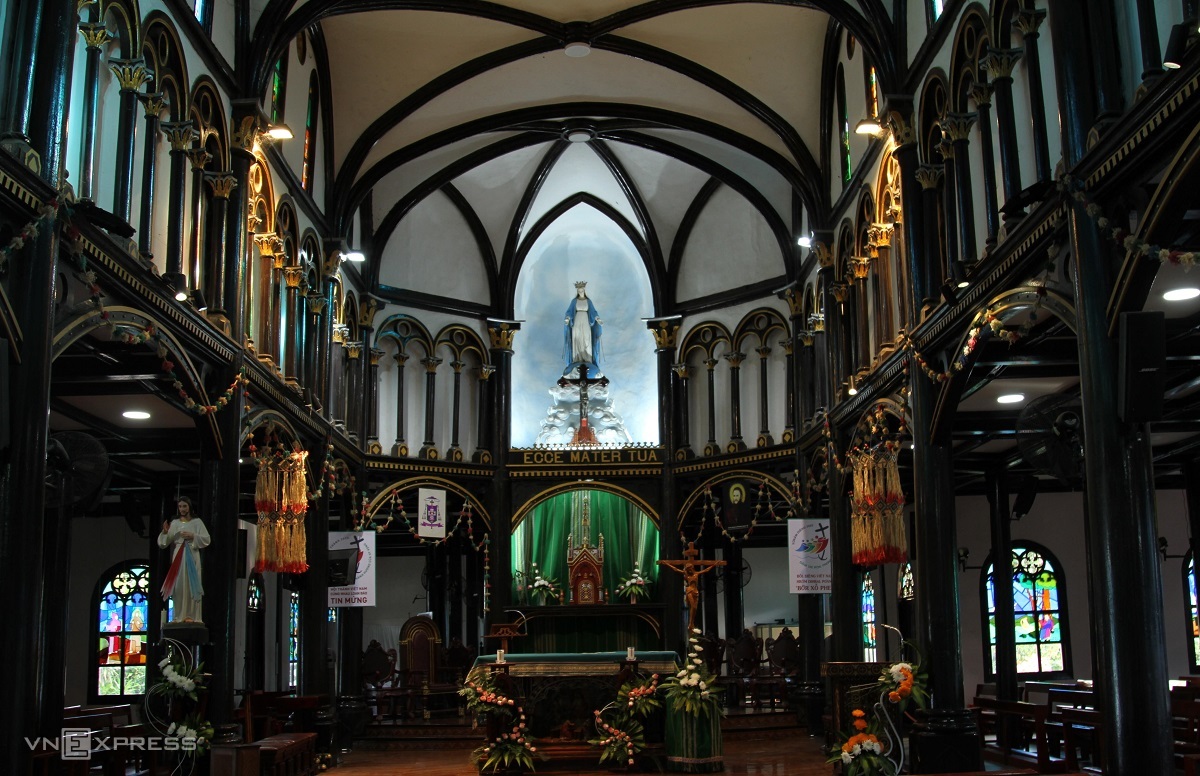 |
The spacious sanctuary, decorated with meticulously carved wood, is where the priest presides over mass and parishioners pray. Photo: Thao Vy |
Many renowned Roman-style heritage sites worldwide, such as the Roman Colosseum, the Papal Basilica of Saint Peter in the Vatican, or Baalbek Temple (Lebanon), were primarily built with stone, brick, and plaster, enduring for thousands of years. Kon Tum Wooden Church, however, is the only Roman-style wooden structure in Vietnam that remains standing.
Over 112 years, Kon Tum Wooden Church has become a cultural and tourism icon, attracting many domestic and international visitors. The structure impresses many tourists who come to visit.
"The ancient style, the vivid paintings, and the unique architecture make me feel like I am immersed in an ancient setting", said Le Thi Diem, 23 years old, a tourist from Dak Lak.
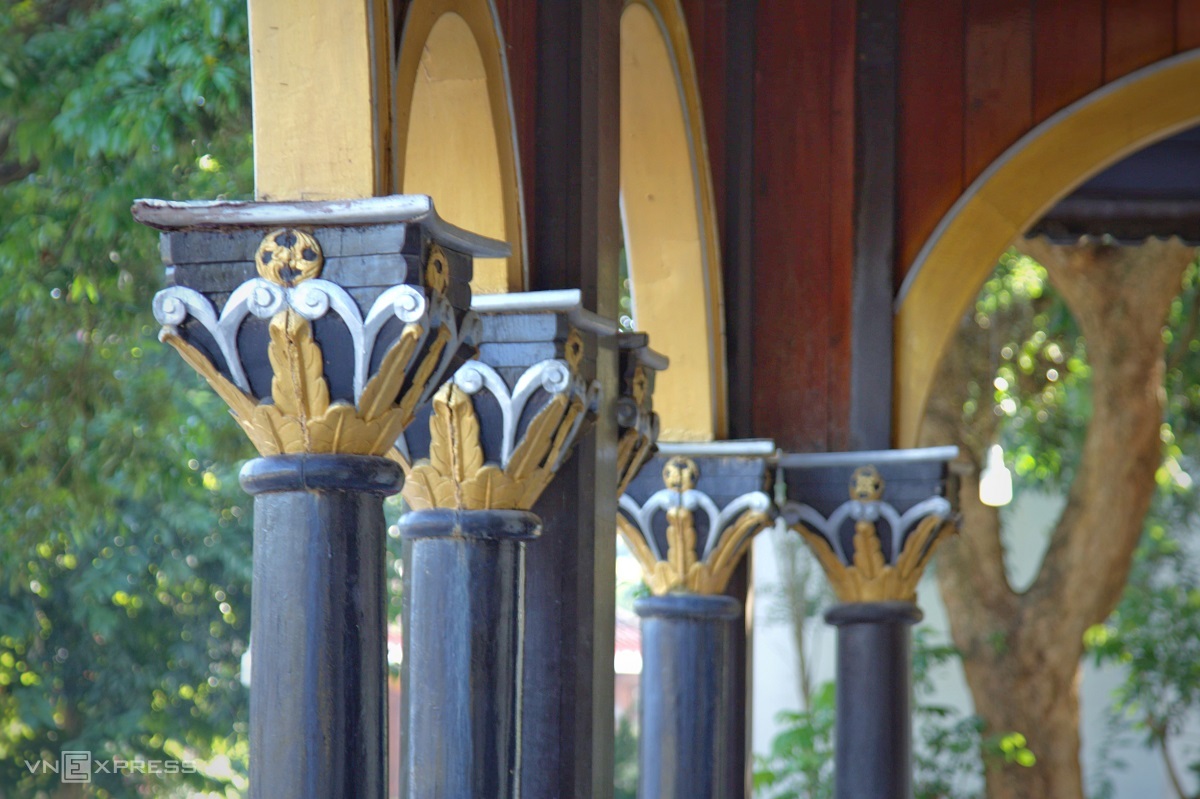 |
The details were meticulously hand-carved by carpenters, remaining sharp for over 100 years. Photo: Thao Vy |
Beyond exploring and taking photos at Kon Tum Wooden Church, visitors can also stop at the souvenir shop or enjoy coffee at the cafe within the premises.
Thao Vy