Representatives of the Cambodia-Thailand Joint Border Committee (GBC) signed a joint statement reaffirming their commitment to fully implement the ceasefire. Lieutenant General Maly Socheata, spokesperson for Cambodia's Ministry of National Defense, stated that the signing took place at 10:20 am today at the Prom - Pak Kard border checkpoint, concluding their meeting.
Cambodian Defense Minister Tea Seiha and his Thai counterpart Nattaphon Narkphanit co-chaired the meeting, with ASEAN observers overseeing the proceedings.
Both sides agreed to implement the ceasefire starting at 12:00 pm today, aiming to foster peace, stability, and security for residents living along the border. Forces from both nations committed not to engage in unprovoked firing, advance, or deploy forces close to the other side's positions, according to Fresh News.
Thailand has yet to issue a statement regarding this ceasefire agreement. Thai Prime Minister Anutin Charnvirakul stated on 26/12 that Bangkok accepted a 72-hour ceasefire but rejected Phnom Penh's proposal to resume border negotiations based on positions held before hostilities erupted on 7/12.
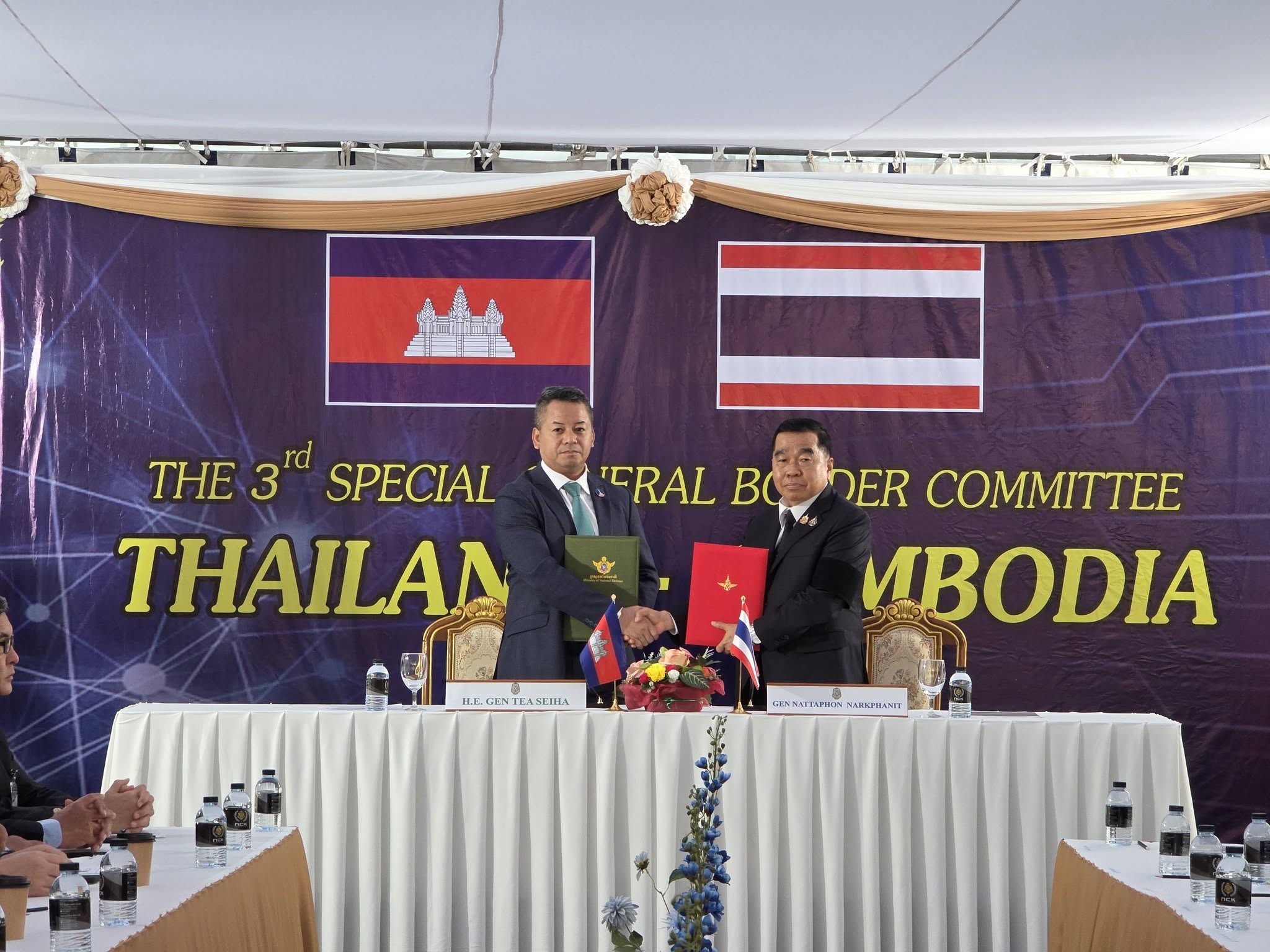 |
Cambodian Defense Minister Tea Seiha (left) and Thai Defense Minister Nattaphon Narkphanit exchange documents at the signing ceremony for the joint statement on 27/12. Photo: Cambodian Ministry of National Defense
Anutin emphasized that Thailand had "established sovereignty in areas we believe belong to Thailand" and affirmed that Bangkok "cannot withdraw" from these positions.
The Thai Prime Minister asserted that future negotiations must proceed based on current realities, not from a stance that disadvantages Thailand. "This is not a business negotiation. This is a matter of national sovereignty," he stressed, adding that the military had achieved all objectives related to protecting territorial integrity.
Thailand's National Security Council authorized Defense Minister Nattaphon to finalize the joint statement based on four principles outlined in the Kuala Lumpur Declaration of 26/10. These principles include: withdrawing heavy weapons from the border, implementing mine clearance, coordinating efforts against scam networks, and resolving issues at several border hotspots.
The Thai Prime Minister expressed hope that the final agreement would help restore stability, allow residents to return home, and prevent the risk of escalating tensions. However, he cautioned that Bangkok remains ready to respond if threatened.
Thanh Danh (According to Khmer Times, Bangkok Post)