Kaja Kallas, the High Representative of the European Union (EU) for Foreign Affairs and Security Policy, stated on 9/1 that Russia's launch of the Oreshnik hypersonic ballistic missile into Ukraine constituted a "clear escalation" and a warning to the West. She criticized Russia for not wanting peace, asserting that Moscow was responding to diplomatic efforts with "missiles and destruction".
"EU countries must delve deeper into air defense arsenals and transfer them immediately. We also need to continue making this war more costly for Russia, including through tougher sanctions," Kallas wrote on social media.
In response, Kirill Dmitriev, a special envoy of Russian President Vladimir Putin, criticized Kallas for her "lack of understanding". He stated, "Kaja seems to lack basic knowledge, but even so, she should understand that no defense system can counter the Oreshnik hypersonic missile, which travels at ten times the speed of sound."
 |
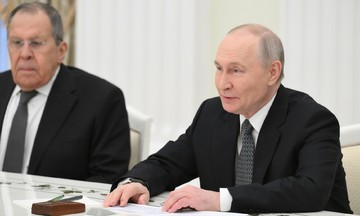
Kirill Dmitriev, special envoy, at the Kremlin in Moscow, Russia in 4/2025. Photo: AFP
The Russian Defense Ministry announced on 9/1 that it had conducted a coordinated strike against Ukraine, utilizing the Oreshnik hypersonic ballistic missile. This was described as retaliation for Kyiv's alleged "drone attack on President Putin's residence", an accusation that both Ukraine and the United States have denied.
Ukrainian officials reported that the missile, launched from the Kapustin Yar training ground in Russia's Astrakhan province, reached speeds of approximately 13,000 km/h, nearly eleven times the speed of sound. Maksym Kozytsky, governor of Lviv province, confirmed that Russia struck critical infrastructure in his province, though he did not provide further details.
Dmitry Medvedev, Deputy Chairman of the Russian Security Council, declared on the same day that the launch exemplified "how to deal with dangerous madmen". He noted that the global situation had become chaotic since the beginning of the year, seemingly referring to the U.S. arrest of Venezuela's president, adding that Moscow needed to act accordingly "because there are too many madmen around".
The targeted area in Lviv is located approximately 60 km from the border with Poland, a NATO member state. Ukrainian Foreign Minister Andriy Sybiha stated that such a strike near the NATO and EU border posed a "serious security threat".
Moment the Oreshnik missile struck Lviv province in Ukraine on the night of 8/1. Video: X/AMK Mapping
This incident occurred days after several European nations agreed to deploy forces to Ukraine following Kyiv's ceasefire agreement with Moscow. The Kremlin has repeatedly opposed this idea, warning that foreign soldiers stationed in Ukraine would be "legitimate targets for the Russian military".
Western experts assess that the Oreshnik strike appeared to be a symbolic act intended to deter Ukraine and its allies, rather than targeting purely high-value objectives.
President Putin previously asserted that no Western air defense system could intercept the Oreshnik missile. General Oleksandr Syrsky, Commander of the Ukrainian Armed Forces, stated in 1/2025 that few missile defense shields worldwide currently have the capability to counter Oreshnik, acknowledging that Ukraine does not possess such weapons.
Pham Giang (According to Reuters, TASS)