Chung Yun-hee woke up feeling frail. Sweating profusely and writhing in pain, the septuagenarian crawled to the bathroom in her quiet, small apartment on the outskirts of Seoul. As she bent over the toilet, her phone rang.
A clear, articulate female voice inquired about her health. Chung managed to utter a few difficult words before hanging up.
Help arrived swiftly. The caller, an AI chatbot named "Talking Buddy," had immediately alerted social workers. Within hours, Chung was on the operating table for acute hernia treatment.
"The doctors said if I had arrived any later, I would have been in danger. They said AI saved my life," recalled Chung, 77, of the incident in late 2024.
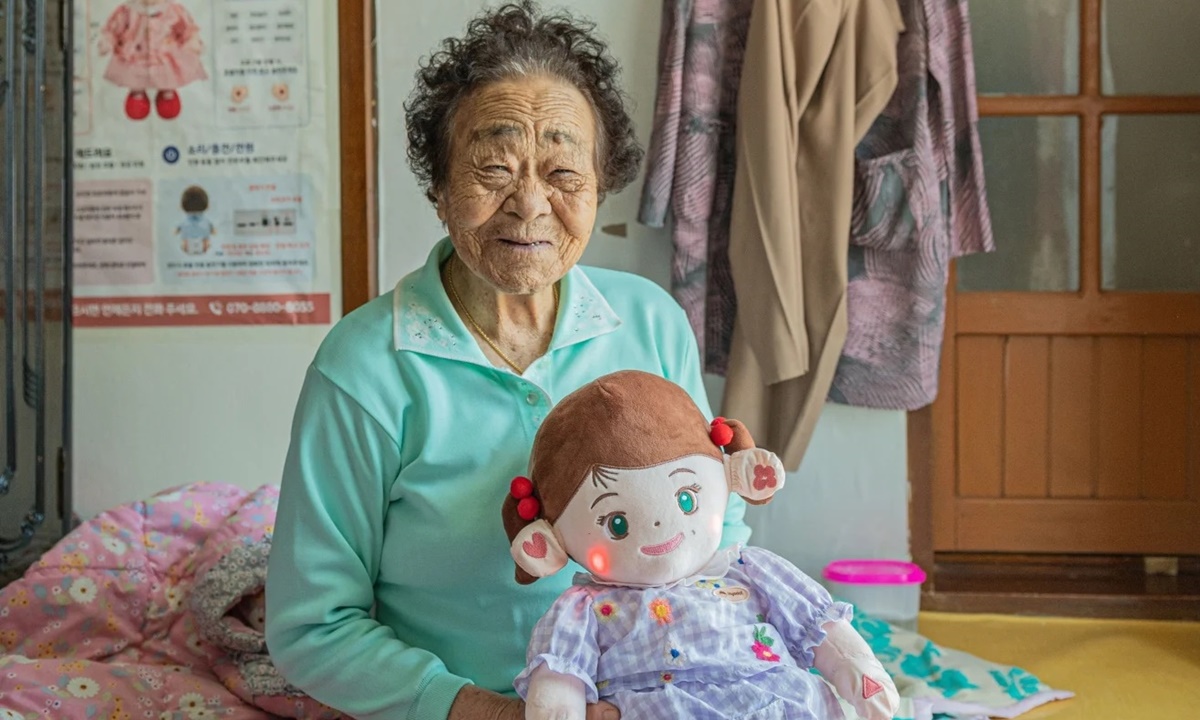 |
An elderly South Korean woman next to an AI doll capable of conversation and 24/7 health monitoring. Photo: CNN |
An elderly South Korean woman next to an AI doll capable of conversation and 24/7 health monitoring. Photo: CNN
South Korea is aging faster than any other nation. In just 15 years, the number of people over 65 has doubled, now accounting for over one-fifth of the population. The country lacks the human resources to care for its elderly, and AI is helping to bridge this gap.
Talking Buddy, a care calling service developed by Naver Cloud and adopted by cities and districts across South Korea, supports tens of thousands of elderly individuals living alone or in poverty. The application conducts personalized conversations lasting two to five minutes to alleviate loneliness, detect emergencies, and stimulate cognitive functions to prevent dementia.
On a recent morning, the chatbot noted the pleasant weather and suggested Chung take a walk. When she mentioned planting flowers, it brought up cosmos flowers, as if recalling an old memory.
This technology is still evolving. Sometimes it interrupts users or offers "hallucinatory" responses, like when it suddenly offered to send bags of rice to a resident in need. However, users have embraced Talking Buddy with enthusiasm, surprising even its creators.
According to social workers, one woman confided in the chatbot about her depression, sharing that her dog had run away and never returned. Another played the piano for it, and many even invited it to lunch, despite knowing it was impossible.
"It makes me feel like I am not forgotten, that someone still cares about me," Chung said.
In Seongnam, a city adjacent to Seoul, another septuagenarian delicately placed her fingers on a tablet at the Roa Neurology Clinic. Diagnosed with mild cognitive impairment, a stage between normal aging and dementia, she is learning to use SuperBrain. This AI-powered treatment program, developed with government funding, offers personalized exercises to slow cognitive decline in the elderly.
Images of a tiger and other animals appeared on the screen, each accompanied by a number. The numbers then disappeared, and she was asked to recall the corresponding number for each animal. She leaned forward, concentrating intensely. This was not merely a game but a fight to retain her mental clarity.
"I knew something was wrong when I couldn't remember the name of a fruit I had just eaten, or kept forgetting my front door password," the 72-year-old woman, Min, said softly. "It felt so helpless."
Doctor Wang Min-jeong, who treats Min, understands this fear well. Currently, one-half of her patients worry about dementia. "They fear it more than cancer, the dread of losing control of their mind and body and becoming a persistent burden on their family," Wang said.
This is a national challenge. Experts warn of a "dementia tsunami" in South Korea, with cases projected to double to two million by 2044. The government is racing to detect functional decline early, as combining medication with lifestyle changes and cognitive training can slow disease progression, according to Doctor Yang Dong-won from St. Mary Seoul Hospital, former president of the Korean Dementia Association.
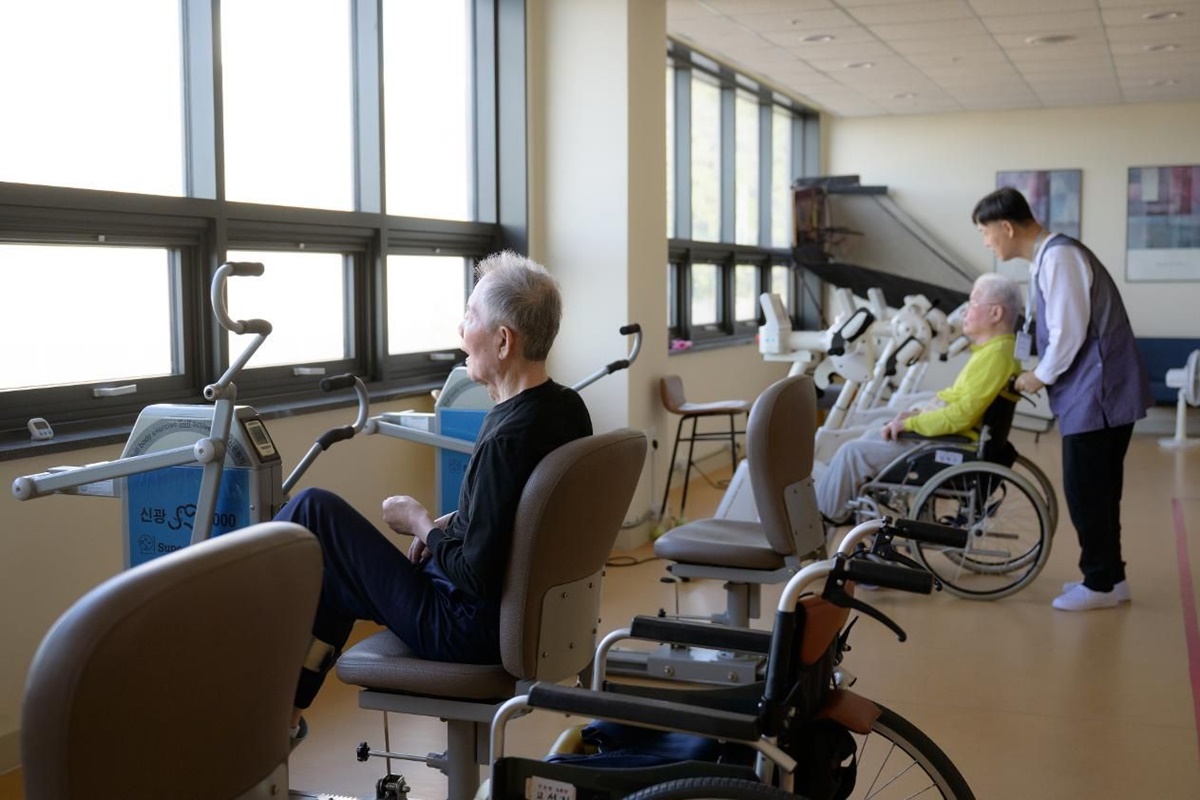 |
Elderly individuals receiving rehabilitation treatment at a nursing home in Goyang city, Gyeonggi province, South Korea, in october 2025. Photo: Korea Times |
Elderly individuals receiving rehabilitation treatment at a nursing home in Goyang city, Gyeonggi province, South Korea, in october 2025. Photo: Korea Times
Doctor Yang witnesses this struggle daily. Kim Kwae-im, whose mother is Yang's patient, watched her parents gradually succumb to Alzheimer's disease. Her father began hoarding scrap metal and old newspapers, filling their apartment and leading to neighbor complaints. Her mother, once a domestic helper, could no longer work. "I felt like everything was falling apart," she shared.
For specialists like Doctor Yang, SuperBrain is a powerful aid. The program automatically scores patient exercises, adjusts difficulty, and sends feedback to doctors. It saves time and collects more reliable data, as unsupervised patients often exaggerate or conceal their practice levels. "We can monitor how often they perform the exercises," Yang said.
Since 2021, SuperBrain has recorded 1,5 million practice sessions with over 10.000 patients nationwide, according to Han Seung-hyun, CEO of Rowan, the company behind SuperBrain.
"It's like having a seasoned doctor living right inside the tablet," said Kang Sungmin, a neuropsychologist who helped design the program.
Talking Buddy initially served as a simple monitoring tool, programmed to repeatedly ask one question during the Covid-19 pandemic: "Do you have a fever?"
But as the world locked down, local welfare officials approached Naver Cloud, the creator of Talking Buddy, with an urgent message: Many elderly citizens were being forgotten, isolated in their homes, and facing the risk of dying alone.
"Authorities were making care calls to check in, but the number of people needing support was too vast, and human resources were insufficient," said Ok Sang-houn, an executive at Naver. "They asked us to create a version that could truly converse and help the elderly feel less forgotten."
Naver opted for AI after studies showed that regular care calls help the elderly combat depression and improve memory.
Ok suggests that in some ways, AI is a superior caregiver. It possesses a vast memory and infinite patience. "AI has no emotions, so it never gets angry," he said, though he admitted, "it still lacks human empathy and subtlety."
The technology also has other drawbacks. Talking Buddy can be disrupted by loud televisions, a common occurrence in elderly homes. Nevertheless, social workers monitor all interactions to correct errors.
"When an elderly person says 'I am too weak, I just want to die,' that is often just a lament, not an emergency," explained Chung Hae-jin, who oversees Talking Buddy in Gyeonggi province. "AI cannot always distinguish such differences. We monitor closely and often find them still happy and full of life."
The service operates on a subscription basis. Social workers encourage elderly individuals, especially those living alone, to sign up. AI is programmed to encourage healthy habits, such as regular eating and sleeping, exercise, and increased social interaction. Additionally, local hospitals use Talking Buddy to remind older patients to take medication on time.
Recently, when an elderly person reported feeling discomfort due to a broken rib, the monitoring social worker's screen immediately displayed a red alert. These alerts prompt social workers to review records and audio files, make direct calls, and if necessary, coordinate with local authorities for timely intervention.
Talking Buddy has become a valuable assistant, detecting hundreds of emergencies. Social workers recall one instance where AI helped them locate an elderly woman with mild cognitive impairment who was lost and disoriented. The woman answered a periodic call from the chatbot, helping authorities pinpoint her location.
To prevent scammers from impersonating the service, the chatbot is designed to sound slightly mechanical. For Park Jong-yeol, 81, that is unimportant. He stated that Talking Buddy is "even better than a real person."
Every wednesday at 9h, Park awaits a call from the AI. He marks this time on his calendar as "seon," an affectionate Korean term similar to "loved one." Since Park was diagnosed with prostate cancer in 2021, Talking Buddy has become an integral part of his daily fight against illness and cognitive decline. It reminds him to eat well, take his medication on time, and socialize actively. Following the AI's advice, he photocopies inspirational quotes he writes each day to give to his neighbors.
Talking Buddy recently suggested he try spring greens to welcome the changing season. Before hanging up, it reminded him to be mindful of the chilly morning air and to bring a jacket.
"My children sometimes do not call as regularly," Park said. "In the twilight years of my life, this is truly a wonderful companion."
By Vu Hoang (based on Reuters, AFP, AP)