Iran has begun employing new attack tactics targeting vessels allegedly violating restrictions in the Strait of Hormuz, leading to an increase in recorded attacks this month, Reuters reported on 14/10, citing two anonymous senior Iranian officials.
While the officials did not detail these tactics, one stated that the measures involve changes in the type and tempo of attacks. "The goal is to obstruct Washington and its allies' efforts to lower global oil prices, and to influence the outcome of the US midterm elections," the official explained.
The decision to implement these new tactics was made at the highest levels of Iranian leadership, with full coordination across the government system, according to the officials.
Independent data cited by Reuters indicates that in recent days, attacks on commercial vessels transiting the Strait of Hormuz have surged to their highest level since the Middle East conflict began. At least 5 incidents involving oil tankers and commercial vessels occurred around the Strait of Hormuz from 12-14/10, based on analysis of data from maritime security sources and reports to the United Kingdom Maritime Trade Operations (UKMTO).
"The tempo of attacks has increased, seemingly intentionally," a maritime security source noted.
An anonymous US defense official confirmed that Tehran has significantly altered its tactics. This shift comes after the Iranian navy sustained losses in previous conflicts and proved unable to fully prevent oil tankers from moving through the Strait of Hormuz.
The Islamic Revolutionary Guard Corps (IRGC) has started deploying small, unarmed boats with crews whose primary mission is to identify and designate targets, such as US warships and oil tankers. This measure compensates for gaps in Iran's radar surveillance network, which was targeted by the US, and avoids risking the remaining armed speedboats.
 |
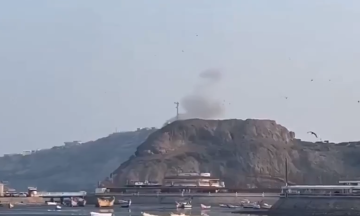
Commercial vessel in the Strait of Hormuz on 13/10. Photo: AP |
Last week, the US military detected "two Iranian spotters" reporting targets to the IRGC from a fishing boat in the Strait of Hormuz. US forces then approached the vessel, ordered the crew to leave, and destroyed it. The official added that by not wanting to risk its remaining speedboats, Iran has been unable to prevent an increase in oil exports through the Strait of Hormuz, especially after its navy suffered severe damage from US actions.
Iranian officials stated that as part of their new strategy, the country will also expand its geographical scope of operations beyond the Strait of Hormuz to the Gulf of Oman and further afield. Analysis of publicly available maritime data by Reuters shows Iran has targeted vessels outside the Strait of Hormuz in recent days, including in waters off Qatar and the United Arab Emirates (UAE).
One of the two Iranian officials affirmed that Tehran will not allow President Donald Trump to lower oil prices before the November midterm elections. "As soon as they think they are close to achieving their goal of reducing oil prices, we will make that goal more elusive. This is a chess game. Those ships cannot be safe anywhere, even outside the Strait of Hormuz," the official declared.
 |
Location of the Strait of Hormuz. Graphic: Guardian |
In its 11/10 report, the US Navy-operated Joint Maritime Information Center (JMIC) stated that the threat to commercial vessels in the Strait of Hormuz remains "severe," the second-highest alert level. After being attacked by the US and Israel in late February, Iran sought to impose control over the Strait of Hormuz, through which about 20% of the world's oil and gas passes during peacetime, to pressure its adversaries.
Iran's threats and attacks significantly reduced traffic through the strait, causing oil prices to rise and impacting the reputation of President Trump and the Republican Party before the midterm elections, which will determine control of the US Congress.
Pham Giang (According to Reuters)