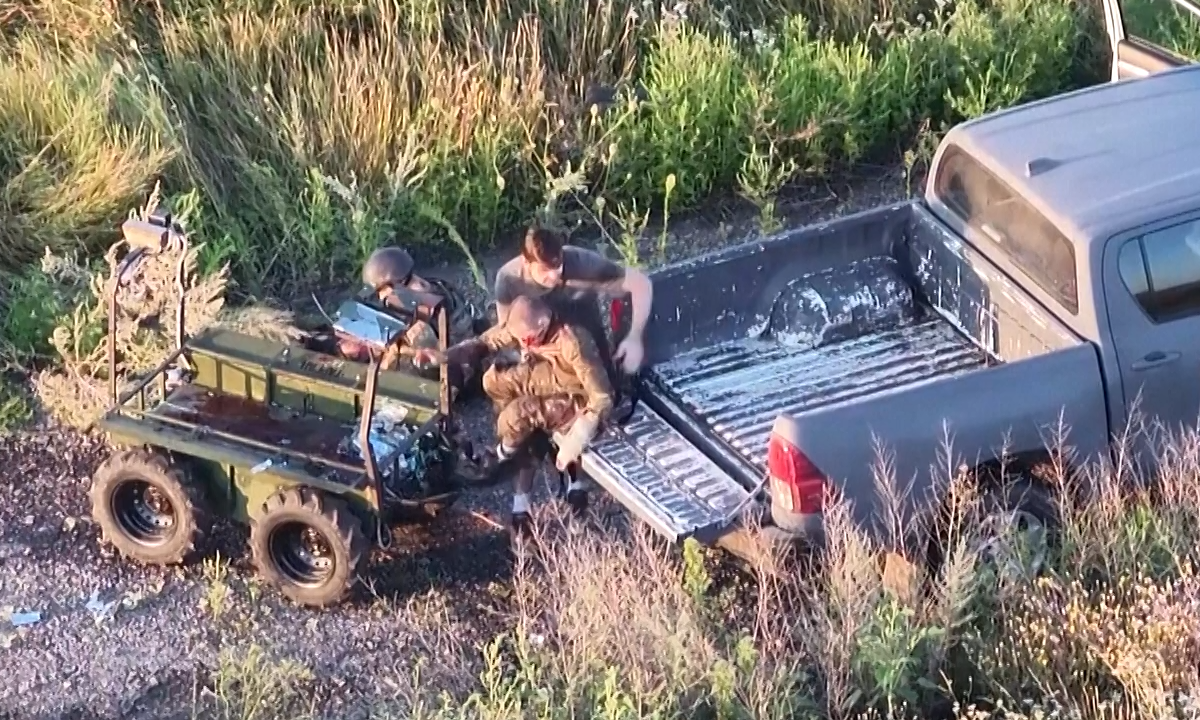
First-person view (FPV) drones move freely across southern Lebanon and northern Israel, hunting targets. Once a suitable target is found, such as an advanced Merkava Mark 4 tank, an Iron Dome air defense system, or a group of Israeli soldiers, the drone dives for a fatal strike.
Fiber-optic FPV drones have become a primary weapon for Hezbollah in its recent conflict with Israel.
A Hezbollah drone attacked an "assembly point" of Israeli soldiers and a Merkava tank in southern Lebanon in late May. *Video: Hezbollah*
At least 12 Israeli service members have died in Hezbollah FPV drone attacks since hostilities resumed in March, accounting for one-third of Israel's casualties in Lebanon. Numerous advanced Israeli assets, including the Merkava Mark 4 main battle tank and the Iron Dome air defense system, have also been hit by drones.
Unlike previous devices Hezbollah used against Israel, fiber-optic FPV drones emit no radio signals, making them difficult to detect. They maintain a high-speed connection with their operator and cannot be jammed by electronic warfare measures.
FPV drones are also small, have a low radar cross-section, and are highly maneuverable, allowing them to strike targets from unexpected directions.
This has prompted the Israel Defense Forces (IDF) to race for countermeasures against these dangerous weapons. "The drone threat is a challenge, but we will overcome it. Technical and operational solutions are under development," said Israeli military commander Eyal Zamir last month.
The race to counter Hezbollah's drones
The IDF's initial step involves deploying hundreds of thousands of square meters of netting to protect soldiers in southern Lebanon and bases in northern Israel. This protective netting aims to entangle drones before they reach their targets. In some instances, it causes drones to detonate far enough away to prevent casualties among vehicle occupants.
The IDF has also equipped soldiers with shotguns and fragmentation rounds to shoot down drones at close range. However, for this measure to be effective, soldiers must be aware of an incoming drone.
The IDF has not disclosed how it plans to improve detection and tracking of fiber-optic drones, nor if it has achieved this. Nevertheless, the force has called upon private technology and defense companies to develop and deploy countermeasures against suicide drones.
 |
The operating principle of a fiber-optic drone. *Graphic: BBC*
Many Israeli businesses have met with IDF officials to address this issue. Some companies are developing non-radio wave sensors capable of detecting fiber-optic drones, while others are pursuing measures to intercept and neutralize drones before they reach their targets.
Tel Aviv-based company Airwayz states it has developed software capable of managing low-altitude airspace and identifying potential threats. The company's technology was deployed by the Miami Police Department in the US to help protect a stadium from drone threats during the 2026 World Cup.
Observers suggest that a combination of sensors, including optical, acoustic, radar, and laser systems, is needed to detect approaching fiber-optic drones.
Airwayz states its system can integrate data from various sensors to quickly identify friendly or hostile drones.
"In most cases, soldiers only hear the drone approaching and have about 3-4 seconds to react. If they received a warning 20-30 seconds in advance, the outcome would be entirely different," said Shai Kurianski, co-founder of Airwayz.
Kurianski admitted that Israeli soldiers currently have almost no self-defense capability against Hezbollah's fiber-optic drones, necessitating urgent action from the country's high-tech industry. "Service members fighting in Lebanon are suffering from explosive-laden drones, and we will not stand by," he stated.
Israel's military unpreparedness
Many Israelis are frustrated that the IDF was not adequately prepared for a serious threat it should have anticipated.
Fiber-optic drones appeared in the Ukraine conflict two years ago. Ukrainian officials had warned Israel about this weapon and offered assistance to Tel Aviv in preparing countermeasures should it be deployed in the Middle East conflict.
 |
Israeli soldiers sit in a Humvee in southern Lebanon on 18/6. *Photo: Times of Israel*
"We did not see much interest from Israeli leadership on this issue. I do not want to speculate on the reasons. I often see frustration that Israel missed an opportunity to save more soldiers' lives," said Yevgen Korniychuk, Ukraine's ambassador to Israel, in May.
Many current and former IDF officials admit that the country was not fully prepared to counter the drones.
Reserve General Yaron Rosen, former commander of the IDF's cyber warfare division, noted that the Israeli military was "completely overwhelmed" by threats across multiple fronts.
"Everyone was saying 'hey, that's coming,' but nobody really knew. We were also preoccupied with other issues, especially Iran," said Rosen, now executive chairman of Airwayz, referring to the drone threat.
He emphasized that the IDF is "doing everything possible" to close gaps in its defensive capabilities and hopes Hezbollah's drones will significantly decrease in effectiveness "in the coming months."
Pham Giang (According to CNN, Times of Israel, Ynet)