China Central Television (CCTV) reported today that the landslide-dammed lake, formed after a recent landslide, began overflowing towards the Gyirong border crossing. This area is where rescue teams are attempting to gain access.
"All rescue teams have been ordered to temporarily hold their positions and await further instructions," CCTV stated, adding that emergency responders who had previously accessed the area "were ordered to retreat 1 km."
The lake's water level was initially expected to continue rising for three days due to ongoing rain, peaking around 1/9. This raised the "risk of the dam breaching, causing floodwaters to surge downstream and potentially inflicting further damage in areas like the Gyirong border crossing and other downstream locations," Xinhua reported on the evening of 27/8.
However, CCTV later indicated that the risk from the landslide-dammed lake was "gradually decreasing" as water was "flowing out naturally, with the outflow exceeding the inflow." The station reported that "the lake's water level had dropped about 10 m compared to its peak on the early morning of 27/8."
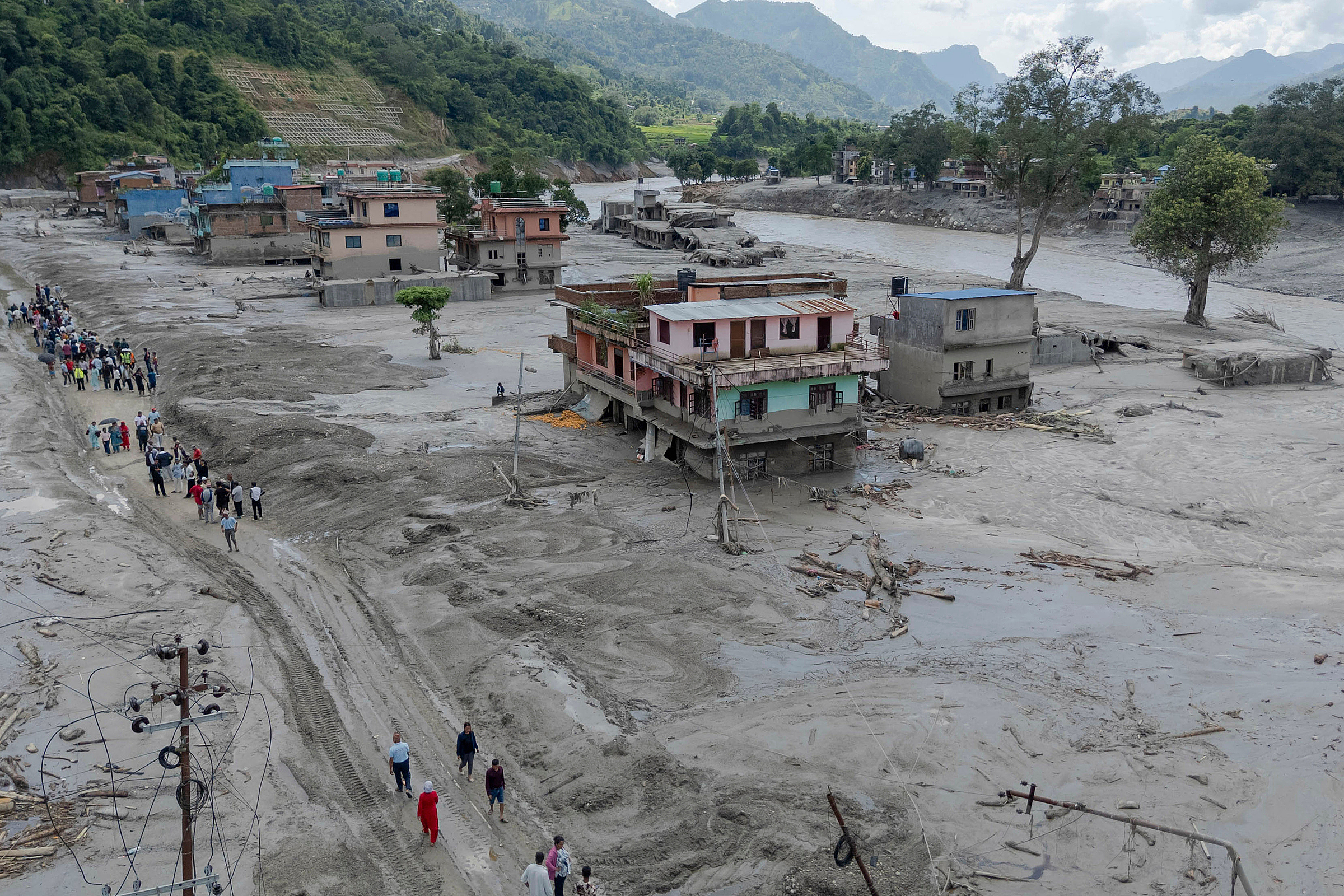 |
Damage in Nuwakot, Nepal on 27/8 following the flash flood. *AP* |
Meanwhile, Nepal announced today that "there are reports indicating a dam continues to breach on the Tibetan side." Nepali officials urged all security personnel, rescue workers, and residents involved in search and relief efforts to remain vigilant, immediately move to safe locations, or report their situation.
According to a Reuters correspondent on the scene, residents of Nepal's Rasuwa district, bordering China's Tibet Autonomous Region, rushed to higher ground on hillsides to avoid the risk of rising river levels.
CCTV reported that emergency technical teams are closely monitoring the situation. As of 28/8, 499 Chinese nationals and 555 foreign individuals had been evacuated from the disaster area.
Rescue forces are employing 3D modeling technology with drones and thermal imaging equipment, combined with manual searches, to locate missing persons.
Chinese President Xi Jinping chaired a high-level meeting today to discuss rescue operations. Xinhua quoted from the meeting, stating, "The area still harbors many potential risks related to glaciers, glacial lakes, and geological disasters, while rescue efforts face significant challenges."
The U.S. Geological Survey (USGS) stated that the disaster on 26/8, Nepal's deadliest natural calamity since the 2015 earthquake, originated from a glacier collapse, creating a torrent of floodwaters containing ice and debris. Currently, 472 victims have died, including 469 in Nepal and three in China, while about 1.400 people remain missing across both countries, including hundreds of foreign nationals.
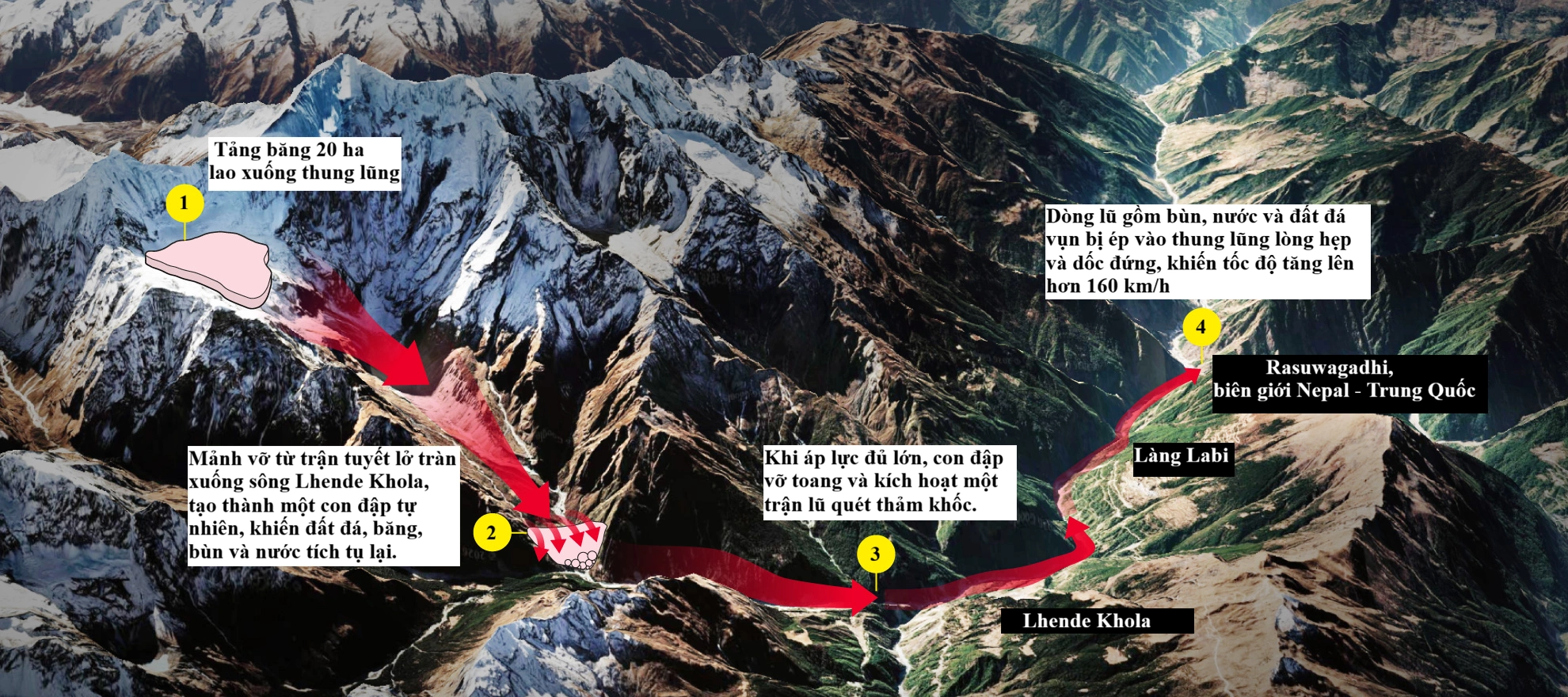 |
Explanation of the flash flood formation process on the Nepal-China border on 26/8. *Telegraph* |
Nepali rescue teams have deployed helicopters to search for survivors and drop emergency aid to thousands isolated in towns and valleys. Emergency response forces, including teams with search and rescue dogs, have recovered dozens of bodies swept downstream into the lowlands.
Offers of assistance have continuously poured in from around the world, but Nepal stated that it does not currently require help from other nations for search and rescue operations.
Huyen Le (According to AFP, Reuters)