Byron Sellers had aspired to invest in real estate for years, but the properties he found were always priced too high. One day in 2017, while driving for a ride-sharing service and listening to a real estate podcast, Sellers discovered an alternative path: buying, renovating, and reselling mobile homes for profit.
"I was surprised to learn that starting a mobile home business only required 3,000-5,000 USD," he recalled. His wife, Sharnice, was enthusiastic about the idea.
The couple began their research, took out a 10,000 USD high-interest consumer loan, and started searching Google Maps for mobile home communities around Chicago, where they rented an apartment.
After reviewing over 40 listings, they found a reasonable deal: two units for 4,300 USD. One was move-in ready, while the other needed repairs. With the help of Sharnice's mother, the couple re-floored, renovated the bathroom, replaced fixtures, and repainted the interior.
They then sold both units. The move-in ready home sold for 10,000 USD, and the one they renovated fetched 9,500 USD. The entire process, from searching to buying, renovating, and selling, took less than 60 days.
Mobile homes are a common housing model in the US, where residents purchase prefabricated houses and place them on rented land. Many homeowners pay lot rent to the community owner and must adhere to internal regulations set by the landlord. This model represents one of the largest sources of affordable housing in the US, providing homes for about 21 million people.
A mobile home listed for sale in California, US. Photo: SMC
Amid a deepening housing crisis, mobile homes have become a viable option for many who cannot afford traditional stick-built homes. The number of new mobile homes in the US increased by 60% from 2014 to 2024, according to census data.
Mobile homes are affordable because their selling price typically excludes land costs; most buyers only pay for the structure itself. These homes are manufactured in factories, resulting in lower production costs due to assembly-line processes. Unlike traditional houses, mobile homes are classified as personal property, similar to an oto, leading to lower property taxes and insurance premiums.
Historically, mobile homes depreciated similarly to cars, but this trend is shifting in the current housing market. A 2024 LendingTree study indicates that the average selling price of a mobile home rose by nearly 60%, from 78,000 USD in 2018 to 124,000 USD per unit in 2023.
The Urban Institute also notes that while the mobile home market is more volatile and prices are highly location-dependent, this housing type generally appreciates similarly to traditional stick-built homes, at about 5% annually.
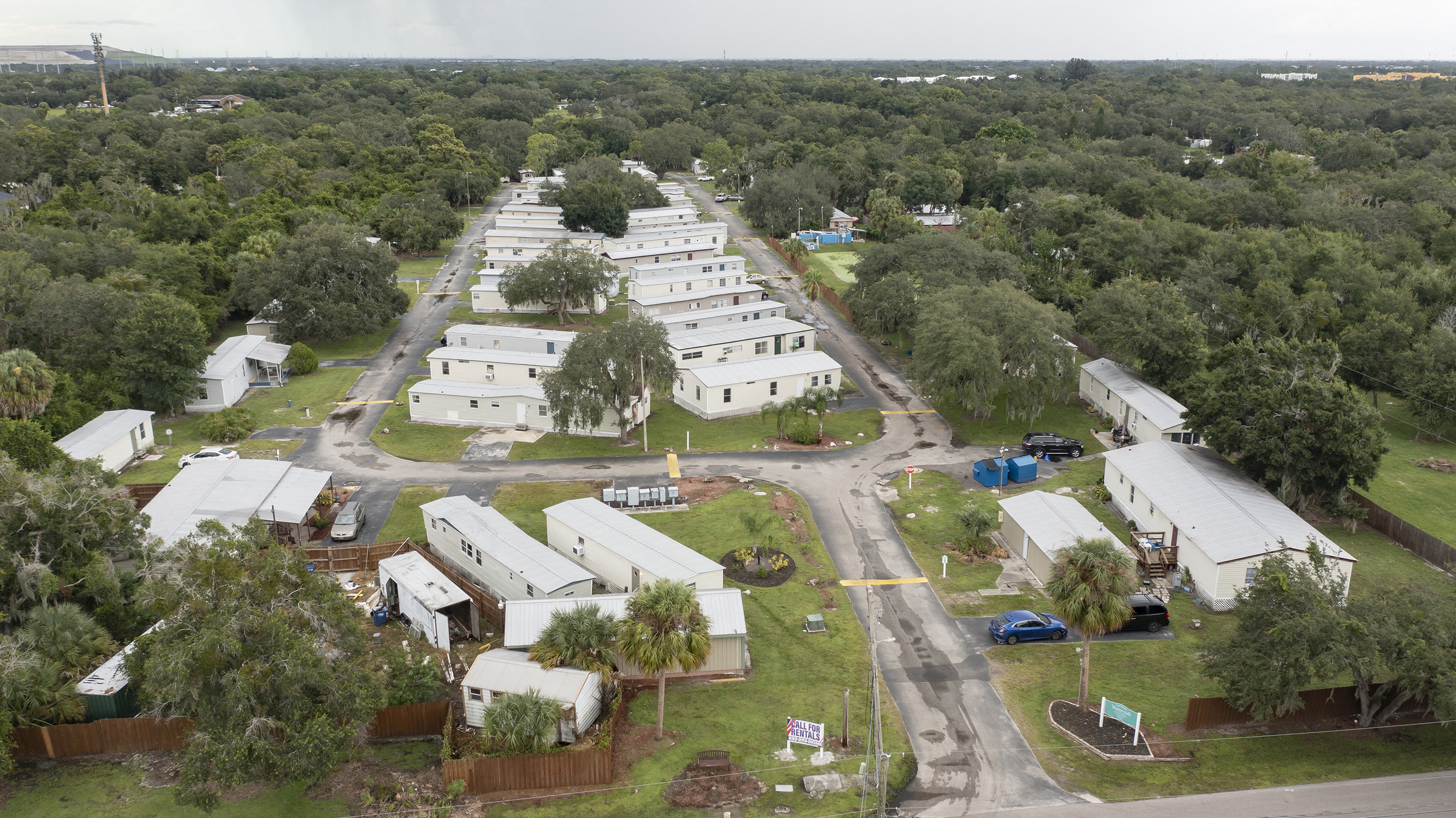 |
A mobile home community in Gibsonton, Florida, in 2024. Photo: Reuters
Investing in mobile homes was once an overlooked and unattractive sector in the US, yet it remains resilient to recessions, enjoys stable demand, and yields some of the highest profits in the housing industry.
The low entry cost of mobile homes has attracted a new generation of investors, including many people of color like the Sellers couple. As housing costs rise nationwide, many mobile home investors recognize significant opportunities, prompting them to train others interested in entering the real estate sector.
In mobile home communities, landowners often seek to fill vacant lots to optimize lot rental income. Investors capitalize on this by building relationships with community management and identifying available units for sale.
Similar to traditional real estate investors, they refer to this practice as "driving for dollars."
"Essentially, we drive around mobile home communities and look for areas with many vacant units," stated Mersadez Joseph, who lives in Columbia, South Carolina. "Then, we contact management, explaining that if they allow us to buy and renovate, they gain both additional revenue and new tenants."
Over four years, the Joseph couple completed about 20 mobile home flip deals, earning approximately 250,000 USD. Their goal is to sell each unit for double their initial investment.
Investors report that the downsides of the mobile home business are similar to other real estate ventures: homes are often in worse condition than expected, tenant issues arise, and contractors can be dishonest.
The high profits in this sector often come from distressed individuals needing shelter as housing and rental costs exceed their means. Not all investors view this endeavor through a community service lens. In recent years, private equity funds have recognized the substantial profits from mobile homes. A Private Equity Stakeholder Project study revealed that institutional investors accounted for 23% of all mobile home purchases between 2020-2021, an increase from 13% in 2017-2019.
 |
Entrance to a mobile home community in Jesen Beach, Florida, in 2019. Photo: AFP
According to the study, the annual compounded return for mobile home communities is 22%, the highest in the real estate market. Large corporations spend millions of USD acquiring mobile home communities nationwide, subsequently raising lot rents. This traps residents, who often lack the financial means to move their entire home elsewhere.
Small-scale investors report observing rising rent trends, but their business operations remain unaffected.
Sellers and Sharnice have prospered since their first deal in 2017. Sharnice left her job at a Chicago oil company, and Sellers stopped driving for a ride-sharing service; both now dedicate full-time to investing in mobile homes. Initially, they bought and sold individual units, then began acquiring entire communities. In 2023, the couple moved to Florida, partly due to the state's vibrant mobile home market.
However, the current trend may not last. Many housing advocacy organizations have begun to view mobile homes as a solution to the nationwide housing shortage, especially after certain protective mechanisms were established. Yet, strengthening these mechanisms will likely cause prices to continue rising. "Where else in the US can you find a move-in ready home for just 30,000-50,000 USD?" Sellers questioned.
By Duc Trung (Based on Insider, WSJ, AP)