


United States President Donald Trump announced last weekend that he would impose tariffs on eight European nations: Denmark, Norway, Sweden, France, Germany, the United Kingdom, the Netherlands, and Finland. This measure will remain in effect until Washington reaches an agreement for complete control of Greenland, an autonomous island territory of Denmark.
The White House leader also criticized European countries for deploying troops to Greenland for exercises at Denmark's invitation. According to him, only the United States can ensure Greenland's security, and Washington does not rule out any options, including military force, to control the territory.
This move comes as a surprise, as all parties are members of NATO, the transatlantic military alliance founded in 1949 based on a commitment to collective defense. The belief that the United States would stand by and protect its European allies from external threats has been the foundation of NATO's credibility and deterrence capability, but this factor is gradually weakening.
Observers suggest that recent developments "have mixed security and trade tensions into an explosive concoction," pushing NATO into a serious crisis.
"NATO exists, but trust, the glue that binds the alliance, has broken. The organization will no longer function effectively," former US ambassador to NATO Doug Lute told WSJ.
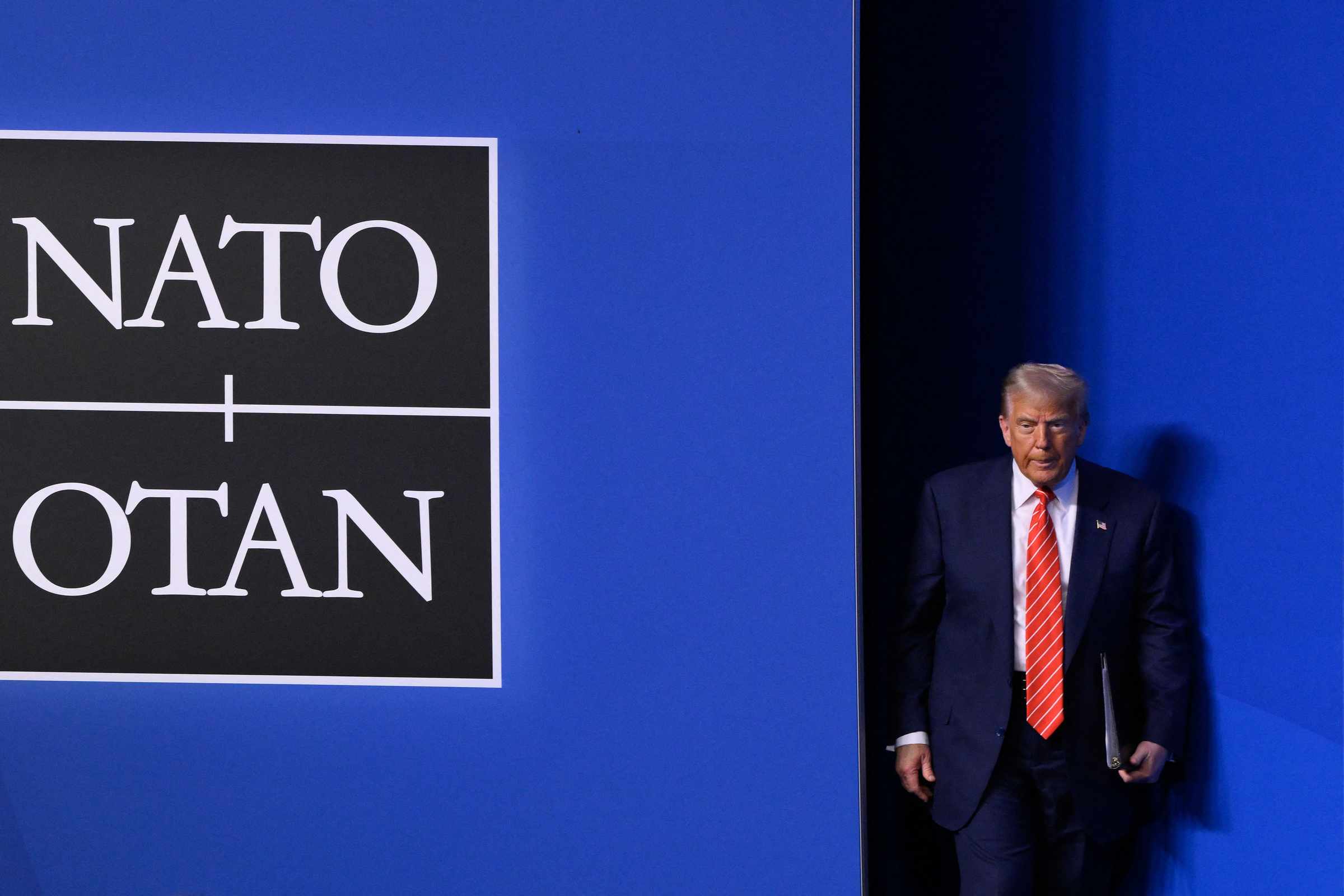 |
United States President Donald Trump prepares for a press conference at the NATO summit in The Hague, Netherlands, 6/2025. Photo: AFP
Warning signs of an uncertain future for NATO emerged when Trump began his second term in 1/2025. At that time, the White House fiercely attacked Europe over immigration and freedom of speech, threatening to impose tariffs on allies. All of this fueled a sense that the United States was turning its back on the transatlantic relationship Washington had diligently built after World War II.
US-Europe relations warmed last summer when the two sides negotiated and reached a trade agreement in 7/2025. Europe then adopted a strategy of appeasement and satisfaction toward Trump, persuading the United States President that they were not a burden and brought benefits to Washington. When European leaders left a White House meeting with Trump in 8/2025, they were cautiously optimistic that the transatlantic relationship had stabilized.
However, this improvement did not last. Trust between the two sides was further damaged when the national security strategy, announced by the White House in 12/2025, primarily targeted Europe, rather than the West's two main competitors: Russia and China.
In early january, Trump reiterated the idea of the United States controlling Greenland, an autonomous island of Denmark, with increasing assertiveness and resolve. He emphasized that the United States must "own" Greenland for national security, calling on NATO to support Washington's control of the island. This stance made Greenland no longer just an issue between the United States and Denmark, but a test for the entire alliance.
Kristian Soby Jakobsen, an associate professor at the Royal Danish Defence College, warned that if the United States sought to annex Greenland by force, it would break the foundation of NATO's existence, severely weakening the transatlantic security structure.
Greenland could become a "trigger point," causing a chain reaction that would destabilize NATO politically, militarily, and economically, according to Jakobsen.
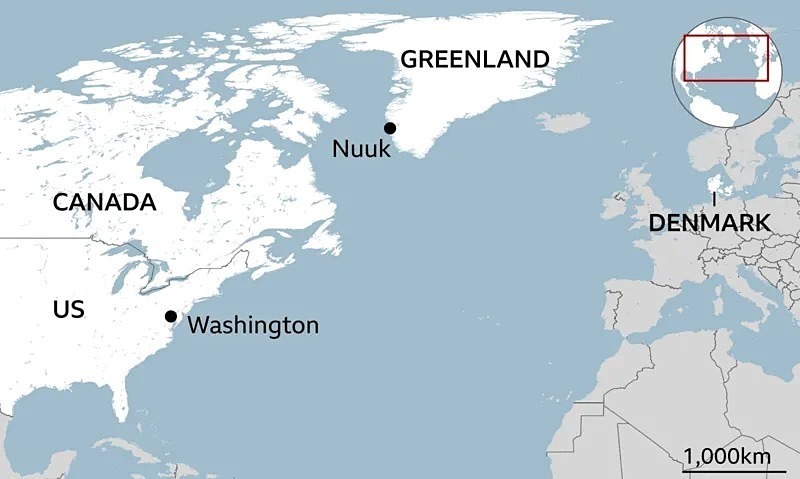 |
Location of Greenland island. Graphic: BBC
To avoid a worst-case scenario, European nations are maintaining relations with the White House through cooperation and measured concessions. They are trying to find an appropriate response that does not further anger Trump but also draws a clear line on the Greenland issue.
Some countries want to show President Trump that his pressure will have many consequences for the United States itself, including the collapse of the trade agreement with Europe. Others hope to ease tensions through behind-the-scenes contacts with US administration officials. Overall, Europe fears a major rift could lead Trump to withdraw the United States from NATO, dismantling the world's largest military alliance.
Former NATO officials believe that NATO's self-dissolution is a long-held desire of Russia, and Western adversaries would be the biggest beneficiaries of the current division.
"Ultimately, this only harms America's standing in the world. The United States and Europe both need allies in an increasingly dangerous world," said Oana Lungescu, former NATO spokesperson and now a researcher at the Royal United Services Institute (RUSI).
NATO has overcome many internal tensions before, such as the Suez crisis in 1956. At that time, the United States forced the United Kingdom and France to stop military intervention in Egypt. When the United States intervened militarily in Iraq in 2003, France and Germany also strongly objected.
"Those events were also difficult moments for NATO," Lungescu said. "But this time brings a sense of extreme urgency, something we have never seen before."
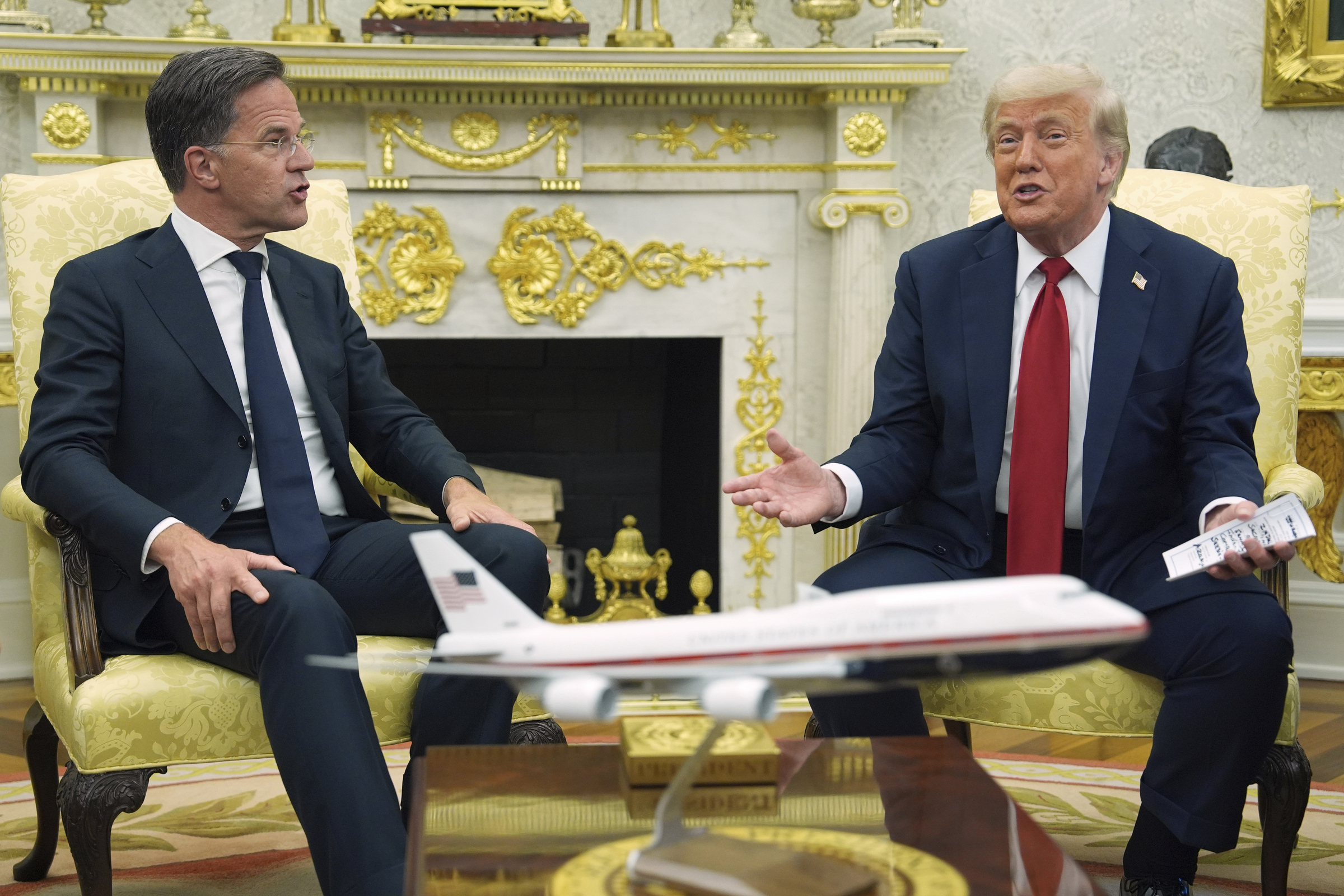 |
United States President Donald Trump (right) meets NATO Secretary General Mark Rutte at the White House, 7/2025. Photo: AP
Daniel Fried, a researcher at the Atlantic Council, suggests that the United States and Europe have three paths to avoid a "disastrous confrontation": one is diplomacy, through working groups that US, Danish, and Greenland officials agreed to establish after a meeting in Washington on 14/1; two is for the US Congress to act to block the scenario of the United States using force to seize Greenland; three is for Denmark and other NATO members to increase their presence and exercises around Greenland to strengthen deterrence.
"This trouble should not have arisen, but the parties can achieve a result where NATO remains intact, and Arctic security is strengthened," Fried wrote.
Nhu Tam (According to WSJ, CNN, Reuters)


