China's military on 27/8 released images showing that most structures at the Gyirong border crossing, including the customs office building, police station, and the bridge connecting the two countries, were flattened. Nepal's Rasuwa customs building also suffered destruction due to the flash flood one day prior.
Nepal police reported 389 deaths this morning, while China recorded three fatalities. A total of 1,468 people were missing as of 27/8, including 910 in Nepal and 558 in China. Many missing individuals are foreign nationals and Hindu pilgrims en route to the sacred Mount Kailash in Tibet.
The Gyirong - Rasuwa border crossing plays a significant role on the China-Nepal border, handling nearly one-third of the two countries' trade volume in 2024.
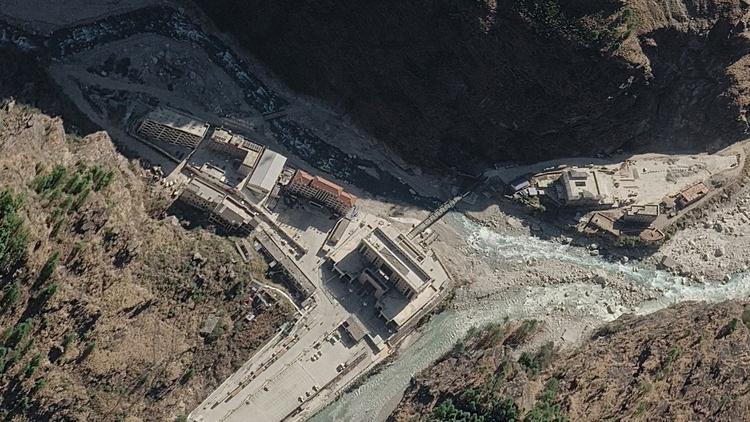 |
The Gyirong - Rasuwa border crossing in photos taken on 1/8 and 27/8. *Photo: CNN, PLA*
Nepal's Prime Minister Balendra Shah surveyed some of the most affected areas. His office stated that Shah directed local authorities to "provide emergency relief to evacuated families and reopen blocked routes."
China's Prime Minister Li Qiang also visited the site in Gyirong County. Reuters suggested this move indicates China considers the disaster a top national priority. China's Ministry of Foreign Affairs announced the country is coordinating closely with Nepal on search and rescue efforts.
The disaster site at the Nepal-China border in a video released on 27/8. *Video: PLA*
The flash flood on 26/8 occurred after a glacier collapse, unleashing a massive flow into the areas below. Ruth Gamble, an environmental expert at La Trobe University in Australia, described the mudslide as a "land tsunami," traveling nearly 170 km south into Nepal's territory.
Nepal's disaster response agency also issued an urgent alert regarding a rising reservoir formed by debris blocking the river. It advised residents downstream of the Bhote Koshi River, tourists, rescue teams, and relevant parties to exercise caution.
"There is a risk of another flood due to blocked flow upstream of the river on the Nepal-China border," warned Qianggong Zhang, head of climate and environment risks at the Nepal-based International Centre for Integrated Mountain Development (ICIMOD).
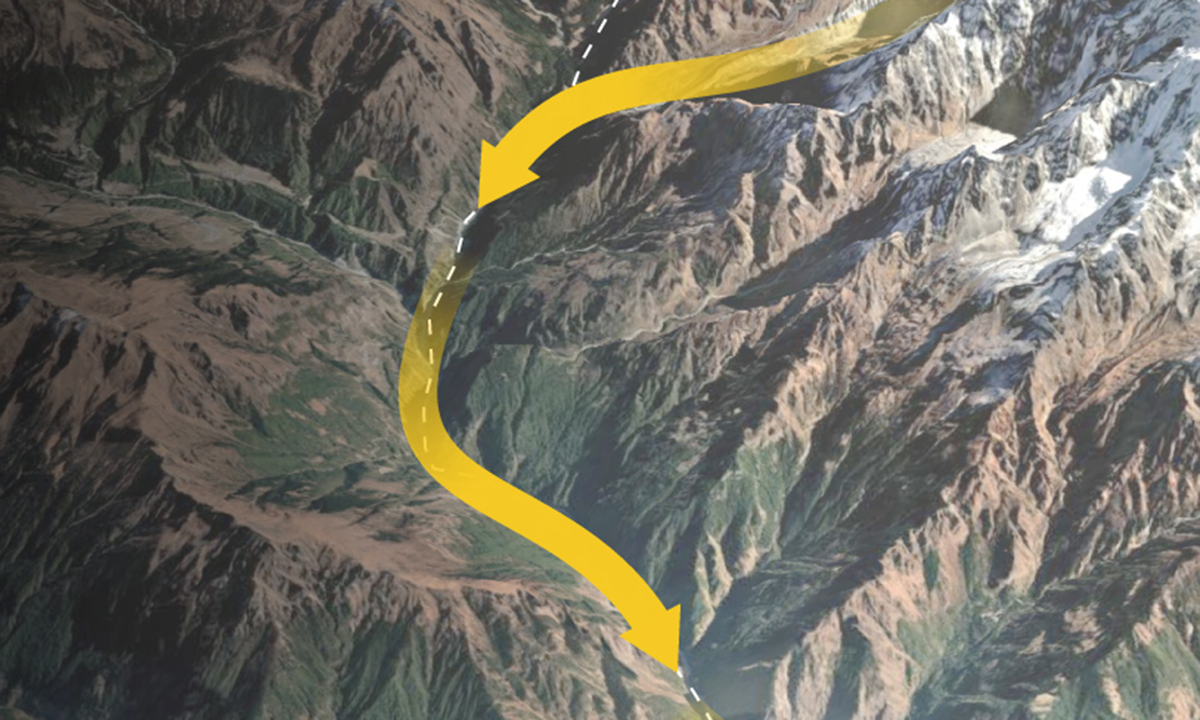 |
The path of the flash flood, resembling a tsunami, at the Nepal-China border. *Click on the image for full view.*
Experts suggest climate change may have played a role but emphasize that specific evidence is lacking to determine the precise cause of the disaster.
*Nguyen Tien (According to CNN, AFP, Xinhua)*