The US Bureau of Labor Statistics released new data early this month, indicating that as of April, approximately 66,6% of US men aged 20 years and older were employed or actively seeking employment. This figure marks a decrease from 73% in 2006 and represents the lowest level in nearly 20 years.
This rate is close to the level recorded after the 2008 Great Recession, when the labor market participation rate for men aged 20 and older dropped by seven percentage points in just one year.
The United States currently has 123,7 million men aged 20 and older. Consequently, the reported rate means that 33,4% of this group, or 41,3 million individuals, are not participating in the labor market and are not seeking employment.
The group not participating in the labor market includes both unemployed individuals and those outside the labor force, such as retirees, students, disabled individuals, or those who choose to stay home as homemakers.
The employment rate then slowly increased in the 2010s before sharply declining during the 2020 pandemic, when only about 59% of men participated in the labor market. The rate partially recovered in the following two years, then gradually declined to its current low.
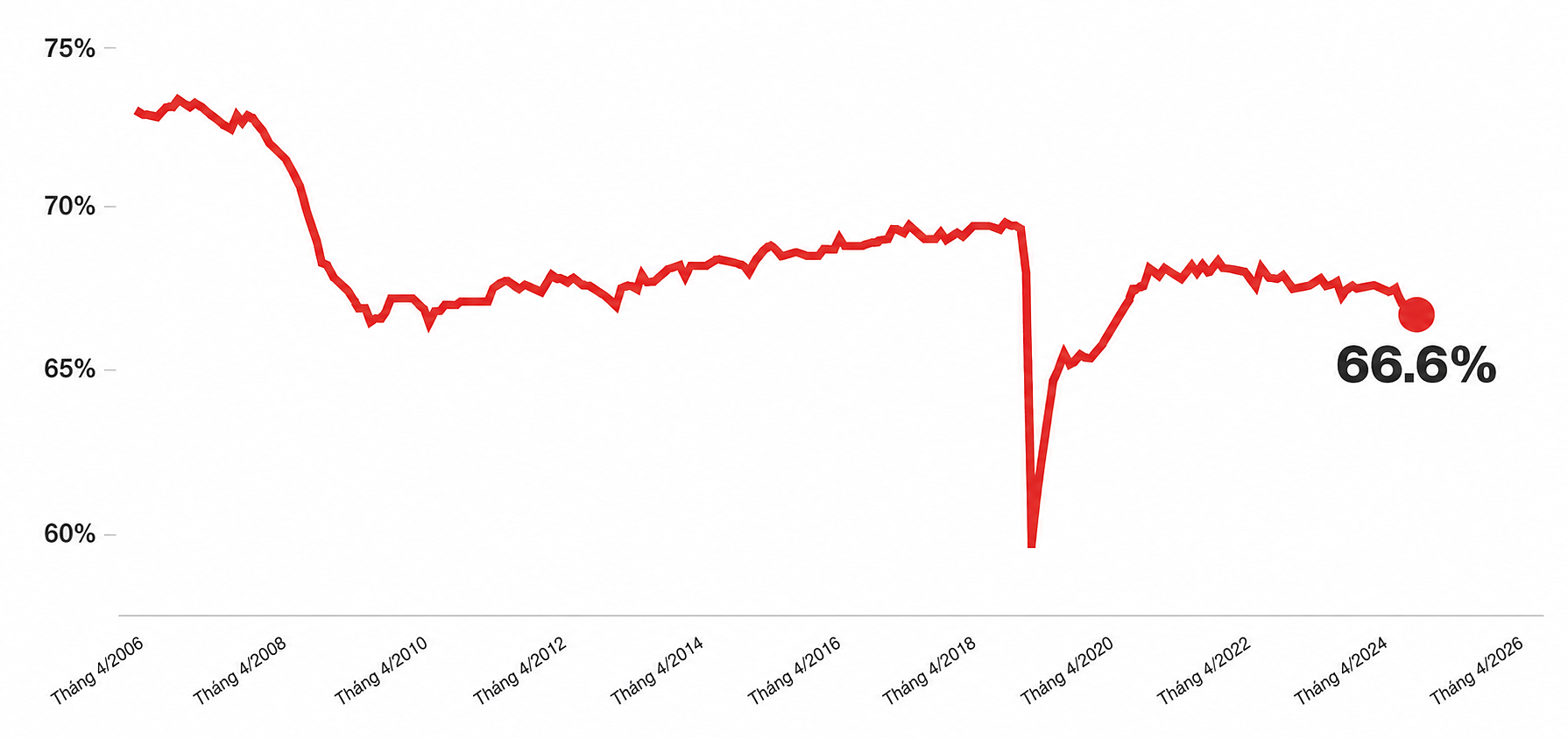 |
Labor market participation rate for US men aged 20 and older. Graphics: US Bureau of Labor Statistics |
The indicators continued to worsen. As of April, the employment rate for men decreased by one percentage point compared to the same period in 2025.
According to the Washington Post, this decline is due to various factors, including a wave of job cuts in sectors that traditionally employ many men, such as transportation, manufacturing, and manual labor.
An increase in retirees and male students has also contributed to the shrinking size of the working-age population participating in the labor market. However, men leaving the labor force due to limiting health conditions accounted for the largest proportion of those no longer working.
"If my mother and I did not live together, it would be very difficult for me to manage my life," said Andy Breedlove, 51 years old, living in West Virginia. He had to quit his gas station manager job in 2018 due to a bone disease that prevented him from standing for extended periods. He now stays home to care for his elderly mother and relies on government aid of approximately 1,000 USD per month.
 |
A job fair in New York, US, 27/3/2025. Photo: AFP |
Even some young men are forced to remain outside the labor market because of health issues.
"Sometimes I have a lot of difficulty with daily tasks," said Cordell Loll, 25 years old. He has never worked due to chronic stomach problems and mental health issues. Loll spends his time managing his health, playing video games at home, and living on disability benefits. "Just thinking about going to work feels nearly impossible," he stated.
The rate of women leaving the labor force has generally followed a similar trend over the past two decades, but with much lower volatility. During the 2008 recession, the employment rate for women only decreased by two percentage points, while the rate for men decreased by five percentage points.
After the female labor force recovered from the 2020 pandemic, this rate also experienced a slight decline but has not fallen below 56% since 2022. In absolute terms, US women's participation in the labor force has historically been lower than that of US men.
By Duc Trung (NY Post, Washington Post, AP)