Russia's Ministry of Defense announced today that on the night of 8/1, the Russian military launched a large-scale coordinated attack using precision weapons from warships and ground platforms, including the Oreshnik medium-range ballistic missile, along with long-range unmanned aerial vehicles (UAVs), targeting key facilities in Ukraine.
The ministry emphasized that the operation was a retaliatory action for an "attack on the Russian President's residence in Novgorod province on 29/12/2025". It added that the targets were UAV manufacturing facilities for the Ukrainian military and energy infrastructure supporting the adversary's defense industry.
Moment believed to be an Oreshnik missile striking Lviv province in Ukraine on the night of 8/1. Video: X/AMK Mapping.
"The operation has completed its objectives. All targets were hit. Any Ukrainian attacks will be met with retaliation," Russia's Ministry of Defense stated.
On the same day, Ukraine's Air Force Command reported that Russia attacked the country with 242 UAVs of various types, along with 13 Iskander-M ballistic missiles and converted S-400 air defense missiles, 22 Kalibr cruise missiles, and one medium-range ballistic missile launched from the Kapustin Yar training ground in Astrakhan province.
"The main direction of attack was Kyiv. Ukrainian air defense units shot down 226 UAVs, 8 Iskander-M and S-400 missiles, and 10 Kalibr missiles. 18 missiles and 16 drones hit 19 locations," the command stated.
Ukraine's Western Air Force Command previously reported that Russian ballistic missiles targeting infrastructure in Lviv province on the night of 8/1 flew at approximately 13,000 km/h, but did not specify the type of weapon.
AMK Mapping, an X account specializing in tracking open-source intelligence data on the conflict in Ukraine, indicated that Russian Kalibr and Iskander-M missiles targeted the CHP-4, CHP-5, and CHP-6 combined heat and power plants in Kyiv province, while an Oreshnik missile attacked an unidentified target in Lviv province.
Military information sites linked to the Russian military suggested the Oreshnik target was the Bilche-Volitsko-Uhersky underground gas storage facility, Europe's largest gas storage site. This facility is located approximately 10 km north of Stry city in Lviv province, has a capacity of over 17 billion cubic meters, accounting for 50% of Ukraine's total gas reserves.
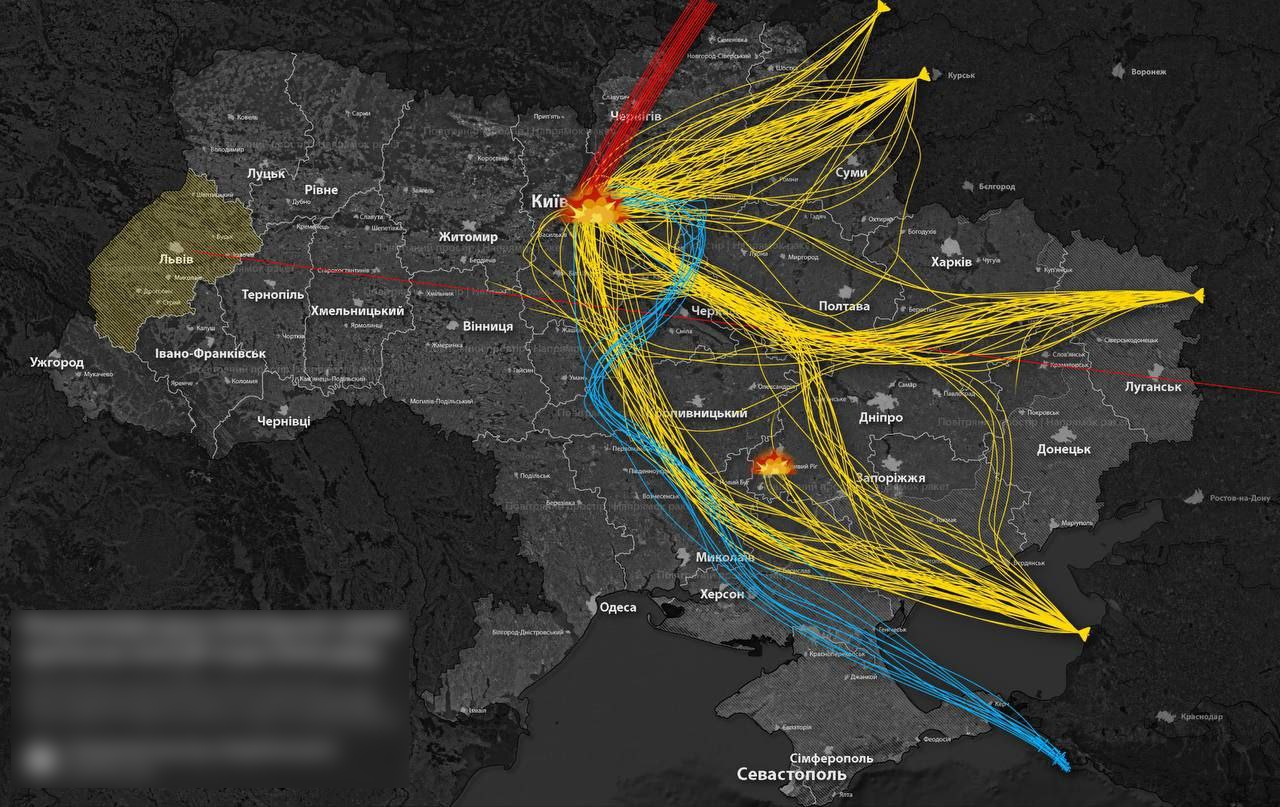 |
Flight paths of Geran-2 UAVs (yellow) and Russian missiles during the attack on 8/1. Graphic: Ukraine Pyx.
Russian officials claimed Oreshnik reaches speeds over 10 times the speed of sound, equivalent to more than 12,000 km/h. Beyond its high speed, the missile also uses multiple independently targetable re-entry vehicle (MIRV) technology, allowing each missile to carry up to 36 warheads.
The Oreshnik warhead reportedly contains no explosives, as its kinetic energy is greater than the energy an internal explosive charge could release. The absence of explosives also simplifies the manufacturing process for hypersonic warheads.
Russia first used the Oreshnik missile in an attack on the Southern Machine-Building Plant (Yuzhmash), a facility specializing in producing rocket boosters, ballistic missiles, and liquid fuel for Ukrainian missiles, in Dnipro city in 11/2024.
President Putin announced in 8/2025 that Russia had begun mass production of Oreshnik missiles and the military had received the first complex. Four months later, he stated that this weapon would be combat-ready by late 2025.
Nguyen Tien (According to AFP, RIA Novosti, AP, TASS)