Russia's Ministry of Defense announced on 21/5 that Belarusian military personnel practiced receiving tactical nuclear warheads from a field depot. They then transported these warheads to a staging area and loaded them onto Iskander-M ballistic missiles. These nuclear-armed missiles were subsequently moved discreetly to designated launch areas, ready for deployment.
A video released on the same day showed trucks, carrying tactical nuclear warheads, departing from the depot and traveling along forest roads. The warhead loading process occurred during the night, with the Iskander-M missiles then mounted onto their launchers in daylight.
On the preceding day, Russian military personnel conducted similar training activities with the Iskander-M system. Additionally, the Russian military held drills involving Iskander-K cruise missiles, which included practicing launcher escort, system deployment, and camouflage techniques.
These activities were part of Russia's nuclear exercises held from 19-21/5. The drills involved the nuclear deterrence triad, comprising ground-launched intercontinental ballistic missiles (ICBMs), submarine-launched ballistic missiles (SLBMs), and nuclear-capable aircraft.
Over 64,400 military personnel and 7,800 pieces of equipment participated in the exercises. This included over 200 missile launchers, 140 aircraft, 73 surface warships, and 13 submarines. According to the plan, Russian forces anticipated launching cruise and ballistic missiles during this operation.
The exercise also encompassed coordinating the preparation and use of nuclear weapons currently deployed in Belarus. Russia transferred Iskander-M systems to Belarus in 2022. Last year, Russia deployed Oreshnik hypersonic missiles, capable of carrying nuclear warheads, to the country.
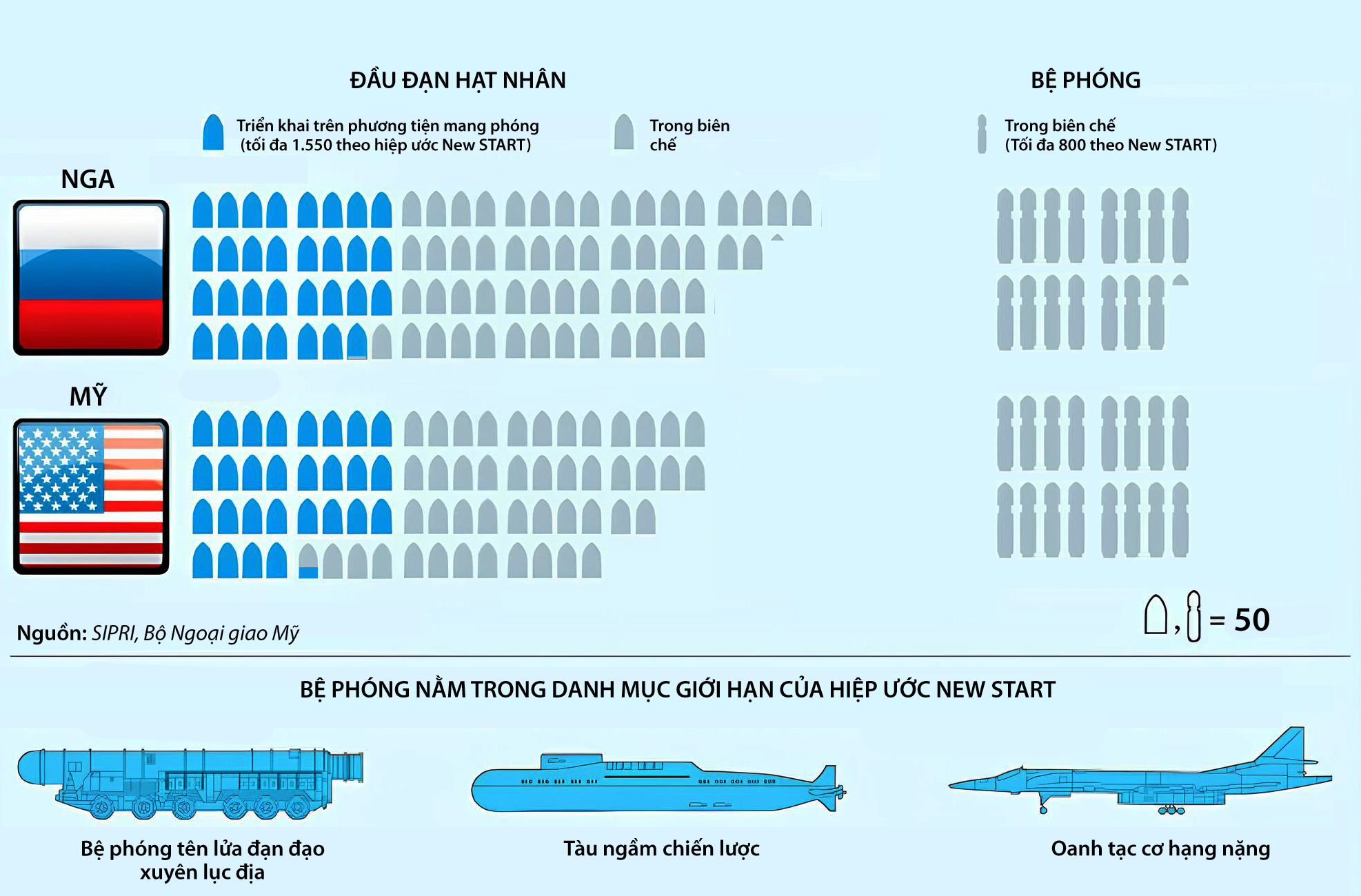 |
The nuclear arsenals of Russia and the US, totaling over 8,000 warheads. Graphics: RIA Novosti |
This marked the thu nhat drill of Russia's "nuclear triad" since the country announced an end to all obligations under the New Strategic Arms Reduction Treaty (New START) in February. New START was the last nuclear arms control treaty between Russia and the US.
The New START treaty was signed by the US and Russia in 2010, becoming effective mot year later. The treaty stipulates that each party cannot deploy more than 700 intercontinental ballistic missiles (ICBMs), submarine-launched ballistic missiles (SLBMs), and nuclear-capable bombers. The number of nuclear warheads on these delivery vehicles also cannot exceed 1,550.
Furthermore, the number of "deployed or undeployed" launchers for each country cannot exceed 800. The treaty also restricted Russia's long-range nuclear weapons that could reach US territory.
Nguyen Tien (According to RIA Novosti, AFP, Zvezda)