During their summit in Beijing on 20/5, Russian President Vladimir Putin and Chinese President Xi Jinping exchanged warm praise, discussing various topics and outlining directions for bilateral cooperation.
"One day apart feels like three years" (Nhat nhat bat kien nhu tam thu he), a classical poem, was quoted by President Putin during the talks to express his delight at meeting President Xi again, while also commending Russia-China relations as being at an "unprecedented high".
Later, during a tea reception, President Xi cited the Chinese proverb "One who persists in working will succeed, one who keeps moving will reach their destination" (Vi gia thuong thanh, hanh gia thuong chi), expressing confidence that China-Russia relations would maintain their high-quality development momentum and reach new heights.
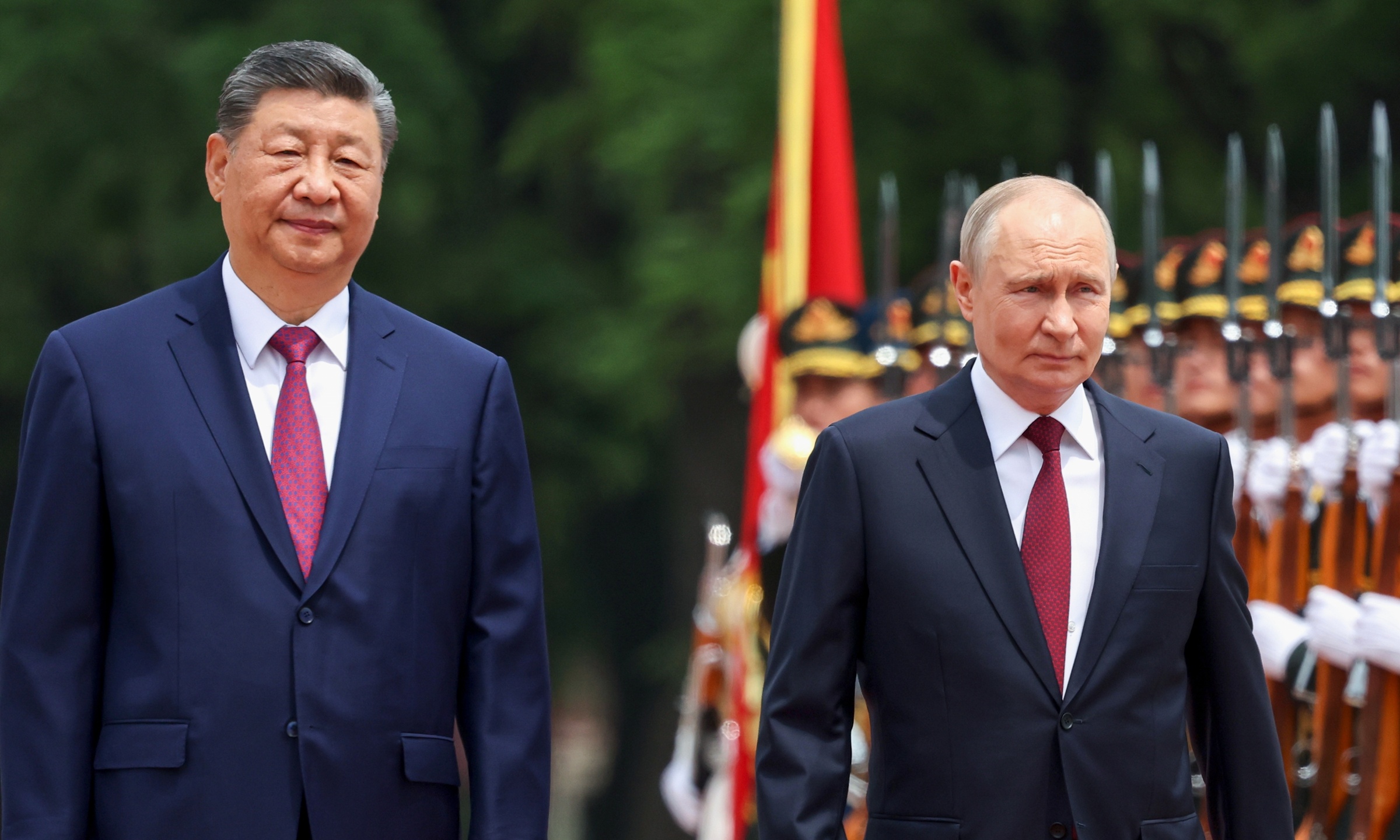 |
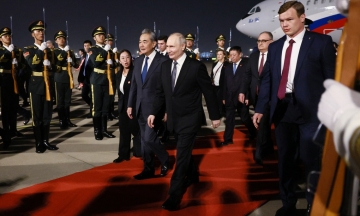
Chinese President Xi Jinping and Russian President Vladimir Putin review an honor guard during a welcome ceremony at the Great Hall of the People in Beijing on 20/5. Photo: AP
The two leaders signed a joint statement on further strengthening their "comprehensive strategic partnership and coordination", along with another document aimed at promoting a "multipolar world order".
Consolidating Strategic Strongholds
Speaking at the signing ceremony in the Great Hall of the People in Beijing, President Xi emphasized that China and Russia must continue to be "mutual strategic strongholds", committing to closer coordination in areas such as AI and technological innovation.
President Xi also stressed that China and Russia need to act as "responsible great powers", opposing all unilateral bullying and actions that go against the historical process.
Following the Chinese leader, President Putin affirmed Moscow's readiness to maintain a continuous supply of oil and gas to Beijing. He described bilateral trade as a shield protecting both countries from "external influences" and global market instability.
Henrik Wachtmeister, a researcher at the China Center at the Swedish Institute of International Affairs, believes the biggest outcome for President Putin from the visit was securing assurances of deepening political ties between China and Russia. This comes at a time when both countries are increasingly at odds with the West.
The meeting took place just 4 days after US President Donald Trump's state visit to China. China received President Putin with protocols no different from those for President Trump, indicating Beijing's balanced approach in its relations with Washington and Moscow.
In a recent commentary, Dmitry Trenin, chairman of the Russian International Affairs Council, highlighted that Moscow does not want to become a "junior partner" to Beijing. "It is important to maintain an equal position in relations with China and remember that Russia is a great power," Trenin wrote.
President Xi had invited President Trump to Zhongnanhai, China's "heart of power". When hosting President Putin, President Xi invited the Russian President to a one and a half hour tea talk at the Great Hall of the People in Beijing. Yuri Ushakov, the Kremlin's foreign policy advisor, stated that the tea reception was the "most significant event" of the visit, as the friendly atmosphere was ideal for discussing sensitive issues.
Tea talk between President Xi Jinping and President Putin at the Great Hall of the People on 20/5. Video: Reuters
Statements from China clearly indicate President Xi's efforts to ensure its status as a "global diplomatic power" before partners it considers peers, such as the US and Russia, noted Temur Umarov, an expert at the Carnegie Russia and Eurasia Center, based in Berlin.
President Putin assessed that this visit to China was effective and yielded many positive results. The two sides signed at least 20 agreements in trade, technology, and expanded cooperation.
China is currently Russia's largest trading partner, purchasing nearly one-half of Russia's oil exports. Chinese companies are also playing an increasing role in supplying consumer goods, industrial equipment, and dual-use technology to Russia, items that Western officials believe are contributing to maintaining Moscow's defense industrial base.
"Structurally, the Russia-China relationship is very robust and that seems unlikely to change," Umarov commented.
Major Gas Project Fails to Achieve Breakthrough
The two leaders signed agreements aimed at strengthening strategic and economic ties between their countries. However, after two days of work, the state visit to China did not help President Putin achieve his expectations for the Power of Siberia 2 gas pipeline project.
This multi-billion USD project is considered vital by Russia to redirect gas exports to China after it faced numerous sanctions and was cut off from most of the European market due to its campaign in Ukraine.
Western sanctions have significantly imbalanced the relationship between Russia and China, particularly concerning energy.
Since the Nord Stream pipeline under the Baltic Sea was crippled, Russia has pushed to complete the Power of Siberia 2 pipeline project, which is expected to transport 50 billion cubic meters of natural gas annually from western Siberia to China via Mongolian territory.
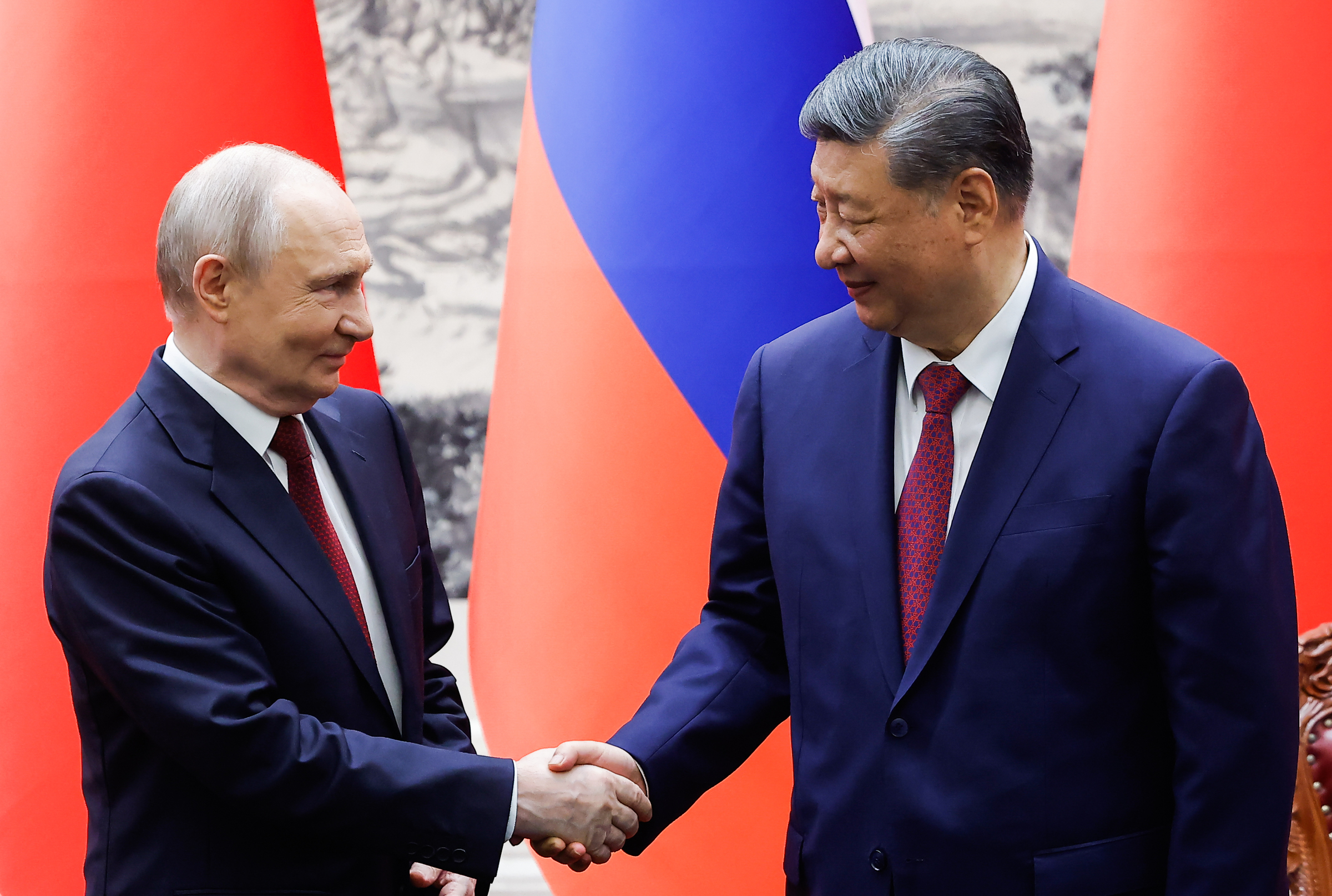 |
President Xi and President Putin shake hands during the signing ceremony at the Great Hall of the People in Beijing on 20/5. Photo: AP
Russia hopes Power of Siberia 2 will help offset lost revenue from the European market. According to Remi Bourgeot, an economist at the French Institute of International Relations and Strategic Affairs, based in Paris, for Russia, the benefits come not only from gas sales revenue but also from a "multiplier effect for Russian pipeline construction companies or steel producers".
However, China appears to be in no hurry and is bargaining aggressively over the price of gas for this major project. Russia's urgent need for revenue has given China the upper hand in negotiations.
"The problem is that the Chinese side has clearly negotiated to get a lower price than what European countries once offered for Russian gas. This is completely understandable, as Russia currently does not have many options," Bourgeot noted.
Go Katayama, a gas analyst at Kpler, believes China clearly recognizes Russia's weak negotiating position after losing the European market. Therefore, China has tried to negotiate steep discounts linked to domestic benchmarks. Meanwhile, Russia needs higher prices to cover the costs of building the massive pipeline infrastructure, Katayama explained.
The two sides have gone through many rounds of negotiations, and President Putin has repeatedly sought to advance this major project during his visits to China. A memorandum of understanding signed in 9/2025 between Russian energy giant Gazprom and Chinese partners was described by officials as a major breakthrough, but it was not a final binding agreement.
The outbreak of conflict in Iran and disruptions to shipping through the Strait of Hormuz were seen by Moscow as an opportunity to persuade Beijing that supplementing gas supplies via pipelines from Russia would help China reduce its dependence on vulnerable maritime transport routes.
However, the outcome of the Beijing talks showed Russia was not as successful as hoped. Kremlin spokesperson Dmitry Peskov stated that the two sides had reached "fundamental understandings" on the route and construction methods for the pipeline. However, he did not provide further details and admitted there was no specific timeline for this major project due to "a few minor issues to resolve".
Core details regarding the project's start or completion dates remain unagreed upon, and the Beijing summit also yielded no public announcement about Power of Siberia 2.
The joint statement after the meeting only briefly mentioned that President Putin and President Xi "agreed to continue deepening their comprehensive partnership in the energy sector", while also "promoting mutually beneficial cooperation in the oil, gas, and coal sectors".
The failure of the two sides to achieve a breakthrough on the Power of Siberia 2 project indicates that the core balance in their bilateral relationship is eroding. "Russia needs trade revenue much more than China needs Russia's energy," expert Wachtmeister noted.
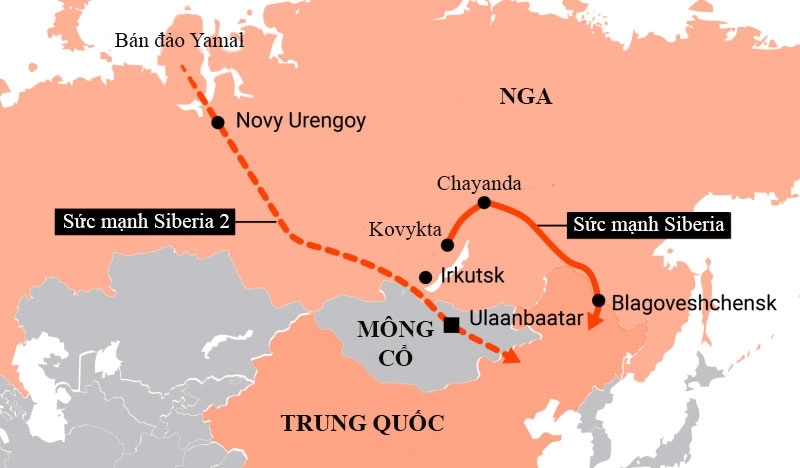 |
The Power of Siberia and Power of Siberia 2 (planned) pipeline systems transfer gas from Russia to China. Graphics: Table
"Russia has very few alternatives for its energy buyers and is selling discounted oil due to sanctions," he further analyzed. "Meanwhile, China has many suppliers and possesses a much larger economic scale."
Russia remains China's largest pipeline gas supplier thanks to the Power of Siberia 1 pipeline, which began operations in 2019 under a 30-year agreement worth 400 billion USD.
However, China is also increasing its imports of liquefied natural gas from Australia and Qatar to avoid dependence on a single source of supply.
Russia's next major increase in gas export capacity to China is expected in 2027, when the Far East pipeline becomes operational and gradually increases delivery volume. If the Power of Siberia 2 project proceeds, China would likely have to reduce gas imports from other partners.
Michael Kimmage, director of the Kennan Institute, a Washington-based research organization, suggested this is why Beijing remains unlikely to rush into committing to a new major pipeline project with Moscow.
China has spent years diversifying its energy imports, in addition to increasing domestic oil and gas production and rapidly expanding renewable energy sectors such as solar and wind power.
"In some respects, Russia is a solution for China, but it is a very slow solution and could be too slow, especially if the conflict in Iran is resolved in the next few months," Kimmage assessed.
Vu Hoang (According to Al Jazeera, AFP, Reuters)