A drone buzzed through a shopping mall in Russia's Voronezh city. Shaman, a drone pilot for the Russian military, demonstrated his control skills while introducing the crowd to the equipment dominating the Ukraine battlefield.
With a hood covering his face, the 19-year-old said he would soon head to the front, vowing to defend his country.
Before deploying to the front lines, Shaman was tasked with manning a booth for the "Cossack Berkut Military Sports Club" inside the Voronezh shopping mall.
However, his goal was not necessarily to convince young people his age to enlist. "Everyone chooses their own path according to their preferences," Shaman said, identifying himself as a "patriot."
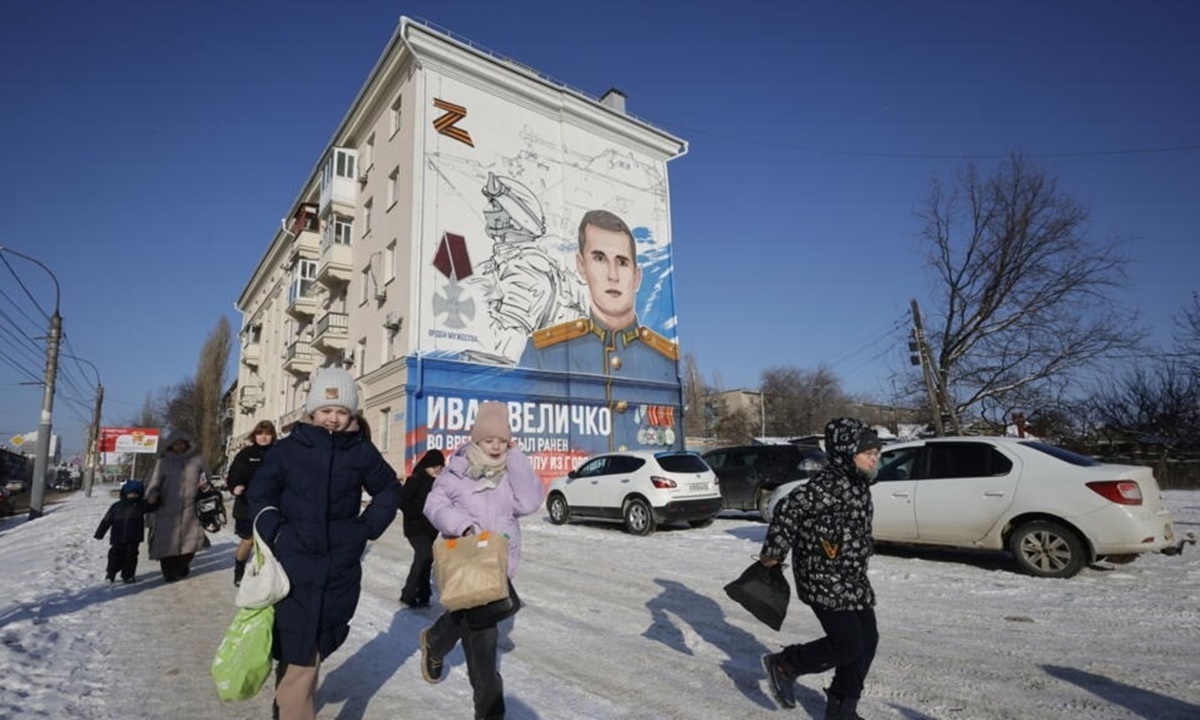 |
Propaganda artwork about the military on a street in Voronezh city. Photo: AFP |
Voronezh, a city of one million residents, lies about 500 km south of central Moskva. Located near the front lines in eastern Ukraine, the city's appearance has changed significantly since the conflict erupted four years ago.
From frequent retaliatory drone attacks by Ukraine to recruitment billboards across the city, the fires of conflict have gradually become ingrained in daily life in Voronezh.
On the snow-covered roads leading to the outskirts, air defense systems peek out from behind camouflage netting. In the city center, countless propaganda posters urging young people to enlist sprang up densely, overshadowing even billboards for the "Swan Lake" ballet at the local theater. Interspersed among them are giant murals honoring fallen soldiers.
A recruitment center promises soldiers a one-time allowance of 2,5 million rubles (about 32,500 USD) if they enlist. This amount is equivalent to three years of average salary in the region.
Abundant financial resources have helped Russia maintain its numerical advantage over Ukraine, despite losses during four years of fighting. Dmitry Medvedev, Deputy Secretary of the Russian Security Council, stated that 422,000 people enlisted last year, a 6% decrease compared to 2024.
For Lyudmila, a 64-year-old woman with deep circles under her eyes, the numbers are meaningless. Only one person matters in her mind now: her son, who has been missing for four months after going to the battlefield.
"Everything is very difficult for me. I still hope, because if there is no hope...," Lyudmila choked up, eyes welling with tears, unable to finish the sentence.
She cannot sleep soundly without knowing her son's fate. Has he died, or was he captured by Ukraine? No one gives her an answer. To forget negative thoughts, Lyudmila volunteers for an organization that sews military uniforms for soldiers.
Even with the attractive offer of a large sum of money, Roman, a tractor driver, firmly refused. "No, no matter how much money," the 48-year-old man said.
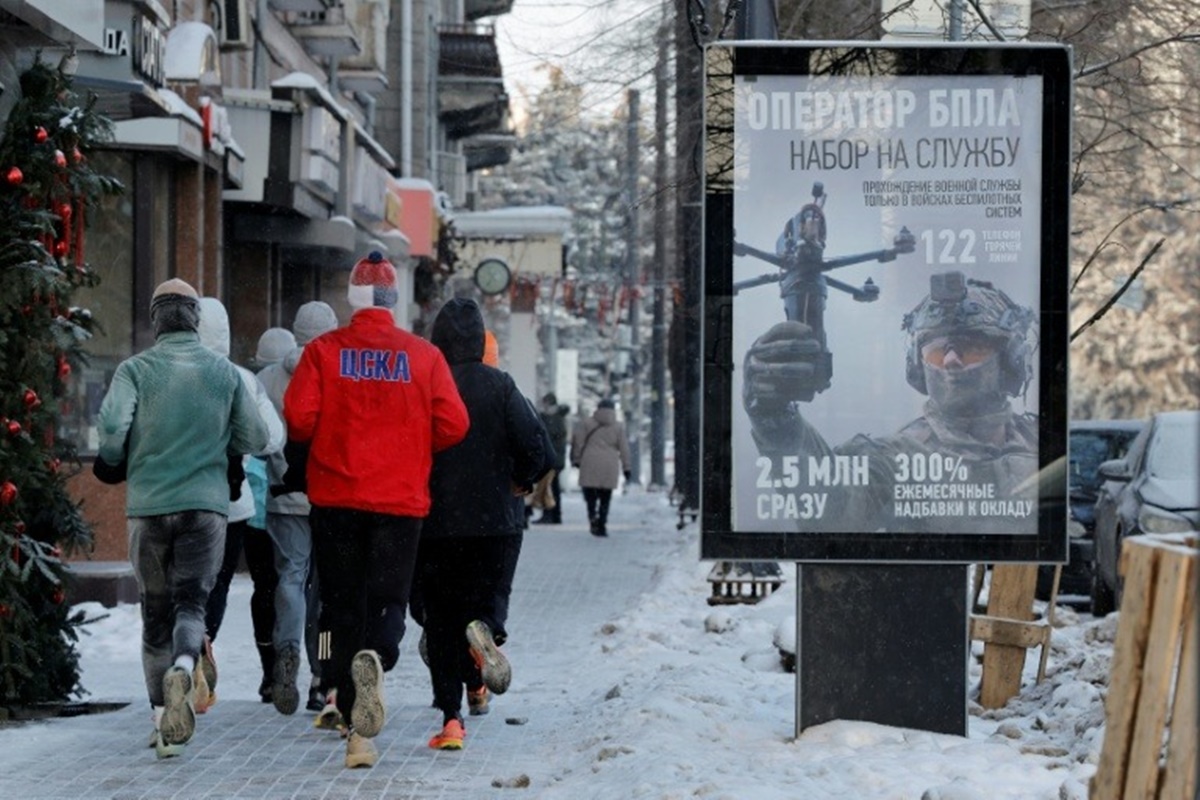 |
A recruitment advertisement in Voronezh. Photo: AFP |
Huddled in a hut on the frozen river, Roman said he only wanted to "relax," "put everything aside," and "think of nothing but fishing" because he was too afraid of Ukraine's drone attacks.
"I often wake up startled by explosions," he recounted. "We hear sirens and explosions every day. Of course, I am scared."
For many months, Russia has continuously launched missiles and drones into Ukraine. The latest wave of attacks crippled Ukraine's energy system, leaving hundreds of thousands without heat as temperatures plummeted to -20°C.
Ukrainians set up tents indoors, baked bricks for warmth.
In response, the Ukrainian military continuously carries out drone attacks, primarily targeting Russia's energy infrastructure and seaports. Last month, one person in Voronezh died in the attacks.
The Voronezh region, which surrounds the city of the same name and borders parts of Ukrainian territory controlled by Russia, is one of the "most frequently" targeted areas, Russian human rights commissioner Tatyana Moskalkova stated last month.
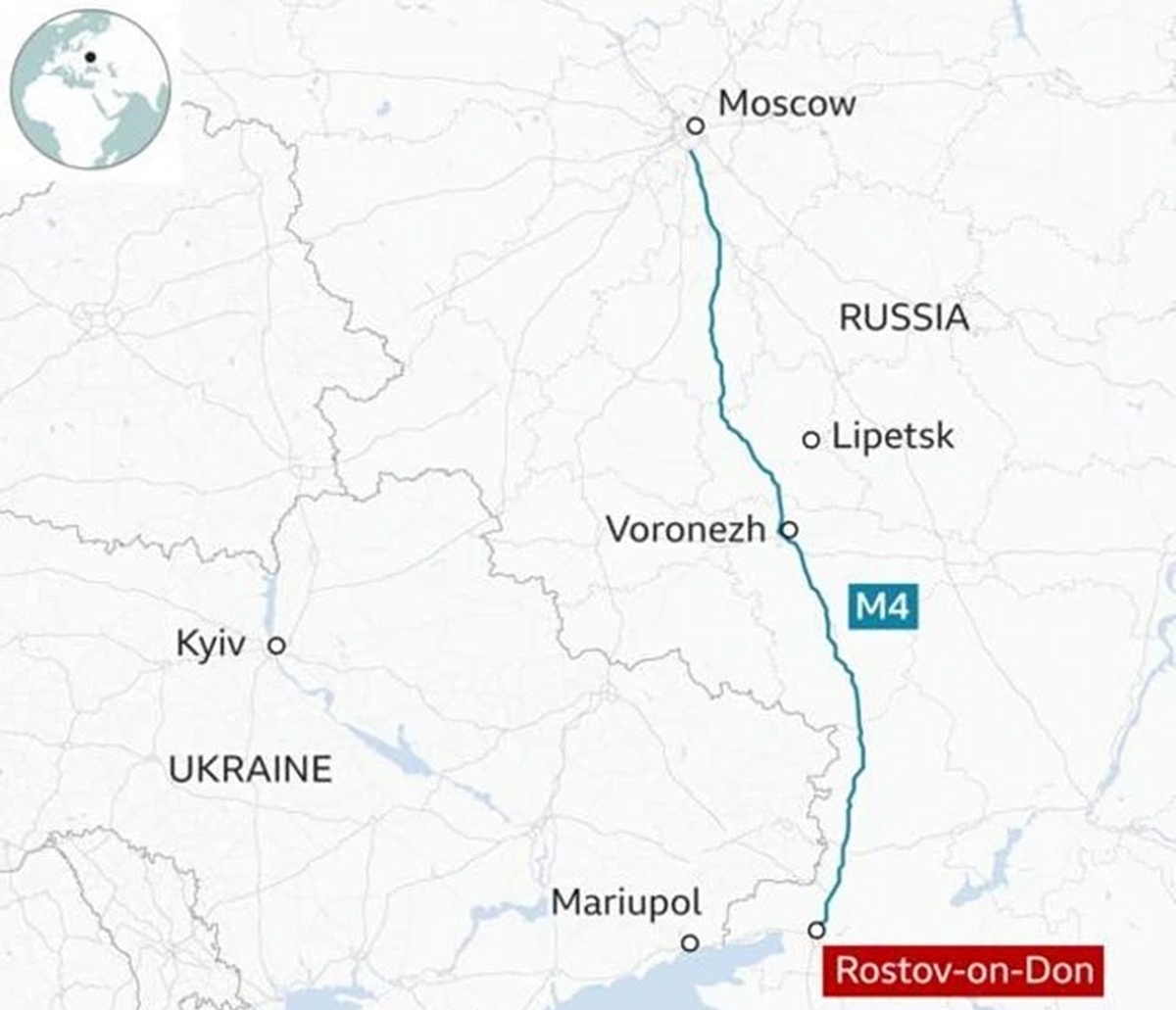 |
The location of Voronezh city, situated on the vital route from Rostov-on-Don to the capital Moskva. Graphic: BBC |
Amidst countless military propaganda posters throughout the city, smaller signs indicate that not everyone wants the conflict to continue.
After Russia launched its campaign in Ukraine, local artist Mikhail attached numerous small ceramic plaques to buildings and walls across the city with calls for peace.
"I want to remind people of the stories of our grandparents and ancestors, who throughout my childhood always said that conflict is terrible," said the 28-year-old artist, known as Noi. "What we should strive for is peace."
Vu Hoang (According to AFP)