"As part of planned combat training activities, the nuclear-powered submarine Arkhangelsk launched an Oniks cruise missile while submerged in the Barents Sea, targeting a simulated enemy surface vessel over 200 km away. Monitoring data shows the Oniks missile successfully hit the target," Russia's Northern Fleet announced on 3/6.
A video released shows the Arkhangelsk submarine operating on the surface before submerging and firing an Oniks missile from beneath the sea.
The Arkhangelsk submarine began construction in 3/2015, was launched in 11/2023, and was commissioned into the Russian navy more than one year later. It is the 4th vessel of Project 885M "Yasen-M", Russia's most modern multi-role nuclear submarine.
Yasen-M class submarines are 130 meters long, 13 meters wide, and have a submerged displacement of approximately 13,800 tons. They can operate at a depth of 520 m, travel underwater at speeds of about 60 km/h, and operate continuously for 100 days with a crew of 64.
Each submarine is equipped with 8 vertical launch systems capable of carrying 32 P-800 Oniks or 40 Kalibr cruise missiles, along with 10 x 533 mm launch tubes that can carry up to 30 torpedoes or mines. Each vessel is also equipped with Igla-S or Verba man-portable air-defense systems to counter aerial threats.
During his inspection of the Arkhangelsk last year, Russian President Vladimir Putin said this submarine was "the most modern, best equipped, and capable of performing various missions." He emphasized that the Arkhangelsk and other Yasen-M class submarines "can do everything," referring to their ability to strike underwater, surface, and land targets.
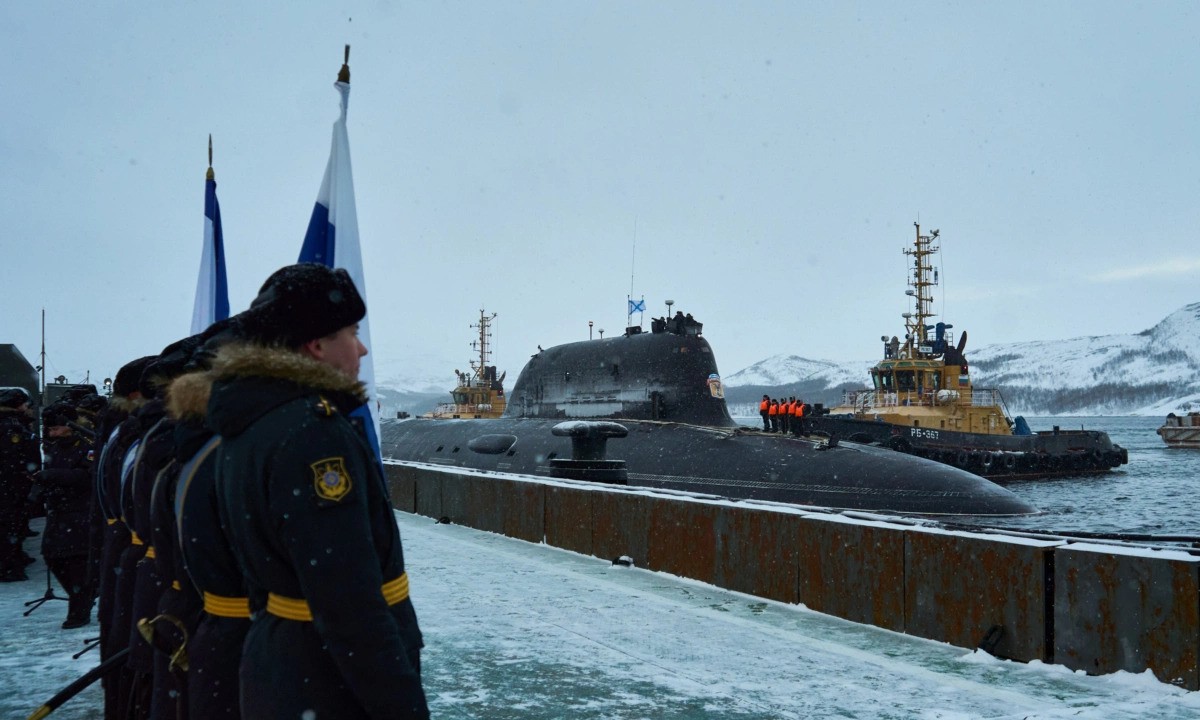 |
The nuclear submarine Arkhangelsk at its homeport in 1/2025. Photo: BQP Nga |
The Oniks supersonic missile boasts a speed of 3,200 km/h and a range of 600-800 km, utilizing a 250 kg high-explosive warhead. The original P-800 model was designed to destroy aircraft carriers and large warships, but the Russian military began using this weapon to strike ground targets during its campaign against Syrian militants in late 2016.
The P-800 uses an inertial navigation system and activates an active radar seeker in its terminal phase to home in on targets. For land attack missions, Oniks can use the GLONASS satellite navigation system to strike predetermined coordinates or employ radar to track targets with high contrast against their surroundings.
Colonel Yuri Ignat, spokesperson for Ukraine's Air Force Command, stated in 4/2025 that Oniks missiles typically fly at an altitude of 10 km during their cruise phase, but descend to 10-15 m when approaching a target. "This, combined with its very high speed, makes it almost impossible to shoot down in time," he said.
Pham Giang (According to TASS, RT, New Voice of Ukraine)