


A video released by Ukrainian media on 26/1 showed a Russian unmanned aerial vehicle, believed to be a Geran model, flying low and circling over the capital Kyiv. There were no air defense alarms at the time, nor any indications that Ukrainian forces attempted to shoot down the target.
The Ukrainian military has not commented on the information.
Russian UAV flies over Kyiv in a video released on 26/1. *Video: Kyiv Info, RBC Ukraine*
Ukrainian experts suggest the incident occurred because the Russian unmanned aerial vehicles flew at low altitudes, possibly below 100 meters, catching the air defense network by surprise. They also warned of a more serious risk: Russian intelligence may have identified the positions of Ukrainian air defense units and surveillance radars. This information could be provided to UAV operators, allowing the aircraft to avoid these areas and enter Kyiv airspace undetected.
Russian military news site RusVesna reported that one of the reconnaissance unmanned aerial vehicles operated for about 4,5 hours over Kyiv. Russian forces used BM-35 aircraft equipped with Starlink satellite Internet transceivers, offering a range of up to 500 km and high anti-jamming capabilities. "The unmanned aerial vehicles appeared over the city center, across both banks of the Dnieper River, and in several districts of the capital Kyiv. The UAVs utilized Starlink terminals, thus avoiding jamming. It remains unclear why Ukrainian air defenses did not shoot them down", the news site stated.
Rybar, a social media account linked to the Russian military and often used as an alternative source for official Moscow statements, indicated that the unmanned aerial vehicles were likely equipped with LTE modems or Starlink Mini transceivers capable of operating within Ukrainian territory. This type of aircraft, combined with Ukraine's shortage of air defense ammunition, allows Russia to resume aerial reconnaissance operations over Kyiv, similar to the early stages of the conflict.
"However, the current situation will not last indefinitely. The adversary is actively seeking countermeasures against Geran unmanned aerial vehicles. The Russian military should capitalize on current achievements, minimizing the time between receiving images from reconnaissance UAVs over Kyiv and deploying appropriate weapons. If additional reconnaissance satellites with high-resolution imaging capabilities are available, the effectiveness of reconnaissance operations will further improve", Rybar added.
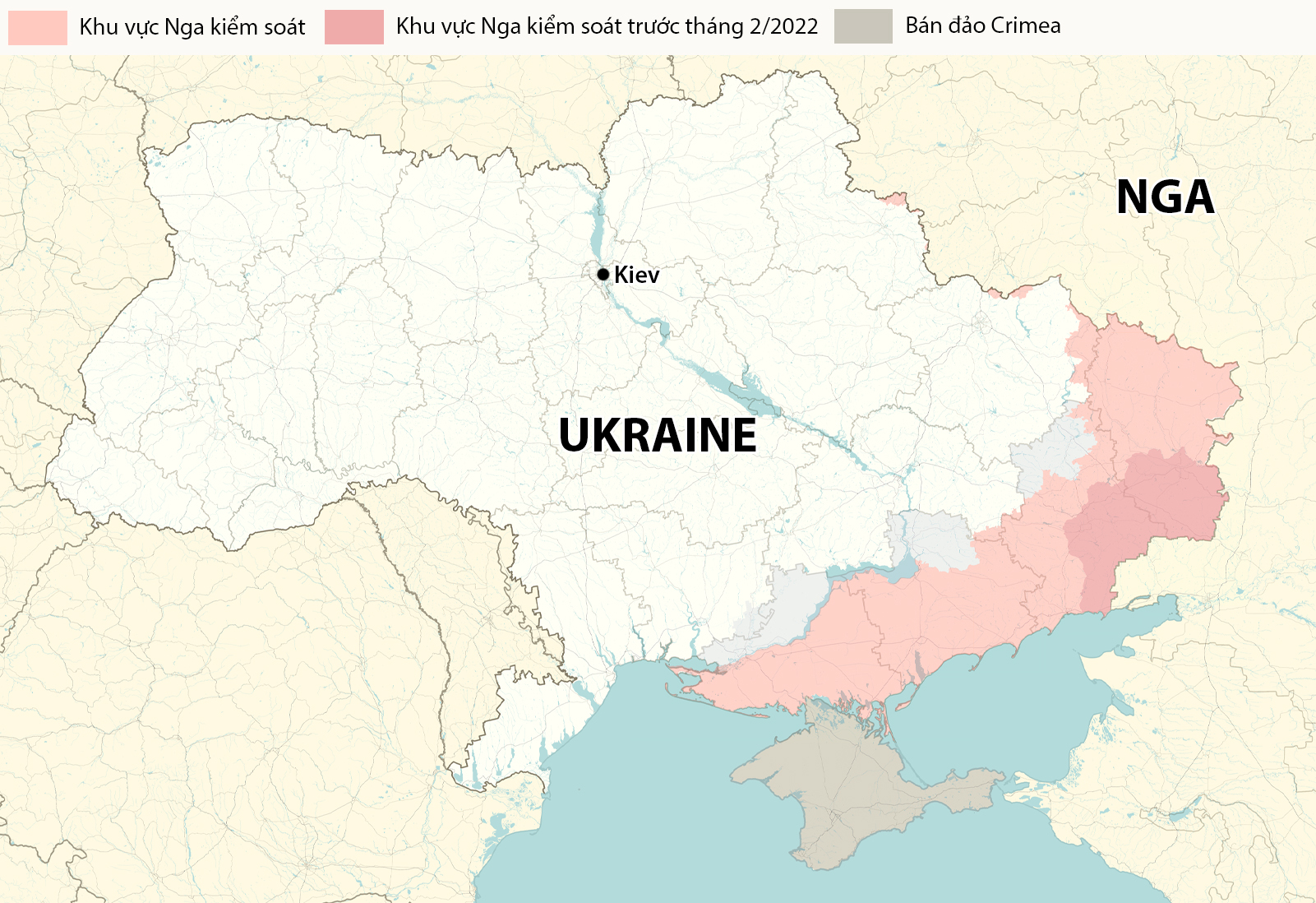 |
Location of Ukraine's capital, Kyiv. *Graphic: RYV*
Russia is continuously upgrading its Geran series of unmanned aerial vehicles, including increasing warhead mass, equipping them with jet engines, cameras, and Internet connectivity via mobile networks or satellites. They are even fitting these aircraft with air-to-air missiles and man-portable air defense systems.
Additionally, Russian forces have recently appeared to use BM-35 suicide unmanned aerial vehicles, also known as Italmas, multiple times to strike Ukrainian targets. This model is constructed from lightweight composite materials, carries a warhead weighing up to 40 kg, has a speed of 100-200 km/h, a range exceeding 200 km, and costs approximately 22,000 USD per unit.
Some BM-35 aircraft have recently integrated Starlink transceivers, suggesting Russia is using them to hunt for high-value targets at medium range, far from the front lines but not too deep within the rear. Anton Zemlyany, an expert at the Ukrainian Center for Security and Cooperation, warned that the BM-35 will be one of Russia's primary precision weapons, fully utilized to hunt expensive systems such as Patriot air defense missiles and HIMARS multiple rocket launchers, in addition to ballistic and cruise missiles.
Nguyen Tien (According to AFP, AP, RBC Ukraine, TSN)


