Private exchanges via messaging applications between heads of state are often likened to "invisible pillars" that help maintain world order. Even when publicly criticizing each other sharply, leaders typically maintain backchannels to seek compromise and prevent worst-case scenarios.
This form of communication emerged in the 2000s and became more prevalent during the Covid-19 pandemic, when direct meetings became difficult. Western leaders frequently exchanged messages this way to reach agreements on even the most complex issues, without concerns about the content of their conversations being leaked.
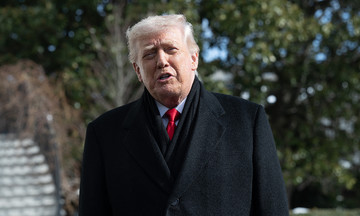
This usually discreet practice was broken by then-US President Donald Trump on 20/1. Within one hour, he successively posted screenshots of exchanges with French President Emmanuel Macron and NATO Secretary General Mark Rutte on social media.
Mareike Kleine, a political scientist at the London School of Economics specializing in informal or confidential communication, stated that she had never seen any precedent for a head of state publicly disclosing private messages from another leader, as the US President had just done.
"It has certainly never happened in this form and with such potentially significant consequences," Kleine told The Times.
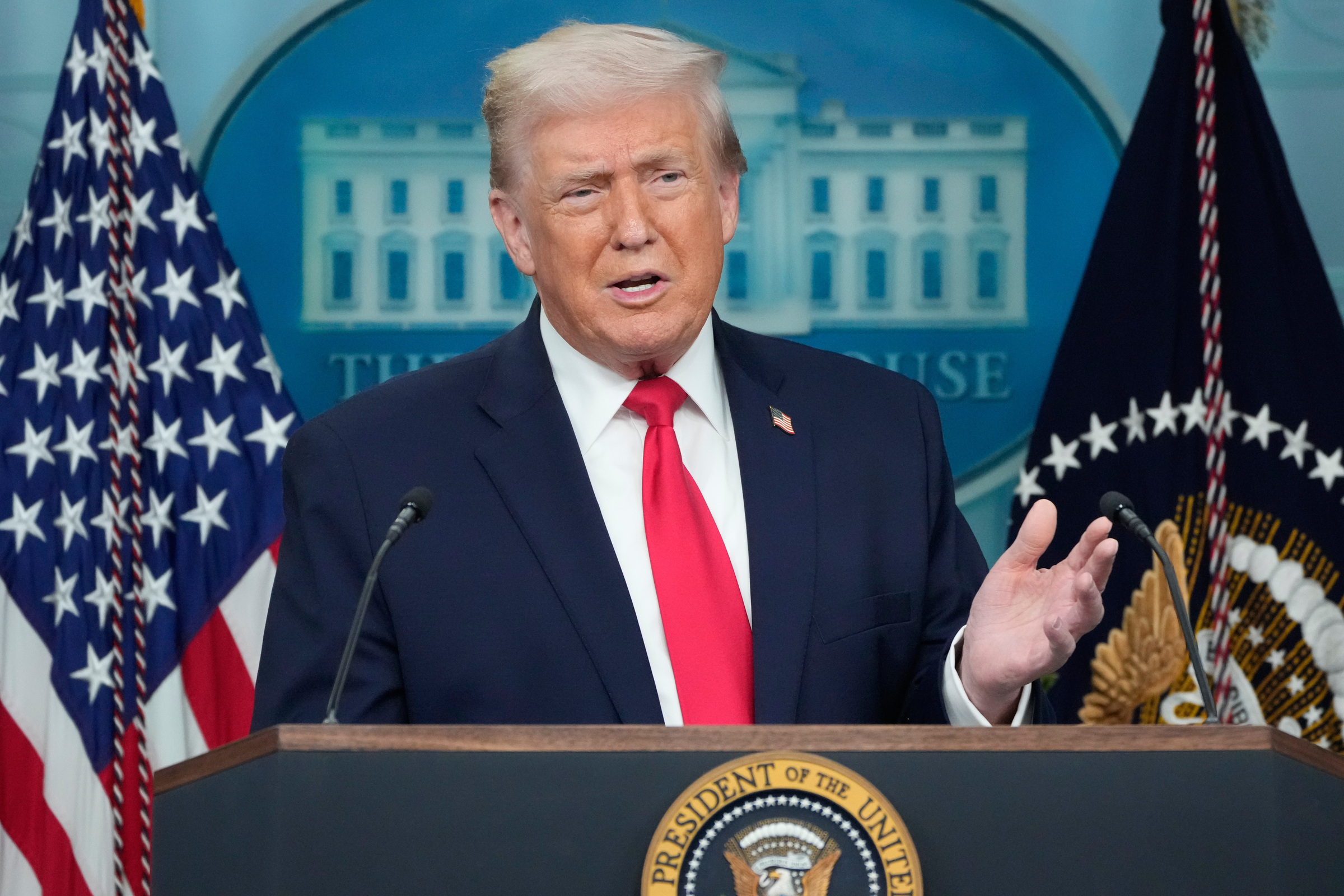 |
Donald Trump speaking at the White House on 20/1. Photo: AP
In his private message, President Macron discussed cooperation in the Middle East with President Trump, as well as proposing a de-escalation of tensions between Europe and the US regarding Greenland. The White House chief had recently advanced the idea of US control over the autonomous Danish island, not ruling out military measures to achieve this goal.
"My friend, we are completely in agreement on Syria. We can do great things on Iran. I do not understand what you are doing with Greenland. Let's build great things together," President Macron wrote in the message, which was in English.
The Elysee Palace chief also proposed a G7 meeting in Paris on 22/1 after the World Economic Forum (WEF) in Davos, Switzerland, concluded. President Macron later invited President Trump to dinner in Paris before the US leader departed for home.
Former French diplomat Francois-Joseph Schichan suggested that the public disclosure of these messages could embarrass Macron, as some parts were overly exposed.
"At the very beginning of the message, President Macron acknowledged something he had never said publicly: that he did not understand Trump's behavior regarding Greenland," Schichan commented to the BBC. The message also showed Macron attempting to "conduct diplomacy in a traditional manner," but it was ineffective with President Trump, because he put everything on social media and the plan fell apart.
President Trump later published messages from NATO Secretary General Rutte praising US achievements in Syria, the Gaza Strip, and Ukraine, stating he "would highlight these in his remarks in Davos" and "committed to finding a way forward" on the Greenland issue.
According to former NATO spokesperson Oana Lungescu, the content of Secretary General Rutte's messages did not differ significantly from his public statements.
"The risk here is that what belongs in the private sphere is no longer guaranteed to be private," Lungescu said, adding that President Trump's posting of such messages reflects the "public diplomacy" trend he pursues.
Nathalie Tocci, director of the Italian Institute of International Affairs (IAI), suggested that Trump seemed to use sarcasm as a "diplomatic weapon."
"The core is to create dependency or concession," Tocci told the FT. "This can be achieved through pressure, as well as by diminishing the opponent's standing and credibility."
Experts argue that Trump has weakened the "safety valve" long implicitly accepted by the diplomatic community. The fear that covert exchanges could be made public at any time is shaking "trust," the foundation of international diplomacy. When this element erodes, diplomacy not only loses flexibility but also easily slides into confrontation and personal dissatisfaction.
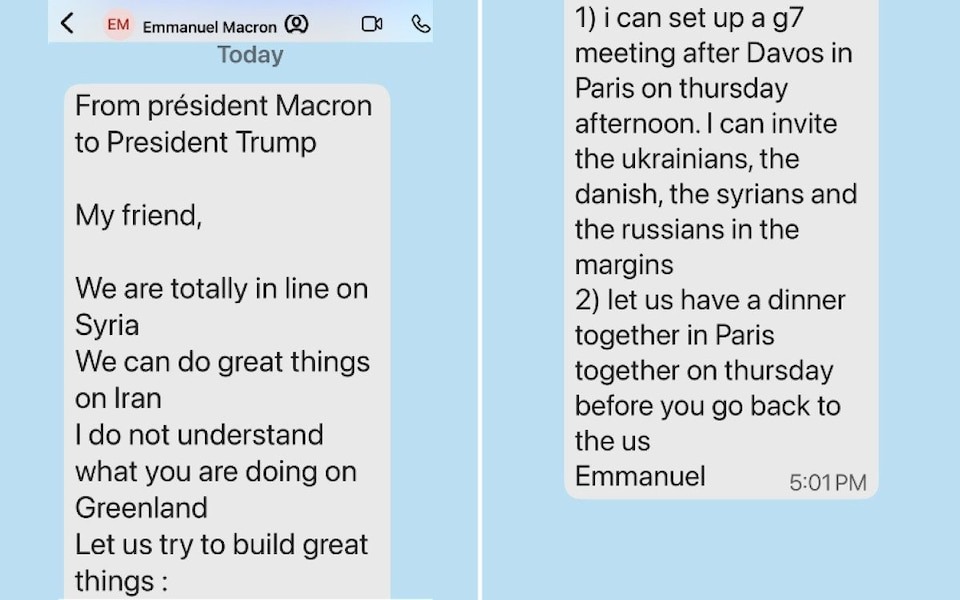 |
French President Emmanuel Macron's message, disclosed by Trump on social media on 20/1. Photo: Truth Social/realDonaldTrump
Lungescu warned that leaders might be tempted to display power on social media, leading to verbal escalation instead of quietly seeking mutually beneficial solutions behind the scenes.
The consequence is that the room for compromise virtually disappears, while official diplomacy stagnates. This could become a serious impediment, especially as the world faces a series of complex issues simultaneously.
However, Kleine does not believe that leaders will abandon using messages to communicate and discreetly resolve complex issues. What is more likely to change is that Trump will increasingly be "marginalized," at least regarding the most sensitive information.
"Certainly, how they deal with President Trump will change," Kleine observed. "He is an unpredictable variable, and they need to assume that anything said to him is unlikely to remain confidential in any way."
Nhu Tam (According to BBC, FT, The Times)