The US Supreme Court issued an emergency order on 29/9, permitting the Donald Trump administration to continue "expedited deportation" to third countries. This decision comes while a lawsuit filed by immigrant advocacy organizations against the policy awaits court arguments in December.
A lower federal court had previously suspended the Trump administration's measure, requiring US government agencies to provide full notification and an opportunity for individuals facing deportation to present concerns about potential torture or persecution in the receiving nation.
This marks the second instance where the Supreme Court has sided with the Trump administration on this issue. Attorney General Todd Blanche stated that the policy is "completely legal and an important tool for enforcing immigration law." He added that the Supreme Court thoroughly reviewed arguments from both sides before making its decision.
 |
Employees at El Salvador's CECOT prison receive individuals deported from the US in 3/2025 under the "deportation to a third country" policy. Photo: AP
The Trump administration has signed agreements with numerous nations, enabling the deportation of approximately 25,000 individuals to at least 29 countries. These include several nations experiencing humanitarian crises, such as the Central African Republic and South Sudan.
According to the Trump administration, individuals deported to a third country are those unable to return to their homeland or whose country of origin refuses to accept them, a group that includes some with criminal convictions. The receiving nations have pledged to the US government that they will prevent oppression or torture.
Government attorney D. John Sauer argued that lower court rulings create significant difficulties for deportation operations, leading to flight cancellations, increased costs, and diplomatic challenges. One such ruling preventing deportation resulted in the government incurring expenses to cancel flights for about 70 individuals destined for three countries.
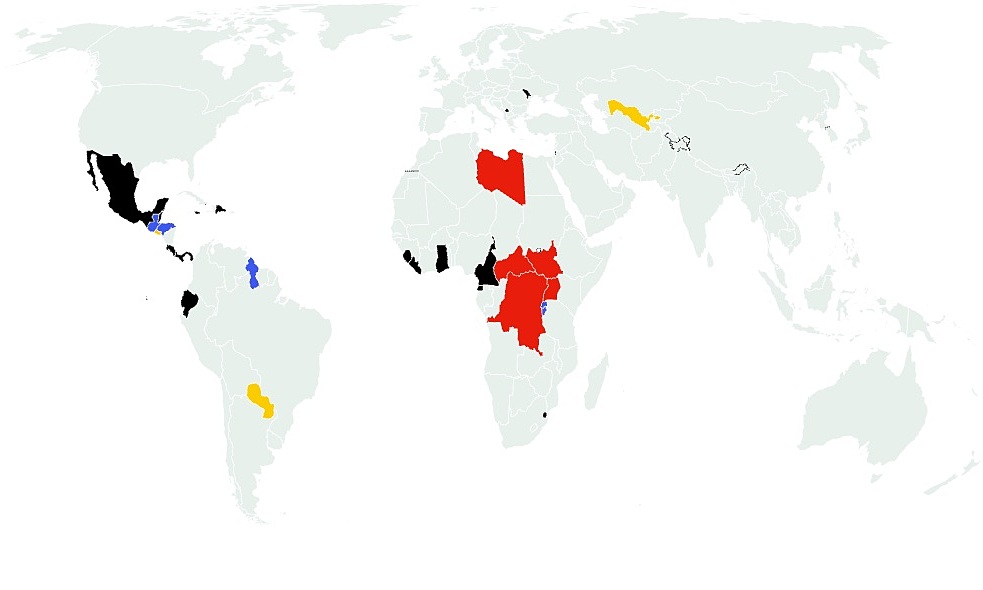 |
Countries receiving individuals deported by the US under the "deportation to a third country" policy. Graphic: Newsweek
Conversely, immigrant advocacy lawyers oppose this policy, contending that individuals facing deportation receive inadequate information and lack a genuine opportunity to express concerns about their safety.
Trina Realmuto, executive director of the National Immigration Litigation Alliance and one of the attorneys involved in the lawsuit, noted that the Supreme Court's new order only temporarily lifts the lower court's injunction. It does not constitute a definitive ruling on the legality of the third-country deportation policy itself.
The US government is currently facing numerous lawsuits related to its immigration crackdown campaign, with President Trump having pledged to deport millions of individuals residing illegally in the country or those who have committed criminal offenses.
By Thanh Danh (Source: Guardian, AP, ABC)