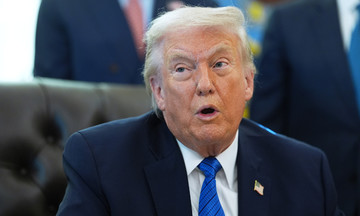
On 3/2, US President Donald Trump stated in the Oval Office, "Putin kept his promise to halt attacks, and a week is a long time. We will do everything because it is truly cold in Ukraine. Russia ceased attacks from 25/1 to 1/2, then resumed them."
When asked if he was disappointed that Russia did not extend its commitment to halt attacks on Kyiv, Trump replied, "I want Putin to do that; I want him to end the conflict."
On 29/1, Trump had announced that Putin agreed to a proposal "to halt airstrikes on Kyiv and other Ukrainian cities for one week" due to extreme cold weather. He did not specify when they communicated. The Kremlin, on 30/1, confirmed the agreement to cease attacks on Kyiv "for one week, until 1/2" was directly proposed by President Trump to facilitate negotiations.
 |
US President Donald Trump on the South Lawn of the White House on 1/2. Photo: AP
Despite this temporary halt, Russia launched a large-scale attack on 3/2. The Russian Ministry of Defense announced its forces used unmanned aerial vehicles (UAVs) and long-range precision weapons from ground platforms and aircraft "in response to Ukrainian attacks on Russian civilian infrastructure."
"The operation's targets were Ukrainian defense enterprises, energy infrastructure supporting their operations, as well as assembly and storage sites for long-range UAVs," the Russian Ministry of Defense stated. "The operation was successful, and all targets were hit."
According to the Ukrainian Air Force Command, Russia launched 450 UAVs and 71 missiles, including 32 Iskander-M tactical ballistic missiles or modified S-300 air defense missiles. Ukrainian air defense intercepted 412 UAVs and 38 missiles, losing track of 6 projectiles. Consequently, 27 missiles and 31 UAVs struck 27 locations.
Explosions as missiles strike Ukraine's capital, Kyiv, in the early hours of 3/2. Video: X/AMK Mapping
This marked the largest coordinated attack using Iskander-M ballistic missiles since the conflict began. The previous highest recorded level was in 10/2025, when Russian forces launched 26 Iskander-M missiles at targets in Ukraine.
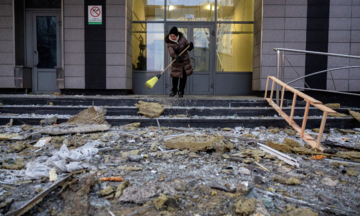
Ukrainian Energy Minister Denys Shmyhal announced that a power plant in the eastern suburbs of Kyiv was severely damaged, describing the country's energy infrastructure as facing serious problems. "It will take considerable time to repair," Shmyhal said, adding, "We are reallocating repair teams and equipment, and also considering options to redirect reserve heat supplies to buildings that have been without power for extended periods."
Ukrainian Minister of Reconstruction Oleksy Kuleba announced that over 1,100 homes in Kyiv lost heating after the attack. Kharkiv city officials reduced capacity and cut heating to 800 households to prevent the entire network from freezing, urging residents to go to city shelters if they needed warmth.
Nguyen Tien (According to AFP, CNN, Reuters, RIA Novosti)