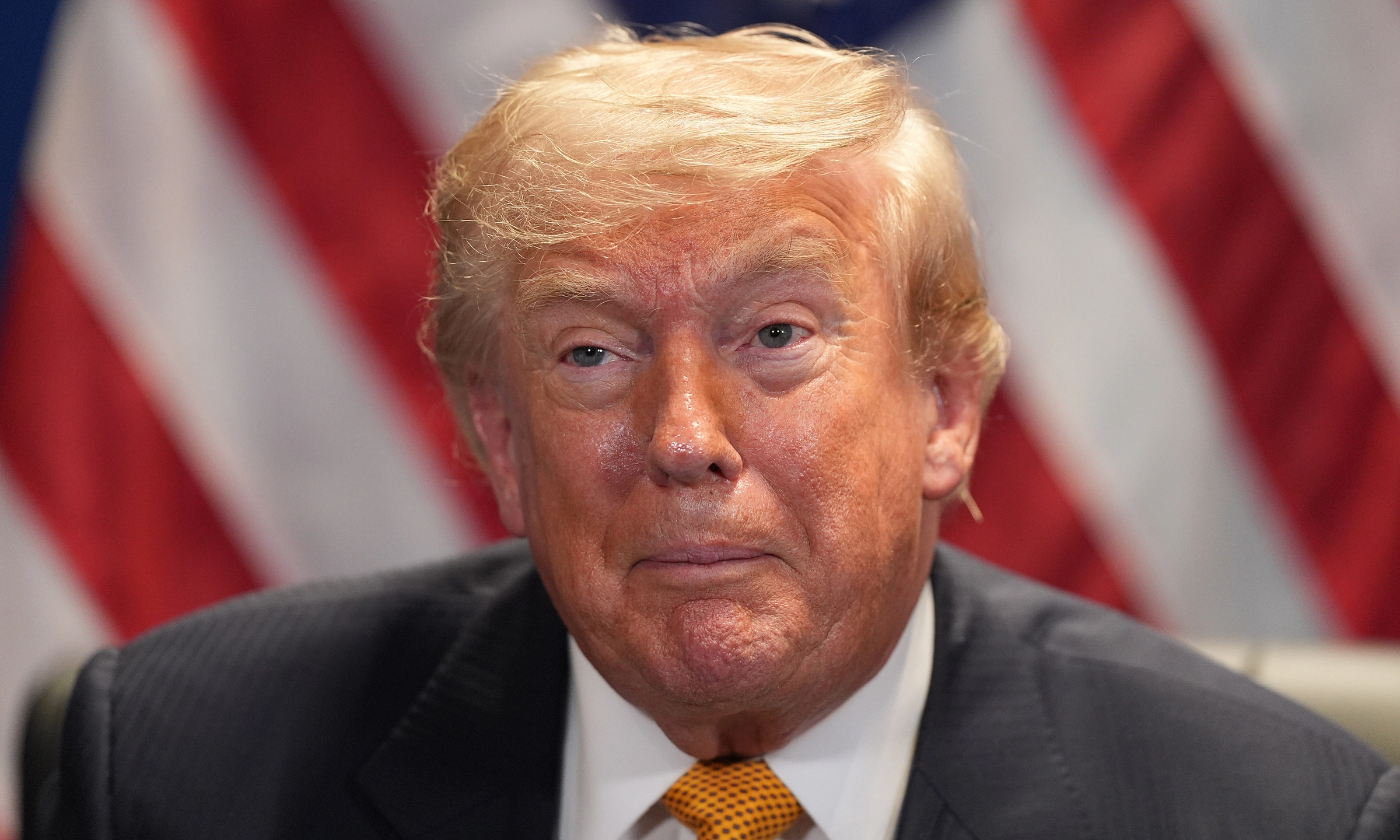
Just two weeks ago, at the opening of the Federal Fair, an event celebrating the 250th anniversary of US independence, President Donald Trump declared, "for the first time in 3,000 years, we are about to have peace in the Middle East". President Trump had also previously lauded the ceasefire agreement with Iran as a "victory" that would help lower gasoline prices in the US.
However, the peace President Trump spoke of is becoming elusive as he announced on 8/7 the "end" of the ceasefire with Iran, less than one month after both sides signed the Islamabad Memorandum aiming for a peace agreement.
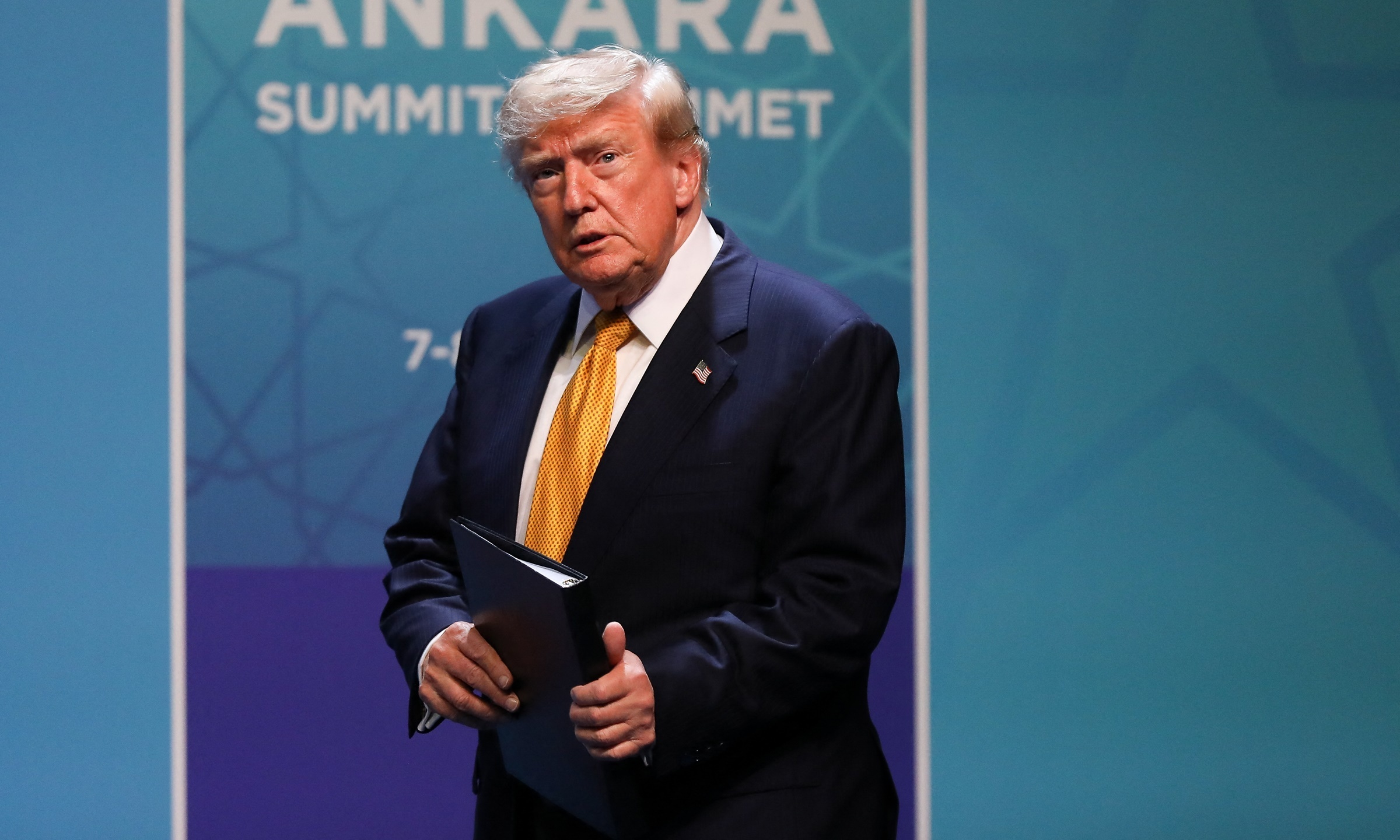 |
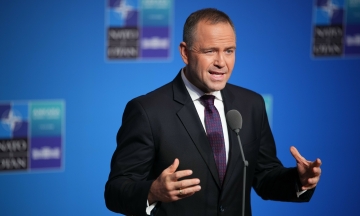
President Donald Trump at a press conference during the NATO summit in Ankara, Turkey, on 8/7. Photo: AFP
"Negotiating with them is just a waste of time", the US president stated on 8/7 at the NATO summit in Ankara, Turkey. "I believe the memorandum signed with Iran has ended".
CNN assessed this as the clearest sign that the deal Trump pursued with Iran has nearly collapsed. Jessica Gardner, a commentator from the Australian Financial Review, remarked that this outcome "was predictable from a rushed ceasefire agreement", and now, Trump faces a dilemma with difficult knots to untangle regarding a new agreement with Tehran.
"Renewed tensions are an almost inevitable consequence of the vague terms included in the Islamabad Memorandum", noted Will Todman, a senior research fellow at the Center for Strategic and International Studies (CSIS). "The document was signed by both sides without addressing the most challenging issues, from who truly controls the Hormuz Strait, the situation in Lebanon, and even nuclear negotiations".
Difficult choices
After both sides exchanged fire, President Trump threatened to resume large-scale airstrikes on Iran, targeting Kharg Island, its largest oil export hub, as well as Tehran's infrastructure and desalination plants.
Yet, Trump has issued similar threats before without acting on them. On 8/7, he also added that he did not foresee a full-scale conflict returning.
Recent US public opinion polls show little support for Washington resuming airstrikes. Some of Trump's Republican allies also voiced concerns about the severe economic and political consequences of a war, with less than 4 months until the midterm elections.
According to Todman, after declaring the ceasefire canceled, President Trump could re-impose a naval blockade on Iranian ports to cut off the country's economic lifeline. However, such a move requires the US to maintain a continuous and strong naval presence in the region. Although during a previous port blockade, Trump asserted it would collapse Iran's economy, this did not happen.
"There is no guarantee that a pressure campaign on Iran this time will yield different results than previous attempts", Todman said.
President Trump announces the ceasefire agreement with Iran has ended. Video: CNBC
Trump could also opt for an ambiguous solution, accepting sporadic conflict in the Gulf interspersed with negotiations. In that scenario, the volume of shipping through the Hormuz Strait, a vital oil transport route, would significantly decrease from approximately 130 trips daily before the conflict, according to Richard Fontaine, CEO of the Center for a New American Security.
But for a president who promised to end the Iran offensive quickly "in just 4 to 6 weeks", a prolonged conflict would mean near-total failure of Trump's initial goal. Moreover, the cost would be substantial, evidenced by the US Department of Defense requesting Congress for approximately USD 70 billion to cover initial operations in the Iran campaign, a cost that increases weekly.
"The problem is that all options, whether escalating conflict or accepting compromise, have their own drawbacks", Fontaine commented. "The most likely scenario is a series of small, tit-for-tat attacks, followed by intense diplomatic efforts from intermediaries to reach another fragile ceasefire, potentially followed by another round of airstrikes".
"It will be a prolonged tug-of-war between cold war and low-level armed conflicts", he added.
Fontaine noted that many issues Trump faces are exacerbated by the ceasefire agreement with Iran itself. The agreement left the fate of Tehran's high-grade enriched uranium stockpile unresolved, awaiting future negotiations, which the president now declares he is no longer keen to pursue.
The agreement also granted Iran at least partial control over traffic through the Hormuz Strait. This is the weapon the Islamic Revolutionary Guard Corps (IRGC) has used to drive up oil prices and is now employing to legitimize attacks on commercial vessels not complying with their new regulations in the strait.
"Iran is aggressively seeking to impose control over the Hormuz Strait and claims this as their sovereign right", stated Kevin Donegan, a former US vice admiral. "That is a key card in their hand, so we can anticipate they will continue to try and obstruct any vessels that follow routes other than those they have announced".
Economic pressure
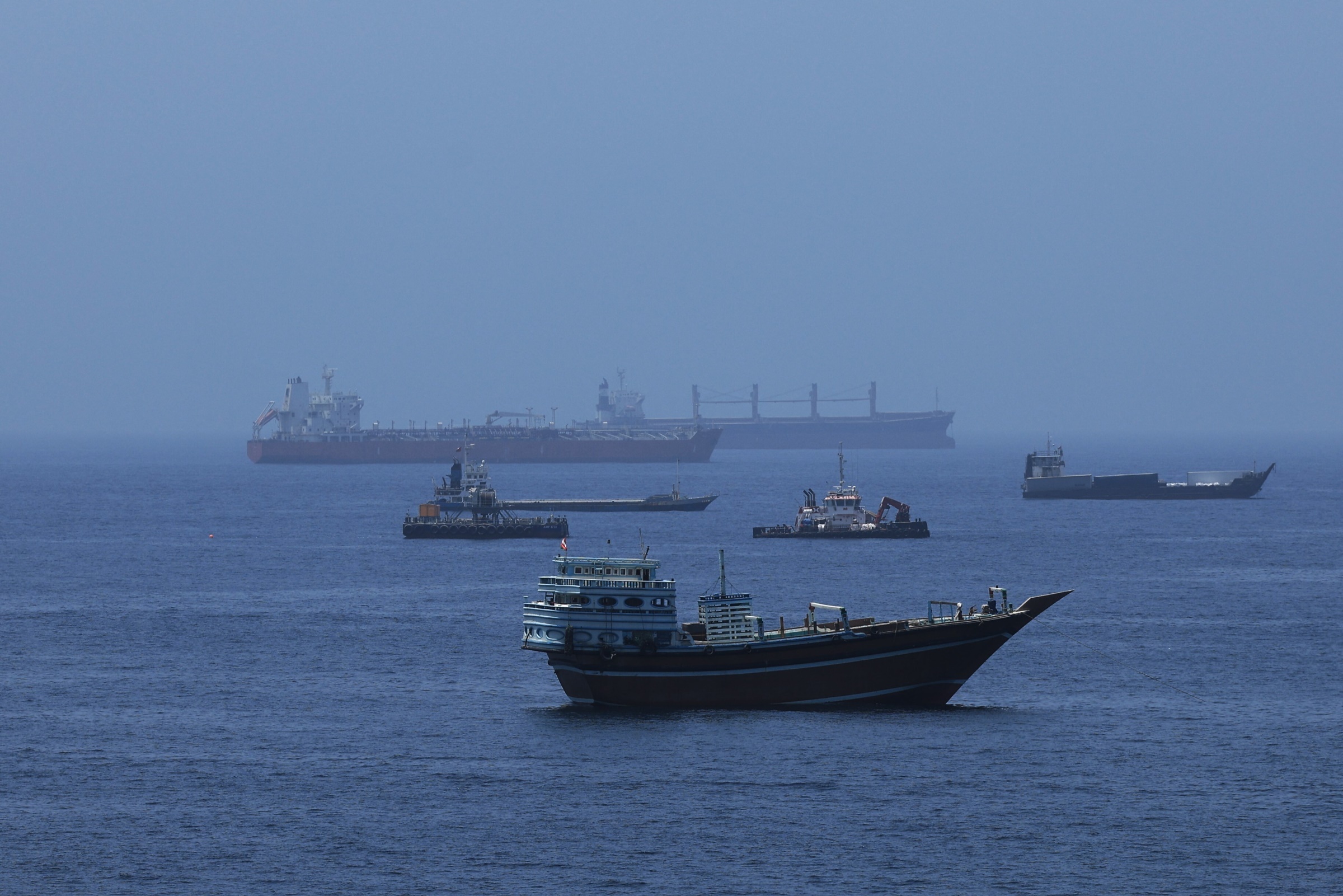 |
Commercial cargo ships and oil tankers anchored in the Gulf of Oman, off the coast of Muscat, Oman, preparing to transit the Hormuz Strait on 21/6. Photo: AFP
After Trump signed the memorandum with Iran on 18/6, world oil prices plummeted, falling below pre-conflict levels last week. The oil market improved as the Hormuz Strait partially reopened, allowing crude oil to gradually flow out of the Persian Gulf after months of congestion. Gasoline prices also slowly cooled to reasonable levels.
However, three weeks of partial reopening of the strait are insufficient to fix the largest oil supply shock in world history. This period has not been enough to fill the commercial and emergency reserves the US needs to fuel itself, nor to avert an impending "economic catastrophe", remarked David Goldman, a veteran CNN commentator.
No one knows whether this new outbreak of fighting in the Middle East is a temporary incident or if a full-scale confrontation is imminent. In the latter scenario, if the Hormuz Strait is blocked again, the US economy could suffer an undesirable heavy blow, Goldman warned.
Approximately 200 million barrels of oil were transported through the Hormuz Strait during the three-week ceasefire, according to Andy Lipow, president of Lipow Oil Associates consulting firm. This volume is equivalent to two days of global consumption.
Notably, about 60 million barrels of this oil came from Iran, a country that the Trump administration re-imposed sanctions on 7/7, giving buyers only 10 days to receive this oil before it was prohibited from being traded again.
The Hormuz Strait remains open, but with very high risk premiums. To charter an oil tanker to transport from outside the strait to Asia, costs range from USD 4 to 5 million. Meanwhile, according to Lipow, bringing a ship inside the strait to transport oil to Asia would cost USD 8 to 10 million.
Traffic through the strait has been consistently at about one-third of normal levels over the past three weeks, and shipping continued on 8/7, although at least 4 oil and gas tankers had to turn back when attempting to pass through the strait that morning, according to Reuters.
"If crude oil stops flowing through Hormuz, the US oil market will certainly face major problems", Goldman said.
The Strategic Petroleum Reserve, the US's emergency oil backup, has significantly decreased since the conflict erupted to compensate for oil blockages in the strait. It now stands at only 319,5 million barrels, a 23% drop from pre-conflict levels and the lowest mark since the Ronald Reagan administration began filling the reserve in 1983.
"This situation leaves the US more precarious than ever if it faces severe weather or if the Hormuz Strait is once again completely closed", Goldman said.
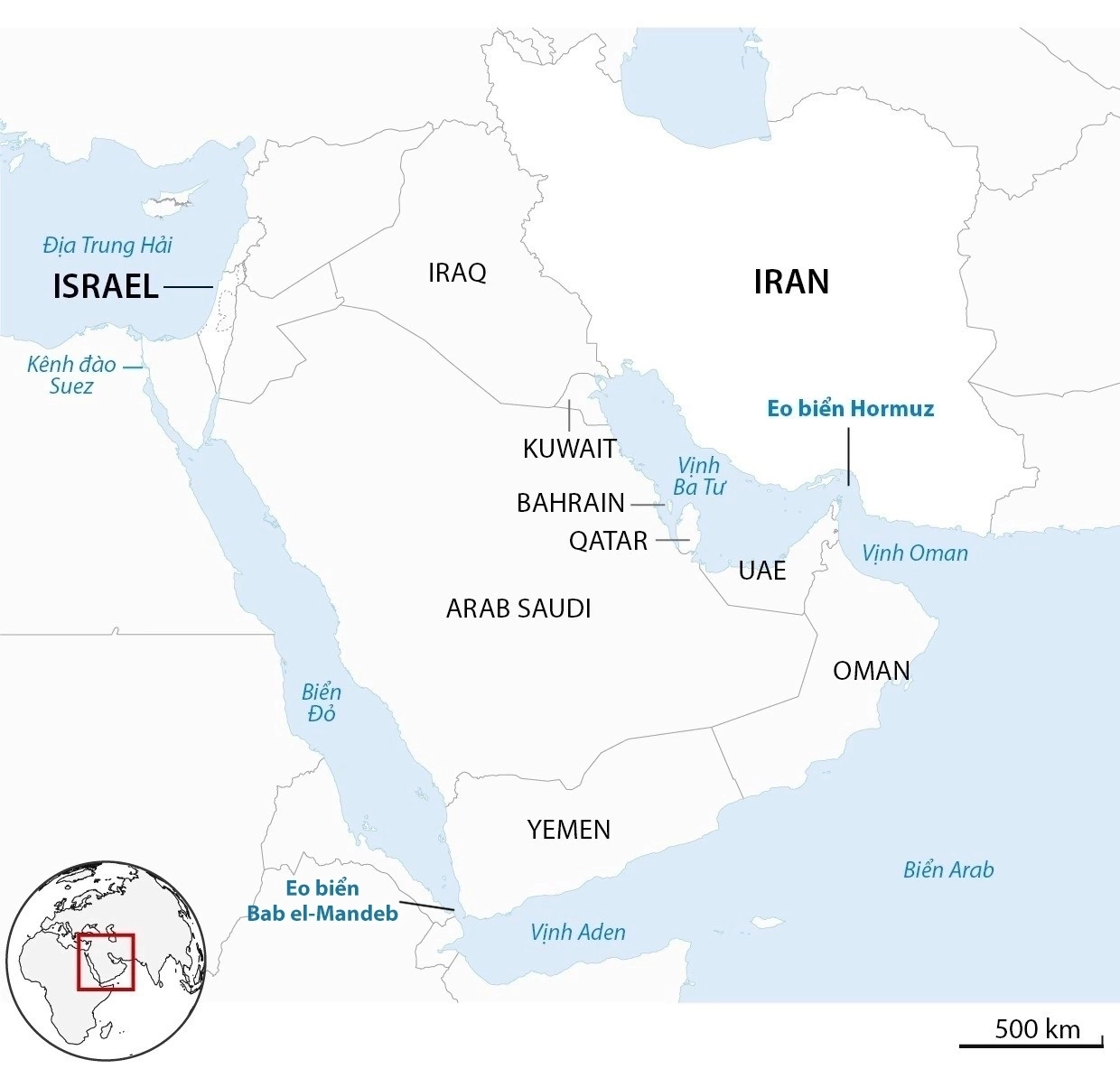 |
Location of the Hormuz Strait. Graphic: Guardian
A more troubling factor is that US commercial inventories remain at alarming levels. Oil stockpiles at the Cushing Hub in Oklahoma, known as the "pipeline crossroads of the world", continue to be below safe operating thresholds.
Although inventories at Cushing increased by about 700,000 barrels last week, the current figure is still under 20 million barrels, a level that makes it difficult for the hub to pump crude oil to refineries nationwide.
This prompted Trump to warn that low oil inventories could harm the US economy.
"I do not want to see an economic catastrophe", the president stated at the G7 summit late June. "If this situation continues, it could absolutely happen".
Vu Hoang (According to CNN, AFP, Reuters)