Central Command (CENTCOM), the US military's operational authority in the Middle East, announced on 16/7 that marine forces boarded the oil tanker Wen Yao in the Gulf of Oman. The mission aimed to ensure the vessel's full compliance with a US-imposed blockade.
According to data from the maritime tracking website TankerTracker, the Wen Yao changed its identification on the navigation system from "LAN JING" to "AZHIN" on the afternoon of 16/7. It subsequently changed its country of registration from Curacao to Iran. A CENTCOM-released video also showed the Iranian flag at the ship's stern.
CENTCOM stated that the US military had forced three commercial vessels to change course since the Iranian seaport blockade took effect on the evening of 15/7. "The Strait of Hormuz and surrounding waters remain free and open to all vessels, except those attempting to breach the US blockade's steel wall," CENTCOM declared.
A day prior, a US aircraft launched a Hellfire missile at the Curacao-flagged oil tanker Belma as it moved through international waters in the Arabian Sea. The missile struck the smokestack, disabling the ship and preventing it from continuing its journey, but it did not threaten the crew's lives. CENTCOM accused the Belma of heading towards Iran's Kharg Island despite multiple warnings from US forces.
This marks the second time the US has imposed a seaport blockade on Iran this year. Washington conducted a previous operation from 13/4 to 18/6, which disabled 9 vessels and forced over 140 others to change course. The Pentagon estimated that the first blockade resulted in Iran losing approximately USD 4.8 billion in oil revenue by 1/5.
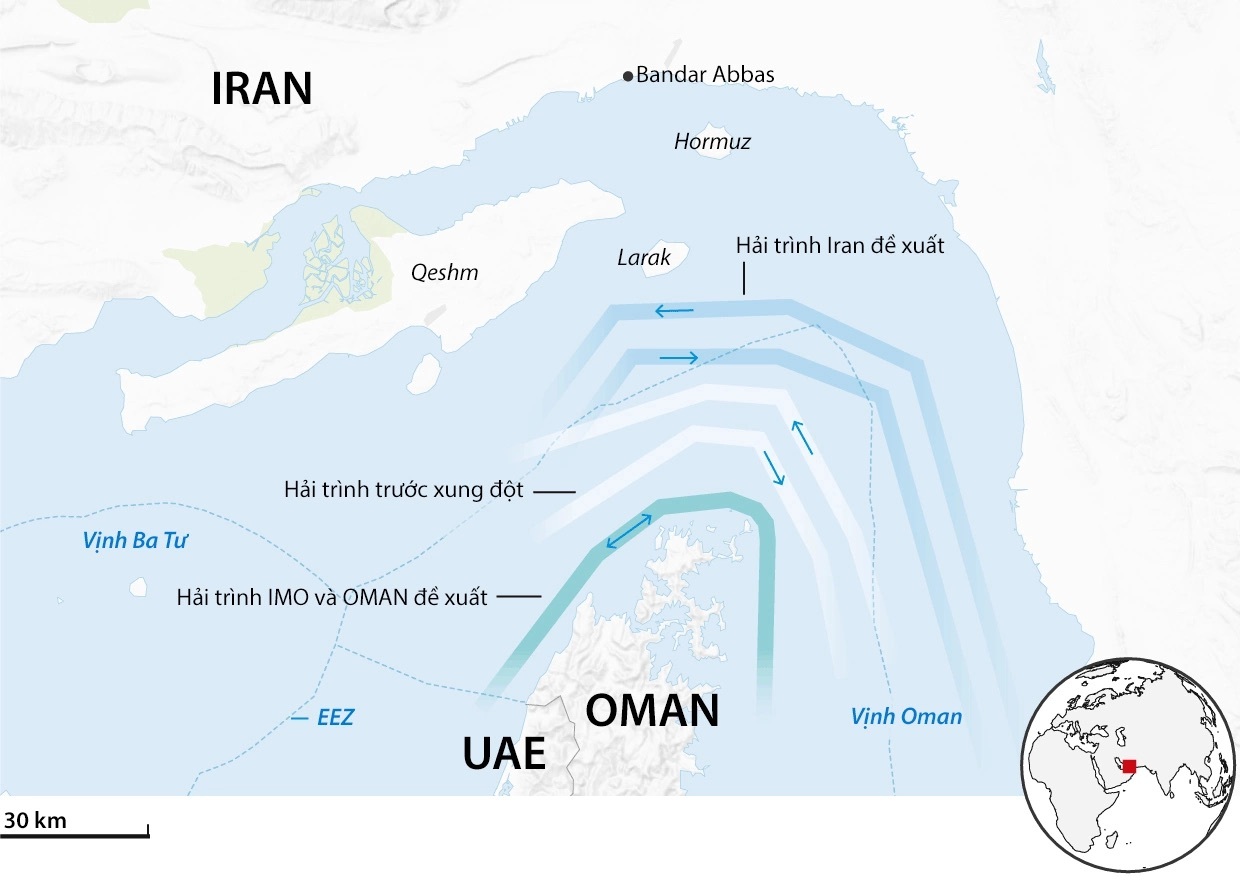 |
Shipping routes through the Strait of Hormuz. Graphics: Guardian |
After the US and Iran signed a memorandum in mid-June, the Gulf region experienced about three relatively calm weeks. However, tensions resurfaced when the US, in coordination with Oman and the International Maritime Organization (IMO), established a new shipping lane south of the Strait of Hormuz, entirely within Omani territorial waters. This initiative aimed to encourage commercial vessels to avoid the northern route that passes through Iranian waters.
Iran's Islamic Revolutionary Guard Corps (IRGC) accused the US of "imposing its will" on the Omani government by attempting to direct vessels through a shipping lane that Iran considers "illegal". Subsequently, numerous commercial ships passing through the Strait of Hormuz were attacked, leading to retaliatory strikes between Washington and Tehran.
By Thanh Danh (AFP, Reuters)