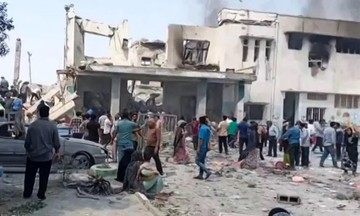
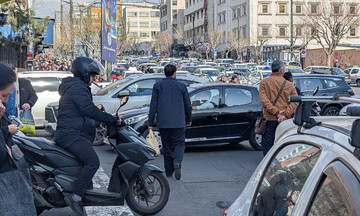
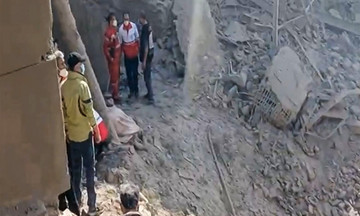
On 28/2, the US and Israel launched a large-scale operation targeting defense and intelligence facilities, as well as the residences of numerous senior officials and generals in Iran. Iranian state media confirmed the deaths of several key military officials.
Beyond these officials, Iran's most significant loss is the death of Supreme Leader Ali Khamenei. Iranian state media confirmed on the morning of 1/3 that Khamenei, 86, was "martyred" following an attack on his residence. The Iranian government declared 40 days of national mourning.
Iran has established a council, as per legal regulations, to govern the country after the death of Supreme Leader Ali Khamenei. The council comprises Iran's incumbent president, the head of the judiciary, and a member of the Guardian Council selected by the Expediency Discernment Council, an advisory body to the supreme leader that resolves disputes with parliament.
Iran's current president is Masoud Pezeshkian, who follows a reformist path, while the head of the judiciary is Chief Justice Gholamhossein Mohseni Ejei, known for his hardline views.
 |
Losses to Iran's power structure. Graphics: RYV. |
Chief of staff of the armed forces
Abdol Rahim Mousavi became the chief of staff of the Iranian armed forces in 6/2025, following the assassination of his predecessor, Mohammad Bagheri, by Israel. With decades of military experience, General Mousavi was the first army commander to hold this position. Previously, the role had always been held by Islamic Revolutionary Guard Corps (IRGC) members.
Commander of the Islamic Revolutionary Guard Corps (IRGC)
The IRGC appointed Mohammad Pakpour as its commander, replacing predecessor Hossein Salami, who died in the Iran-Israel conflict in 6/2025.
He previously commanded IRGC armored units before leading a combat division during the conflict with Iraq in the 1980s. The Iranian general served as commander of the IRGC's ground forces for 16 years until becoming its head.
 |
Mohammad Pakpour attends a military parade in Tehran, Iran in 2024. Photo: AFP. |
Head of the National Defense Council
During the Iran-Iraq conflict in the 1980s, Ali Shamkhani was an IRGC commander. He later became commander of the Iranian navy and the IRGC's naval branch. He served as defense minister from 1997 to 2005 and was the first Iranian defense official to visit Saudi Arabia since the Islamic Revolution.
He placed third in the 2001 presidential election and headed the Supreme National Security Council (SNSC) from 2013 to 2023, becoming the second-longest serving individual in that position since 1979, after former President Hassan Rouhani.
Shamkhani was recently appointed secretary of Iran's National Defense Council, an agency established after the 2025 conflict with Israel to coordinate national security and defense policies.
Defense Minister
Aziz Nasirzadeh participated in the Iran-Iraq conflict and previously served as deputy chief of staff of the Iranian armed forces and air force commander, before becoming defense minister in 8/2024.
Pham Giang (According to IRNA, First Post, Al Jazeera)