The US Naval Air Systems Command (NAVAIR) announced on 14/1 that it had completed tests of manned-unmanned teaming (MUM-T) capabilities. This activity took place at the Point Mugu range in California on 11/12/2025.
The test aimed to refine manned-unmanned teaming between crewed aircraft and loyal wingman unmanned aerial vehicles (UAVs), a concept under development by the US military. Two BQM-177A target drones were modified into loyal wingman UAVs, controlled by Shield AI's Hivemind software.
These UAVs connected to a simulation where a virtual F/A-18 fighter jet commanded and directed the two BQM-177As to protect a target area from simulated enemy aircraft. "When the enemy approached the area and threatened US forces, the two BQM-177As responded to their assigned mission in fully autonomous mode," NAVAIR stated.
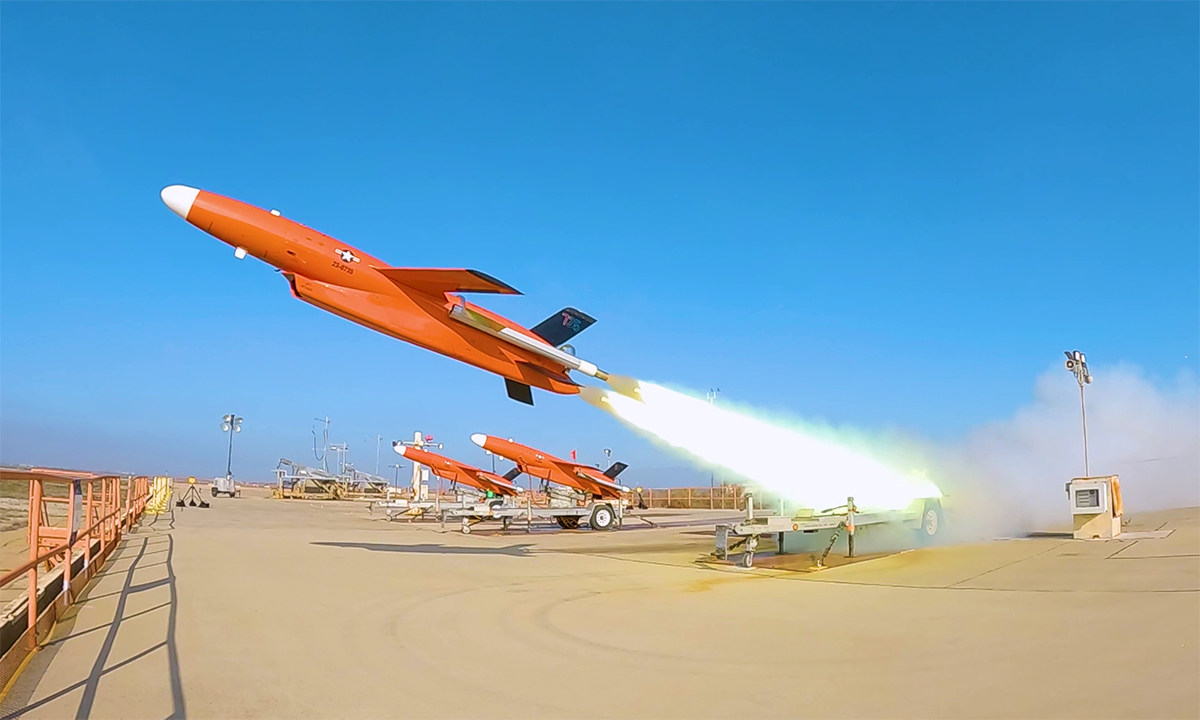 |
Loyal wingman UAV BQM-177A takes off during the December 2025 test. *US Navy*
Rear Admiral Tony Rossi, head of the US Navy's Unmanned Aviation and Strike Weapons Program, noted this as a crucial step towards enhancing the force's autonomous UAV capabilities.
"Equipping manned and unmanned platforms with autonomous capabilities, supported by artificial intelligence, will be crucial as the US Navy develops its next-generation air wing concept and prepares for more complex operating environments," he said.
The US Navy has conducted various tests to develop tactics and strategies for manned-unmanned teaming, though real-world deployment of this ambition is not expected for several years.
The Naval Air Warfare Center Aircraft Division (NAWCAD) announced on 5/1 a significant achievement in advancing the integration of F-35 stealth fighters with the navy's loyal wingman UAV program, through recent virtual tactical tests.
During these virtual tests, F-35 pilots utilized tablets to control UAVs for a range of simulated missions. They also employed communication systems and guided missiles to address complex threats.
Nguyen Tien (According to USNI, AFP, AP)