During their meeting in Kazan today, Prime Minister Le Minh Hung and Russian President Vladimir Putin discussed directions and measures to create breakthroughs in bilateral cooperation, aiming for substantial results. This is intended to solidify the foundation of their comprehensive strategic partnership for long-term development and effectively serve the development goals of each nation, according to the Ministry of Foreign Affairs.
The two sides agreed to enhance regular dialogue and maintain exchanges between their leaders to promptly discuss bilateral and multilateral issues. Defense and security cooperation was identified as a strategic pillar, with a commitment to boosting collaboration on cybersecurity and military exchanges between the two countries.
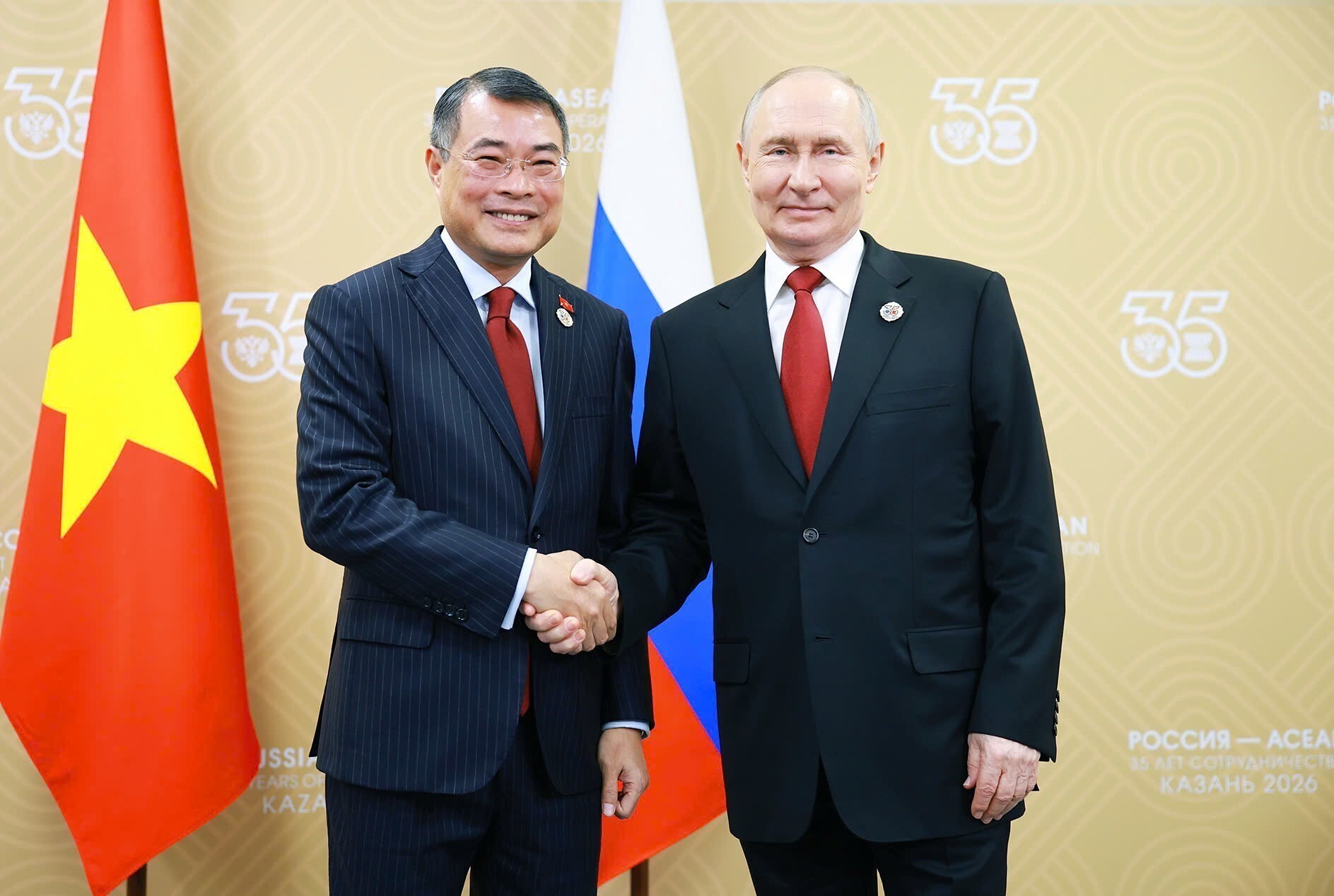 |
Prime Minister Le Minh Hung met Russian President Vladimir Putin on 18/6. Photo: TTXVN |
Prime Minister Le Minh Hung met Russian President Vladimir Putin on 18/6. Photo: TTXVN
Both leaders assessed that Vietnam-Russia cooperation faces many opportunities and potential. Building on the agreed cooperation orientations, Prime Minister Le Minh Hung and President Vladimir Putin agreed to accelerate negotiations for the early implementation of the Ninh Thuan 1 nuclear power plant construction project.
They consider energy cooperation, encompassing oil, gas, and nuclear power, a crucial pillar of Vietnam-Russia cooperation, to be executed according to schedule.
Regarding economic and trade cooperation, both sides are determined to achieve a bilateral trade turnover target of 15 billion USD soon. They agreed to continue coordination in mining, transport, shipbuilding, railway modernization, expanding transport corridors, and intermodal railway routes via China and internationally.
Prime Minister Le Minh Hung requested Russia create more favorable conditions for Vietnamese goods, especially agricultural products, to access the Russian market. The prime minister called for the removal of restrictions on certain seafood processing facilities exporting to Russia and for an expanded list of eligible enterprises to export these products to Russia and other member states of the Eurasian Economic Union (EAEU).
The prime minister also proposed that Russia consider negotiating amendments to the free trade agreement between Vietnam and the EAEU, aiming to completely eliminate safeguard measures on Vietnamese textiles, garments, and footwear exported to Russia and the EAEU.
President Putin affirmed that Vietnam is one of Russia's important partners and a close friend in the region, playing a significant role in connecting Russia with ASEAN countries and promoting Russia's cooperation initiatives in the region.
The Russian leader highly valued the cooperation results achieved by the two countries recently, particularly the strengthening of high-trust political relations, which serves as a firm basis for continuously expanding bilateral cooperation across all sectors.
Earlier, Prime Minister Le Minh Hung joined other ASEAN leaders for a working lunch on "Eurasian Integration", hosted by President Putin.
The leaders affirmed that Eurasian integration is a natural and inevitable trend for the two regions amidst rapid, complex shifts in the geopolitical and geo-economic landscape, and disruptions in the current global economic, trade, and supply chain systems. Connectivity between ASEAN and Russia's Far East and Central Asia has the potential to become new growth poles within the Eurasian space.
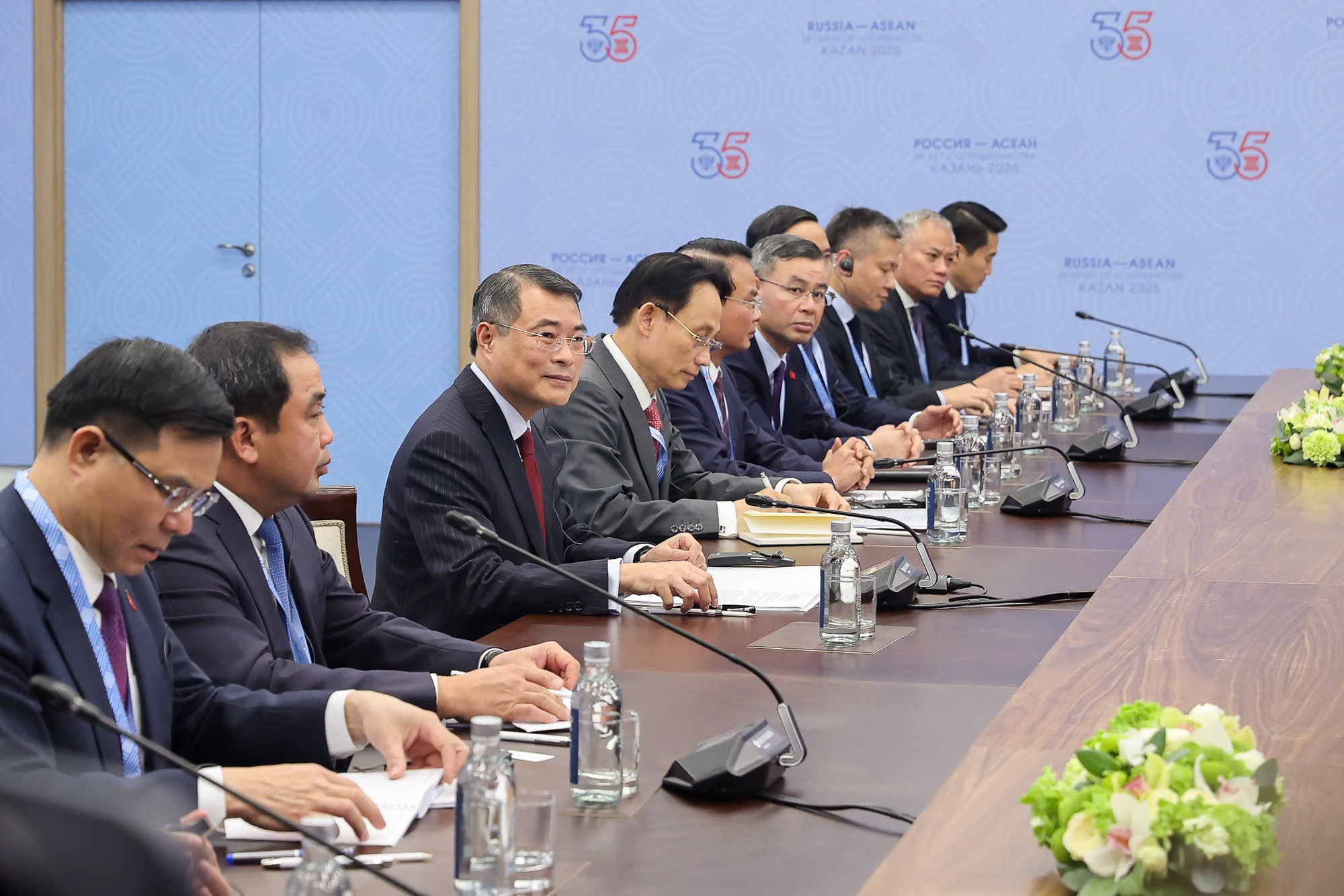 |
Prime Minister Le Minh Hung met Russian President Vladimir Putin on 18/6. Photo: Báo Chính phủ |
Prime Minister Le Minh Hung met Russian President Vladimir Putin on 18/6. Photo: Báo Chính phủ
Countries agreed to strengthen connectivity between ASEAN and the EAEU, proposing to promote trade facilitation, customs procedures, single-window mechanisms, e-commerce, and business connectivity. They aim to support enterprises from both sides in deeper participation in regional and inter-regional supply chains, increasing investment in processing industries, logistics, and cross-border trade infrastructure.
The leaders acknowledged the Eurasian space's critical role in global energy security, agreeing on the need to boost cooperation in oil, gas, liquefied natural gas (LNG), civilian nuclear power, renewable energy, and energy transition.
Countries suggested maximizing the potential of strategic transport corridors connecting Asia and Europe, such as the International North-South Transport Corridor (INSTC), the Trans-Asian and Trans-Siberian railways, and the Arctic Sea Route. This aims to reduce transit times, lower logistics costs, and enhance the resilience of regional supply chains.
The Eurasian space, stretching from Europe, Central Asia, Russia, the Caucasus to South Asia, East Asia, and connecting corridors to the Indo-Pacific, encompasses a population of 3,4 billion people, accounts for 25% of global GDP, and over 15% of international trade.
This region holds over 50% of global oil reserves and 60% of natural gas reserves, strategic minerals, over one-fourth of the world's agricultural land, and significant potential in logistics infrastructure.
Thanh Danh