The Alternative for Germany (AfD) party secured 43.8% of the vote in local elections last weekend in Saxony-Anhalt, becoming the party with the most seats in the eastern German state parliament. This marks the far-right party's best result in a state-level election in Germany.
The AfD won in 38 out of 41 constituencies in Saxony-Anhalt, while the Christian Democratic Union (CDU) of Chancellor Friedrich Merz did not win in any area. This represents a significant shift from 2021, when the CDU won in 40 out of 41 constituencies.
The developments in Saxony-Anhalt are noteworthy not only for German politics but also partly reflect the challenges Europe faces. Other far-right parties across Europe are also receiving more voter support in recent years.
"This is a major concern for the continent," said Mujtaba Rahman, a Europe expert at the Eurasia Group policy institute.
 |
Ulrich Siegmund (center), the AfD's leading candidate for Saxony-Anhalt state premier, in the capital Magdeburg on 6/9. Photo: AP |
Ulrich Siegmund (center), the AfD's leading candidate for Saxony-Anhalt state premier, in the capital Magdeburg on 6/9. Photo: AP
The AfD gained influence amid widespread voter dissatisfaction with the economic situation, cost of living, and immigration policies. These issues have been central to the far-right party's recent election campaigns.
Recognizing voter frustration, the AfD promoted an anti-immigration agenda, proposing accelerated deportation of undocumented immigrants and changing welfare policies to prioritize native-born citizens. The party also opposes sanctions against Russia and Germany's aid to Ukraine, holding views critical of the European Union (EU) and advocating for changing relations with the bloc.
Viewing the Saxony-Anhalt election as an opportunity to prove that the far-right can bring about change, the AfD campaigned with the slogan "Everything is possible!". They pledged to help Germans once again feel proud of their country. Voter turnout of nearly 78%, the highest in Saxony-Anhalt since 1990, indicated significant public interest in this election.
Each voter cast two ballots. The first determined the winning candidate in a constituency, securing a direct seat in the state parliament. The second determined the allocation of remaining seats among parties in the state parliament. Following the election, the AfD holds 39 out of 83 seats, with the CDU in second place with 15 seats. The Social Democratic Party, the Green Party, and the Left Party each hold 8 seats, while the BSW party holds 5 seats.
"Voters sent a message that things cannot continue as they are," Ulrich Siegmund, 35 years old, the AfD's leading candidate for Saxony-Anhalt premier, told ARD. "Chancellor Merz was one of the most effective campaigners for the AfD in this campaign."
The result means the AfD has not secured a majority to form a state government alone. Other mainstream parties have long opposed cooperation with the far-right, implicitly forming a "firewall". However, to become premier, Siegmund only needs to receive more than half of the votes from participating members of parliament.
Nationally, the AfD has also risen in some polls, surpassing other mainstream parties. In a survey in july, 28% of respondents said they would vote for the AfD if Germany held elections now. The CDU ranked second with 21%. The CDU must now both find ways to counter the AfD and maintain its ruling coalition with the Christian Social Union (CSU).
"If the German government has to dedicate significant time and resources to addressing domestic issues, Germany's ability to contribute to solving common European challenges may be limited," Rahman commented.
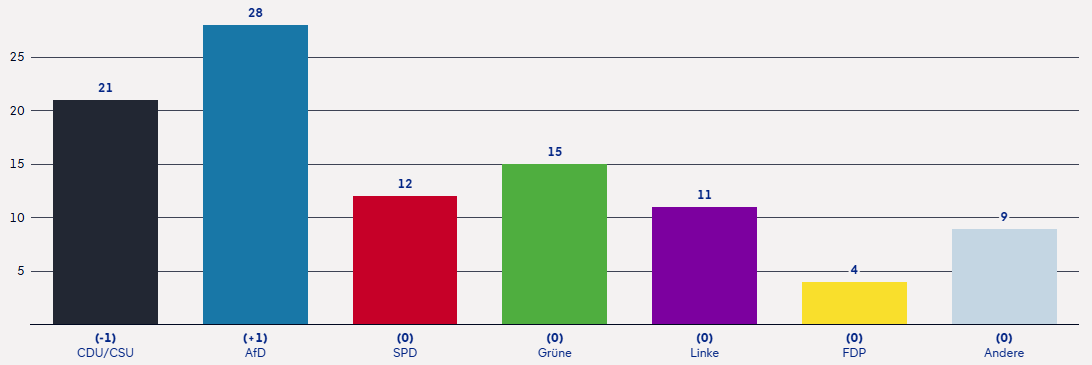 |
Support rates for political parties in Germany in an early july poll conducted by ARD-Deutschlandtrend. Graphic: DW |
Support rates for political parties in Germany in an early july poll conducted by ARD-Deutschlandtrend. Graphic: DW
The AfD's victory comes as far-right parties gain influence across Europe, adding pressure on incumbent governments already struggling with prolonged economic instability.
"Developed countries in Europe are facing significant obstacles in governing their countries," Rahman stated. "Governments have not addressed public concerns about the cost of living and have not met voter expectations."
French voters will elect a president in april 2027. Spain is expected to hold general elections no later than august 2027, while Italy's election will take place before the end of next year.
In France, Marine Le Pen and the far-right National Rally (RN) party are leading by a significant margin in first-round polls, even topping some voting scenarios. This brings Le Pen closer to power than at any point in her 14-year pursuit of the presidency.
Rahman suggested that if the far-right comes to power in Paris, the EU could face major disruptions. France is one of the most influential countries in the bloc, possesses nuclear weapons, and played a foundational role in European integration.
"The anti-far-right front that has existed since World War II in France and Germany is at risk of disintegrating," said Philippe Marliere, a professor of French and European politics at University College London (UCL), UK.
In Spain, the far-right Vox party could join a coalition government after the next election, as the incumbent Socialist government faces pressure from corruption scandals and immigration issues. In the UK, the Labour Party replaced leader Keir Starmer in july to try and regain voter support, as the far-right Reform UK party gains increasing support.
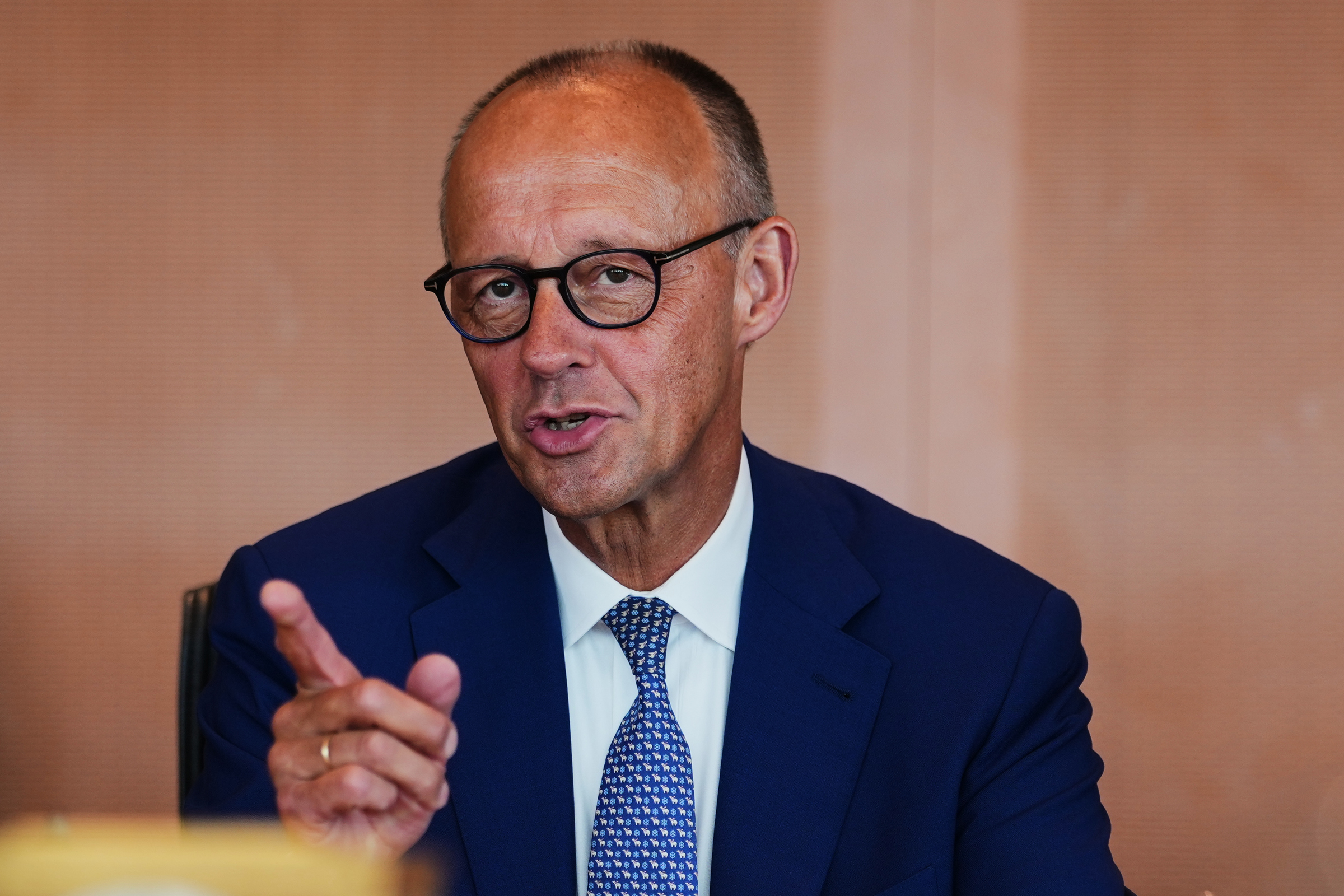 |
German Chancellor Friedrich Merz presides over a cabinet meeting in Berlin on 2/9. Photo: AP |
German Chancellor Friedrich Merz presides over a cabinet meeting in Berlin on 2/9. Photo: AP
However, the far-right's upward trend is not irreversible. In the UK, Reform UK faced challenges when its party leader became embroiled in scandal, allowing the Labour Party time to consolidate its position. In Hungary, the far-right Fidesz party was defeated after 16 years in power.
Timothy Bale, a professor of politics at Queen Mary University of London, believes the impact of the AfD's victory will largely depend on how the party governs Saxony-Anhalt if it comes to power.
French Minister for Europe Benjamin Haddad on 6/9 called the AfD far-right party's landslide victory in the German state election a "worrying development".
"We must humbly listen to the anger, anxieties, and fears of the people, and find ways to address those issues," Haddad said. "Nationalism and xenophobia will never be the solution to these problems."
Nhu Tam (According to DW, AP, WSJ)