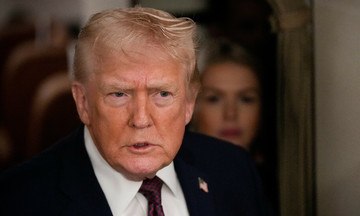
"The story from a Venezuelan bodyguard loyal to Nicolas Maduro is truly chilling, and it explains why Latin America's attitude changed suddenly," White House Press Secretary Karoline Leavitt wrote on social media X last week.
Leavitt cited an unattributed "interview" with a person identified as a member of Maduro's security detail. The interview recounted a US special forces raid aimed at capturing the Venezuelan leader in Caracas on the morning of 3/1.
The alleged bodyguard described the raid: "On the day of the operation, we heard nothing. We were on duty, but suddenly the entire radar system mysteriously failed. The next thing we saw were many drones heading towards us. We didn't know how to react."
He stated that about 8 helicopters appeared immediately after, deploying nearly 20 soldiers to Maduro's location. "Those individuals were equipped with advanced technology we had never seen before," he recalled.
What followed was not a battle, but a "massacre". "We had no chance even though there were hundreds of us. They fired rapidly and precisely, as if each soldier was firing 300 rounds per minute. We couldn't do anything," the person said.
According to the account, US forces then deployed a secret weapon that still haunts the alleged bodyguard.
"At one point they used something, I don't know how to describe it. It was like extremely powerful sound waves. Suddenly I felt my head about to explode from the inside, all of us started bleeding from the nose, some vomited blood. We fell to the ground and couldn't move," the interviewed person remembered.
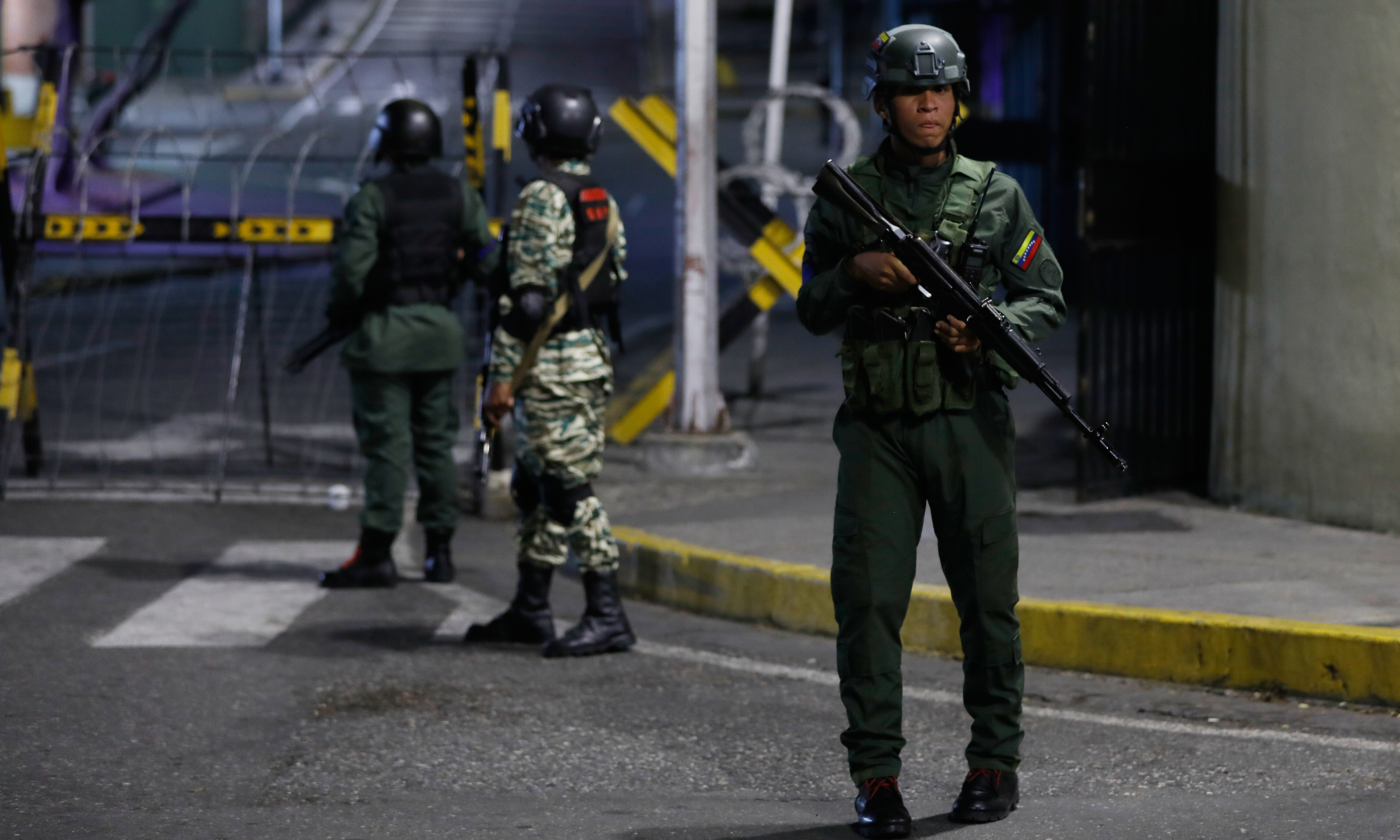 |
Venezuelan soldiers guard the area around the presidential palace in Caracas on 3/1. Photo: AP |
The bodyguard claimed that 20 US special forces neutralized hundreds of Maduro's security personnel without suffering any casualties. "We had no way to counter their weapons and technology. I had never seen anything like it. We couldn't even stand up after the sound weapon, or whatever it was, was used," he said.
Leavitt, the official White House spokesperson, did not disclose the identity of the interviewed person or the context in which this information was provided. US media has not published any such interview with "Maduro's bodyguard", raising skepticism about the story's authenticity.
Skepticism also stems from the fact that the tactics and weapons of the Delta Force special operations unit, which allegedly carried out the raid to capture Maduro, are typically kept secret to ensure technological advantage.
However, military experts confirm that "sound weapons" are real assets, developed to use sound to injure or incapacitate opponents. In 8/2025, the Thai military reportedly used a long range acoustic device (LRAD) to prevent Cambodian citizens from entering Ban Nong Chan village in a disputed area of Sa Kaeo province.
Also known as "sound cannons", LRADs can emit a directional sound beam with intensity up to 160 dB and transmit over long distances. Humans typically experience pain when exposed to sounds greater than 140 dB. Sound intensity of 120 dB can cause permanent hearing damage, even briefly.
LRAD systems are often mounted on trucks, but can also be miniaturized for individual combat use.
US forces launched "Operation Absolute Resolve" in the early morning of 3/1, deploying aircraft to strike multiple targets in Venezuela. This action facilitated special forces movement by helicopter into Caracas to capture President Maduro and his wife.
The Pentagon reported that 7 service members were injured out of nearly 200 personnel deployed to Caracas. Venezuela stated that 100 people were killed after the US raid, mostly Maduro's bodyguards.
Pham Giang (According to NY Post)